
my knee hurts when i bend it and straighten it
My Knee Hurts When I Bend It and Straighten It: How to Choose the Right Next Step

Begin with the movement that exposes the problem
Knee pain during bending and straightening is a symptom pattern, not a diagnosis. The movement that exposes the pain can help you describe the problem, but it cannot identify the structure involved by itself. Whether you notice the symptom on an Ohio winter walk, while using stairs in Chicago, or during an ordinary change of position, the next decision depends on more than the movement alone.
Start by separating two questions: what does the knee do when you move it, and what else changed around the time the pain began? A clinician evaluating knee pain generally considers the location, onset, duration, quality, swelling, mechanical symptoms, systemic symptoms, trauma, and relevant medical or surgical history. That wider pattern helps determine whether cautious monitoring, a routine evaluation, or prompt medical attention makes sense.
Pain during both directions of movement does not automatically mean the same thing as pain during only bending or only straightening. The difference is useful information to record, not a conclusion to make at home.
A useful first knee-pain record is short and specific:
- Write down whether bending, straightening, or both movements cause pain.
- Note whether the pain is in front of the knee, along one side, behind the knee, or more diffuse.
- Record when it started, whether it followed a twist or impact, and whether it is changing.
- Check for swelling, catching, locking, instability, or trouble bearing weight.
- Note whether ordinary walking, stairs, squatting, or getting up from a chair changes the symptom.
This record does not tell you what the problem is. It gives you a clearer basis for deciding what to do next and for explaining the pattern during an evaluation. If the symptom changes, add the change rather than replacing the original description.
Separate possible sources without naming one as the answer
Several knee structures and conditions can produce pain during movement, so symptoms alone cannot select one as the answer. Common categories include joint-surface changes, meniscus problems, tendon problems, and ligament injuries. The same movement can appear in more than one symptom pattern, which is why a symptom list should guide evaluation rather than replace it.
Osteoarthritis can cause aching pain and stiffness when the smooth cartilage in the knee wears down. A meniscus problem may follow squatting or a twisting injury and can cause one-sided pain, popping, catching, or locking. These patterns can be useful clues, but they can overlap with other causes.
The practical question is not whether you can match yourself to a condition. The practical question is whether the history, function, and associated symptoms point toward monitoring, an evaluation, or prompt care.
Tendon problems can cause pain below the kneecap and tenderness. Ligament sprains or tears can occur when a ligament is stretched beyond its normal range, often during an injury. ACL injuries are common in sports with sudden changes of direction, while a meniscus can tear when the knee twists under weight.
A basketball cut, soccer change of direction, uneven landing, or planted-foot twist may therefore be worth recording even if the pain appeared later. Those activities do not prove an ACL or meniscus problem in your case.
A knee that hurts during a squat may reflect a different issue from a knee that began hurting after a planted-foot twist, even if both symptoms appear during bending. Use the difference to improve your description, not to assign yourself an injury.
Pain behind the knee has several possible causes, including strain or overuse, a Baker’s cyst, arthritis, a meniscus problem, nerve compression, and, less commonly, a blood clot in the popliteal vein. Location can narrow the questions you bring to an evaluation, but it does not establish which cause is present.
Use the category as a prompt for better description: identify the location, note the movement that reproduces the pain, and record any swelling, locking, weakness, or change in walking. A visible lump behind the knee, a new change in function, or pain that keeps returning gives you a reason to arrange professional assessment rather than relying on location alone.
Let onset and activity provide context
Gradual knee pain also deserves context. Note whether symptoms followed more walking, running, cycling, repeated squatting, kneeling, or another change in activity. Overuse or strain can contribute to pain behind the knee, while joint conditions can produce aching or stiffness without one memorable injury.
Record duration as well as cause. A symptom that appears only after a particular activity, a symptom that occurs with ordinary walking, and a symptom that remains present during routine movement create different conversations. The pattern does not provide a diagnosis, but it helps you decide whether to choose gentler movement temporarily and whether to arrange an evaluation.
Seasonal activity can make the timeline easier to overlook. A change from indoor winter routines to outdoor walking in Ohio, or a return to recreational sports around Chicago, may be worth including if it preceded the pain.
A knee-pain timeline can include four points:
- What you were doing when the pain first appeared.
- Whether the onset was sudden or gradual.
- How the pain has changed since it began.
- Whether swelling, instability, locking, fever, or reduced motion appeared with it.
Add the movements that reproduce the symptom and the activities you have stopped or changed. Keeping those details together is more useful than judging the symptom by intensity alone. Share the timeline if you seek care.
Use the timeline to compare the knee with your usual baseline rather than to judge whether a condition is present. Note whether you can still walk your usual routes, manage stairs, rise from a chair, or complete ordinary daily tasks. If you have changed how you move, reduced activity, or started relying on support, record that change. These details show how the symptom affects function without requiring you to repeatedly reproduce the pain.
The timing also helps organize the conversation. A sudden onset after an event should be described with any immediate swelling, instability, or trouble bearing weight. A gradual onset should include changes in walking, running, cycling, squatting, kneeling, or other repeated activity. If no clear event preceded the pain, record that too and describe when ordinary movement first became different. A clear trigger does not prove the cause, and no clear trigger does not make persistent symptoms unimportant.
Update the record if the pattern changes from activity-only pain to pain with ordinary movement, or from discomfort to catching, locking, instability, swelling, or reduced weight-bearing. Those changes are reasons to revisit the next-step decision rather than simply extending the same observation period.
Check whether the knee still functions
Knee function is a major part of deciding how quickly to seek care. Ask yourself whether you can bear weight, walk without the knee giving way, bend and straighten it within your usual range, and move without the joint catching or locking. Swelling and instability matter alongside pain because they can change the urgency after an injury.
Important symptoms to watch include swelling, instability, locking or catching, and trouble bearing weight. After acute trauma, severe pain, swelling, instability, or inability to bear weight warrants urgent medical evaluation.
Function can change even when pain intensity is modest. A knee that repeatedly gives way, catches, or prevents ordinary walking deserves attention because the loss of function changes the next-step decision.
Function gives you a practical checkpoint without requiring you to name the injury. A knee that remains stable and weight-bearing is not automatically free of a serious problem, and a knee that hurts less is not automatically recovered. Record what you can and cannot do, especially if the limitation is new or worsening.
If a movement consistently causes pain, note the movement and its effect rather than forcing the full range. If the knee cannot support you, appears unstable, or becomes harder to move, use that change to move from observation toward professional care.
Record whether a limitation comes from pain, a catching or locking sensation, instability, swelling, or concern about bearing weight; this vocabulary can help a clinician understand change without becoming a self-diagnosis.
Also note any adaptations: holding a rail, avoiding stairs, shortening a walk, or shifting weight away from the affected side. A knee can remain weight-bearing yet function differently from your baseline. Conversely, the absence of dramatic pain does not prove recovery. If ordinary activity is becoming more restricted or you are compensating to get through it, treat that as a meaningful change and consider an evaluation. The purpose is to capture function accurately, not to pass a home test.
Use location as a clue, not a conclusion
The location of knee pain can help organize your description, but location cannot confirm a diagnosis. Pain below the kneecap with tenderness can occur with a tendon problem. One-sided pain with popping, catching, or locking can occur with a meniscus problem. Aching and stiffness can occur with osteoarthritis.
Posterior pain that persists or changes should be discussed with a healthcare professional rather than interpreted from location alone.
A location map is most useful when paired with onset and function. Front-of-knee pain after repeated activity, one-sided pain after a twist, and pain behind the knee with a new change in walking are different descriptions even before a cause is known.
Map the knee symptom in ordinary language:
- Front: describe whether the pain is below the kneecap, around the kneecap, or deeper in the joint.
- Inner or outer side: note whether the pain is one-sided and whether twisting, squatting, or weight-bearing changes it.
- Back: note whether the discomfort feels deep, superficial, tight, or associated with a visible lump.
- Whole knee: record stiffness, swelling, reduced motion, or a change in stability.
This map helps a clinician choose relevant examination questions. It does not tell you which tissue is responsible. If the location changes, record the original location and the new one so the pattern remains clear.
Apply the urgent-care override
Acute knee injury changes the timeline when severe pain, swelling, instability, or inability to bear weight is present. Seek urgent medical evaluation rather than relying on home monitoring if those symptoms follow a fall, twist, collision, or other injury. A knee that cannot support you or appears unstable needs prompt attention even if the pain level is difficult to judge.
A rapid change after an injury matters more than whether the original activity seemed minor. Do not delay urgent assessment to complete a symptom record or wait to see whether ordinary movement becomes comfortable.
Fever with a swollen, red knee and limited movement warrants urgent medical evaluation because this pattern can indicate a joint infection. Deformity, rapid swelling, fever with redness, numbness below the knee, or inability to bear weight are also warning signs requiring urgent care.
Use urgent orthopedic care or an emergency department for warning signs that need immediate assessment. Do not wait for a routine appointment when the knee has a concerning injury pattern or signs of possible infection. These warning signs take priority over choosing a treatment or deciding whether regenerative care might be relevant.
If no warning sign is present, support comfort carefully
General knee-pain guidance advises keeping the knee gently moving instead of stopping movement completely. You do not need to force the full range immediately. Let a painful movement guide you to a smaller, more comfortable range while you observe how the knee responds.
If swelling is present, support the leg while resting and keep the ankle higher than the hip. A pillow can support the knee during sleep. These measures support comfort and movement; they do not identify the cause or create a personalized treatment plan.
Choose ordinary movement that you can perform without forcing the painful range. If a movement causes a clear increase in pain or function becomes less reliable, record that change and reconsider whether monitoring remains appropriate.
An ice pack may be applied for 10 to 15 minutes with a damp towel between the pack and your skin. Do not apply ice to the knee if you have poor sensation there, an infected wound, Raynaud’s syndrome, or cryoglobulinemia.
Stop a home measure that increases pain, numbness, skin changes, or swelling. Seek care instead if symptoms are worsening, function is declining, or a warning sign appears. Avoid turning temporary comfort into permission to return immediately to the activity that provoked the pain.
Gentle knee movement can remain part of ordinary daily activity, but painful full-range repetition is not a useful test. Choose comfortable movement, well-fitted shoes, and a supported resting position while you decide whether symptoms are improving.
A home-support plan needs a clear boundary. If you cannot move the knee comfortably, cannot safely bear weight, or notice increasing swelling or instability, move from self-care to professional evaluation rather than adding more home measures.
Do not let temporary relief settle the question
Temporary relief does not identify the cause of knee pain. Several different problems can produce pain during movement, and the symptom may ease when you rest, change position, or reduce activity without resolving the underlying question. Treat improvement as a change in the symptom record, not as proof that the knee is fully recovered.
If the movement remains limited even though the pain is less noticeable, function still matters. Record what has improved and what has not.
If symptoms improve, continue to watch function, swelling, stability, and range of motion rather than pain alone. If pain returns each time you resume an activity, if the knee begins catching or giving way, or if walking becomes harder, arrange an evaluation. Recurring symptoms deserve attention even when each episode settles.
The same boundary applies when a home measure helps but the movement problem remains. Comfort can help you get through the next period of observation; it cannot establish which condition is present. A repeated pattern is a reason to discuss the knee rather than repeatedly restarting the same cycle of activity and temporary relief.
Know what an evaluation can clarify
A knee evaluation starts by connecting your symptom history with an examination. An orthopedic visit may include a medical history, physical examination, and, when appropriate, blood tests or imaging such as X-rays, MRI, or CT scans. A systematic knee examination may include inspection, palpation, range-of-motion and strength assessment, neurovascular testing, and specific examination maneuvers.
The purpose is to clarify the pattern and decide which additional information is relevant. Imaging is not automatically required for every episode of pain. The decision can depend on the duration, injury pattern, examination findings, and other details of your history.
During the history, the clinician may ask about age, where and when the pain began, how long it has lasted, the quality of the pain, associated mechanical or systemic symptoms, swelling, trauma, and previous medical or surgical procedures. The examination can then compare what you report with inspection, palpation, motion, strength, neurovascular status, and specific examination maneuvers. This sequence is why a movement description is useful but not conclusive. Blood tests or imaging may be considered when appropriate rather than assumed in every case. Share changes in function or new associated symptoms even if the original movement pattern has stayed the same.
The cited initial-evaluation review says radiographs should be reserved for chronic knee pain lasting more than six weeks or for acute traumatic pain that meets specific evidence-based criteria.
The length of symptoms does not identify the cause. It changes the value of arranging an assessment. A shorter duration does not cancel the need for prompt care when warning signs are present.
An orthopedic evaluation can help you ask focused questions:
- What features of my history and examination matter most?
- What does the movement pattern suggest, and what remains uncertain?
- Is imaging appropriate for this duration and injury pattern?
- Which changes would mean I should seek care sooner?
- What should I monitor if the knee remains stable while the evaluation is arranged?
These questions keep the appointment centered on what your knee is doing rather than on choosing a treatment before the problem is understood.
Prepare the movement record before calling
A movement record makes a knee evaluation more efficient because it puts the timing, activity, function, and symptom changes in one place. Before an orthopedic visit, prepare a medication list, relevant records and imaging, a timeline of prior treatments and their effects, and questions to ask.
Add the details most relevant to pain with bending and straightening:
- The exact date or approximate period when the symptom began.
- The activity, twist, fall, or impact that preceded it, if any.
- The movement that hurts most and whether the pain occurs during bending, straightening, or both.
- The location, severity, duration, and frequency of the pain.
- Swelling, catching, locking, instability, fever, redness, numbness, or trouble bearing weight.
- Activities you have stopped, changed, or can no longer complete comfortably.
A short video of movement may seem useful, but do not repeatedly provoke pain or instability to create one. A written description of what happens during ordinary activity is enough to begin the conversation.
Bring prior imaging reports and relevant records when they are available. Include a timeline of treatments or self-care measures and whether each one changed the pain, movement, or function, and for how long. A written question list can prevent the appointment from ending before you discuss the issue that matters most to you.
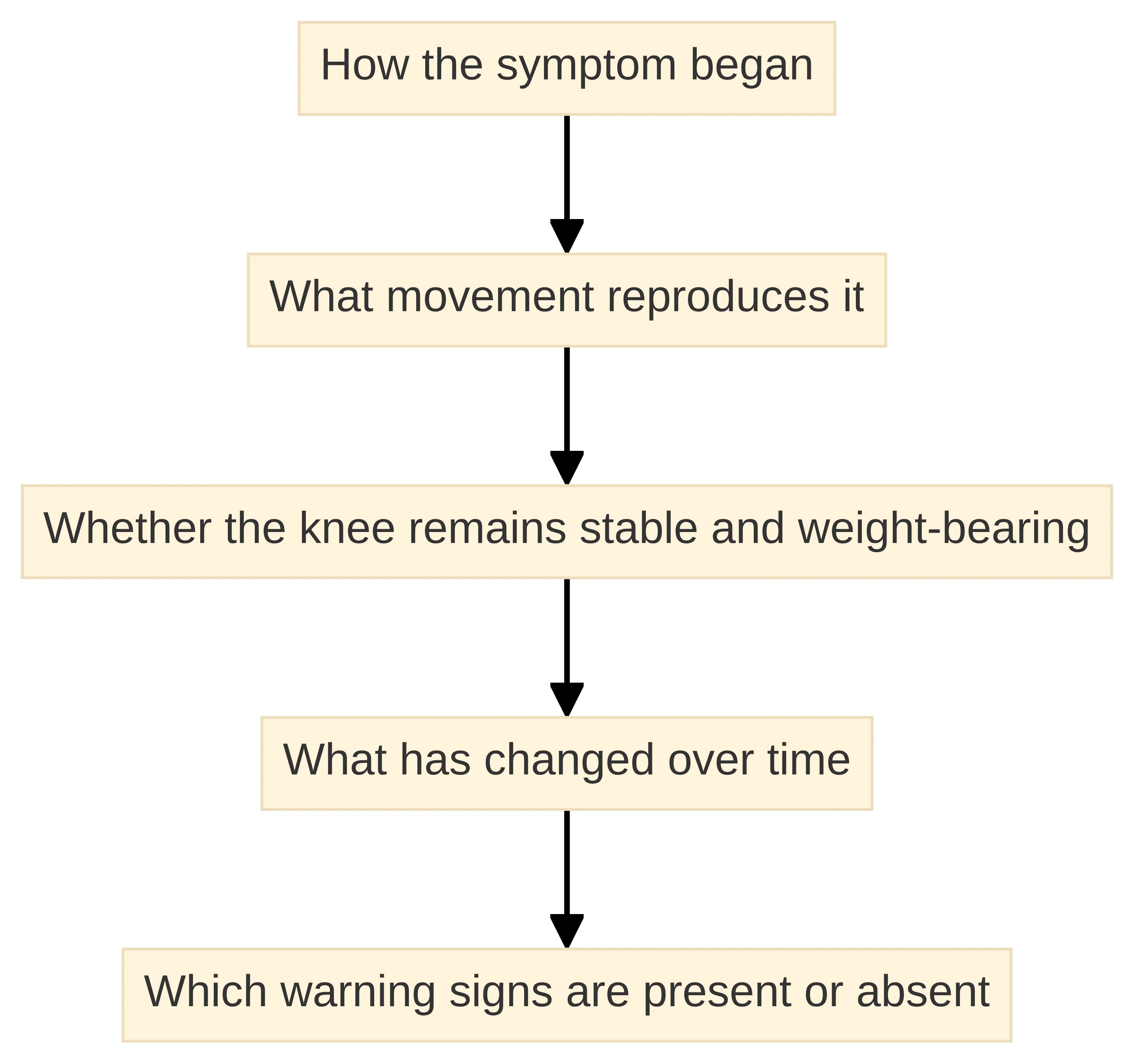
Organize the record in the same order as the decision:
- How the symptom began.
- What movement or activity reproduces it.
- Whether the knee remains stable and weight-bearing.
- What has changed over time.
- Which warning signs are present or absent.
Do not wait to create a perfect record before seeking urgent care. Warning signs take priority over paperwork.
When gathering records, make the medication list complete enough for the clinician to review: include prescriptions, over-the-counter medicines, herbal preparations, and vitamin supplements. If an MRI or other advanced imaging was obtained elsewhere, bring the report and, when available, the physical disk or other image record. An outside facility may not have transferred everything needed for review, so identify what is available rather than assuming the records will arrive automatically.
Make the treatment timeline specific. Include pain management, bracing, physical therapy, injections, and related surgeries when applicable, along with what changed and how long any relief or improvement lasted. Note whether a measure changed pain, movement, or function, since those are not always the same outcome. This gives the clinician a trend instead of a single snapshot and helps keep the discussion focused on what remains unresolved.
If a record or report is unavailable, say so when arranging the visit; do not delay urgent care while trying to assemble a perfect file. These materials do not establish a diagnosis, but they can make the history clearer and help the clinician decide what examination or testing, if any, is appropriate.
Choose between watching, evaluation, and prompt care
Cautious monitoring may be reasonable when no warning sign is present, the knee remains stable and weight-bearing, and the symptoms are improving with gentle activity and basic comfort measures. Keep a brief record of movement, swelling, and function while you observe the trend. Move to an evaluation if improvement stops, symptoms return, or ordinary activity remains limited.
Monitoring is a decision with conditions, not a declaration that the knee is fine. Recheck the same practical questions: Can you bear weight? Is the knee stable? Is swelling increasing? Can you move it within a comfortable range? Has the symptom persisted or returned? A change in any answer can change the next step.
Arrange a professional evaluation when knee pain persists, recurs, interferes with daily activity, or remains unexplained after the initial episode. Symptoms lasting more than six weeks meet the chronic timeframe described in the cited initial-evaluation review, and that is a clear boundary against indefinite self-monitoring. Bring your movement record, medication list, records, imaging, treatment timeline, and questions.
An evaluation is also reasonable sooner when you are unsure how the onset, location, or functional change fits together. Uncertainty does not require you to choose a diagnosis first. It is enough to describe what happens and how it affects your movement.
Seek prompt medical attention after acute trauma when severe pain, swelling, instability, or inability to bear weight is present. Seek urgent care for a deformed knee, rapid swelling, fever with a red or swollen knee, limited movement with fever, or numbness below the knee. Those patterns override a plan to watch the symptom at home.
The decision can be summarized simply:
- Improving symptoms without warning signs: monitor cautiously and track function.
- Persistent, recurring, or function-limiting symptoms: arrange an evaluation.
- Injury-related or infection-related warning signs: seek urgent medical attention.
This sequence helps you choose a timeline without claiming to identify the diagnosis. If your symptoms do not fit neatly into one branch, use the more cautious option and arrange an evaluation.
An evaluation from REGEN Orthopedic Medicine is an option, not a treatment conclusion
REGEN Orthopedic Medicine offers free consultations for knee, hip, or shoulder pain. We provide physician-led, non-surgical regenerative medicine for the knee, hip, and shoulder, and we tailor each treatment option to your specific needs.
That service information does not mean regenerative treatment is appropriate for your knee or that it should replace urgent care. A qualified professional must decide whether any treatment is suitable after considering your symptoms, examination, history, and any needed testing. Choose the appropriate timeline first; an evaluation can then address what your knee needs next.
If urgent warning signs are present, seek urgent medical attention rather than waiting for a consultation.
If your knee pain is persistent, recurring, or concerning and you want an individualized assessment, a consultation is an available next step. Bring the movement record so the discussion can begin with when the pain appears, what the knee can do, and which warning signs are present or absent.
What should I expect if I request an evaluation?
What are common causes of knee pain when bending and straightening?
Knee pain during bending and straightening can arise from various issues, including osteoarthritis, meniscus tears, tendon problems, and ligament injuries. Each condition may present different symptoms, such as aching, popping, or locking.
When should I seek urgent medical attention for knee pain?
Urgent medical attention is warranted if you experience severe pain, swelling, instability, or inability to bear weight after an injury. Additionally, fever with a swollen, red knee and limited movement also requires immediate evaluation.
How can I prepare for an orthopedic evaluation for my knee pain?
Before your orthopedic evaluation, prepare a record of your symptoms, including when they started, activities that trigger pain, and any changes in function. Bring a list of medications, relevant medical records, and questions to discuss with the clinician.
What should I monitor if I choose to watch my knee pain instead of seeking immediate care?
If you decide to monitor your knee pain, keep track of any changes in symptoms, such as increased swelling, instability, or difficulty bearing weight. If symptoms worsen or do not improve, consider arranging an evaluation.
What does an orthopedic evaluation typically involve?
An orthopedic evaluation usually includes a thorough medical history, a physical examination of the knee, and possibly imaging tests like X-rays or MRIs to assess the condition and determine the appropriate treatment.
Are there free consultations available for knee pain evaluation?
Yes, REGEN Orthopedic Medicine offers free consultations for knee pain evaluations, allowing you to discuss your symptoms and potential treatment options with a qualified professional.
Free consultation
Find out whether regenerative treatment is right for you.
Most consultations begin as a telehealth call with a physician specialist, so you can start without travelling to a clinic. No referral needed.