
knee pain after sitting with legs bent treatment
Knee Pain After Sitting With Legs Bent: How to Choose Your Next Step

Compare sitting-triggered and movement-triggered knee pain
Knee pain after sitting with your legs bent does not identify one diagnosis or automatically require urgent care. Start by comparing two parts of the episode: does the discomfort appear mainly after the knee has stayed bent, or does it also appear during active bending and straightening, walking, stairs, or squatting? Then note whether it eases after you stand and move, or continues during ordinary movement. That comparison does not name the cause, but it keeps the seated position from becoming a diagnosis. Pain around or behind the kneecap that worsens with prolonged sitting can occur with patellofemoral pain, while the same source describes related symptoms with squatting, stairs, and jumping. The pattern alone cannot identify the cause.
Use the comparison and the rest of the episode to choose among three timelines:
- Brief monitoring: The pain is mild, appears mainly after prolonged sitting with the knee bent, settles as you change position or move, does not keep returning, and does not limit ordinary function. Monitor the sitting-to-standing pattern rather than treating temporary relief as a diagnosis.
- Routine evaluation: The pain persists after you stand, appears during active movement or ordinary activities, recurs frequently, affects walking or other activities, comes with swelling or instability, or remains unclear after you modify the provoking position. Arrange a non-urgent knee evaluation.
- Prompt assessment: Severe pain, marked swelling, instability, inability to bear weight after an injury, fever, redness, or severely limited motion changes the timeline. Seek prompt or immediate medical assessment rather than continuing to compare positions.
A knee evaluation also considers onset, duration, quality, swelling, instability, mechanical symptoms, trauma, and relevant medical history. Those details help distinguish a symptom that is tied mainly to prolonged seated flexion from one that has become part of a broader movement or function problem.
The symptom pattern matters more than the bent-knee position by itself. Sitting with the knee flexed can expose pain from several different problems, while the absence or presence of injury, swelling, systemic symptoms, and loss of function helps determine how quickly you need care. This guide can help you organize the next step, but it cannot determine what is causing your pain without an examination.
If you are unsure which timeline fits, give more weight to worsening function, swelling, instability, fever, redness, or a recent injury than to the fact that movement briefly makes the knee feel better. Temporary improvement is useful information, not a clearance to ignore symptoms that keep returning.
Why a bent-knee position can bring symptoms out
A bent-knee position can bring out pain around or behind the kneecap because some conditions become more symptomatic when activities compress the patellofemoral joint. Patellofemoral pain is one possible explanation for pain that is activity-related and worsens with prolonged sitting. The same source describes pain with squatting, stairs, and jumping as related patterns, but those activities are clues rather than proof of a specific condition.
The location helps you describe the symptom, not name it. Pain in front of the knee may fit a patellofemoral pattern, while pain outside, behind, above, or below the joint can point the evaluation toward other structures. Several conditions can overlap in how they feel, so avoid deciding that a familiar label explains your symptoms before the rest of the pattern is assessed.
Knee stiffness after prolonged sitting can change when you begin moving. In a study of healthy adults, stiffness measured one minute after movement remained above baseline after 60 and 90 minutes of sitting, although the differences stayed within that study’s minimum clinically important difference. Reported pain returned to baseline after one minute following 15 and 30 minutes of sitting, while some pain measures remained above baseline after longer sitting periods and also stayed within the study’s minimum clinically important difference.
That finding gives you useful context but not a diagnosis. Feeling stiff when you first stand can occur without establishing a knee disorder, and improvement after a few steps does not rule out a problem that deserves evaluation. Record how long the discomfort lasts after you stand, whether it returns when you sit again, and whether movement improves function or only masks the symptom briefly.
The timing of relief can help you describe the episode more precisely. Note whether symptoms begin only after a long period with the knee bent, appear within a few minutes, or continue after you resume ordinary movement. Also note whether the symptom is pain, stiffness, pressure, or a feeling of instability. Those distinctions do not diagnose the cause, but they give a clinician a clearer account of what the position is exposing.
Read the episode in context, not isolation
The knee pain episode becomes more informative when you connect it to its surrounding details. A clinical history typically considers the pain’s location, onset, duration, quality, associated mechanical or systemic symptoms, swelling, precipitating trauma, and relevant medical or surgical history. Use the bent-knee position as one part of that history rather than as the whole explanation.
Ask yourself:
- Did the pain begin after a fall, twist, change in activity, or no clear event?
- Is it in front of the knee, around the kneecap, along the inner or outer side, behind the knee, or spread through the joint?
- Does it feel aching, sharp, burning, tight, or stiff?
- Does it ease after standing, or does it continue during walking and other ordinary movement?
- Have you noticed swelling, warmth, catching, locking, giving way, fever, or a change in your ability to bear weight?
These observations do not diagnose the cause. They help you decide whether monitoring remains reasonable and give a clinician a clearer starting point if you arrange an evaluation.
Your function after the episode is another useful boundary. Note whether you can stand, walk, use stairs, and change position without a meaningful loss of ability. A knee that feels briefly stiff after sitting presents a different practical question from a knee that repeatedly gives way, swells, or prevents weight-bearing. General self-management advice should be used alongside professional guidance, particularly when pain continues or an activity makes it worse.
The surrounding pattern also includes what is absent. A symptom that occurs only after sitting may call for a different timeline from pain that wakes you, continues at rest, follows a clear injury, or appears with fever or visible redness. You do not need to sort those details into a diagnosis at home. Use them to decide whether to observe briefly, arrange a routine appointment, or seek prompt assessment.
Several knee problems can produce a similar pattern
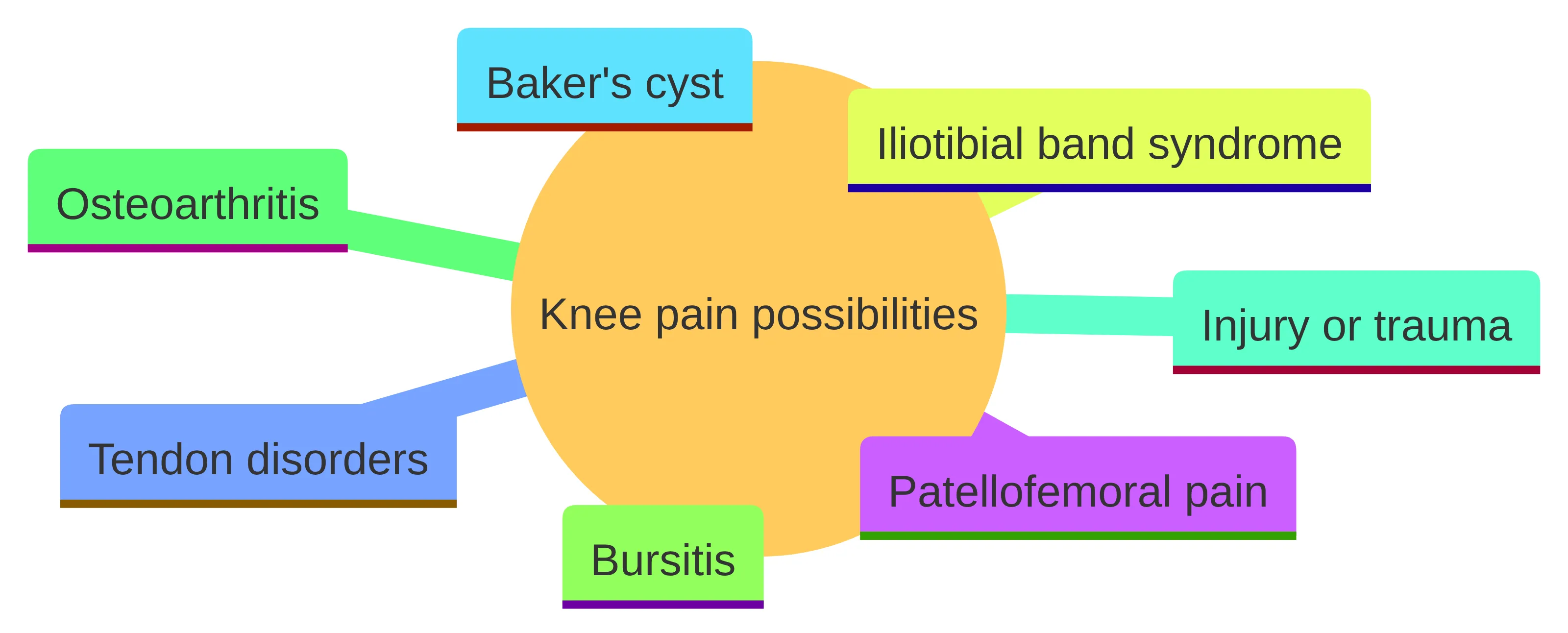
Several knee problems can cause pain when you bend the joint, including patellofemoral pain, tendon disorders, iliotibial band syndrome, bursitis, osteoarthritis, injury or trauma, and a Baker’s cyst. Prolonged sitting can occur in the symptom pattern of patellofemoral pain, but the same sitting position does not separate that possibility from the others.
The symptom quality and accompanying signs can give the categories different emphasis:
- Around or behind the kneecap: Patellofemoral pain can cause pain in that area and may worsen with prolonged sitting or activities that compress the joint.
- Diffuse pain with swelling or morning stiffness: Osteoarthritis may produce a more widespread knee ache along with swelling and morning stiffness.
- Warmth, swelling, and pain over or below the joint: Bursitis may affect the fluid-filled cushions around the knee and can produce those local signs.
- Pain along a tendon or the outer side of the knee: Tendon disorders and iliotibial band syndrome are among the possible contributors to pain with bending.
- Pain after an injury or a sense of fullness behind the knee: Trauma and a Baker’s cyst are also possible categories that require the rest of the history and examination for context.
These categories are a way to organize questions, not a menu of diagnoses to choose at home.
A similar position can stress different tissues, and the same condition can feel different from one episode to another. Location alone cannot establish the cause, and pain intensity alone cannot reliably tell you whether a problem is minor or significant. A proper evaluation combines the symptom story with an examination that checks motion, strength, swelling, stability, and other relevant findings.
Instead of asking which diagnosis matches one symptom, ask which additional detail would change your next action. Swelling, instability, a traumatic trigger, fever, redness, limited motion, or inability to bear weight carries more practical weight than a familiar description such as an ache in front of the knee. Bring those distinctions to an evaluation rather than selecting treatment from a symptom label.
When pain stays tied to prolonged sitting
Brief monitoring may be reasonable when your knee pain is mild, appears mainly after prolonged sitting with the knee bent, improves as you change position or move, and leaves your ordinary function intact. The sitting-specific pattern is more suitable for observation when active bending and straightening, ordinary walking, and stairs remain comfortable. This approach fits a symptom that is settling rather than escalating and is not accompanied by swelling, instability, fever, redness, or an injury that changed how you bear weight.
Monitoring means observing a defined comparison, not ignoring the knee indefinitely. During that period, note four parts of each episode: how long the knee was bent, whether active movement also brings on the symptom, how long discomfort lasts after you stand, and what you can do afterward. Notice whether the discomfort appears sooner, lasts longer after you stand, begins during ordinary walking, or starts affecting work, exercise, sleep, or stairs. If the symptom crosses from a sitting-only trigger into active movement or reduced function, move from observation to a routine evaluation. Do not deliberately hold the knee in a painful position or repeat a movement just to reproduce the symptom.
A short observation period should end when pain remains present, keeps returning, or makes activity harder. General self-management material is intended to be used alongside health-professional advice, and pain during an activity is a reason to discuss that symptom with a health professional. Do not use a few comfortable steps after sitting as proof that the knee is healthy, and do not use a brief flare as proof that a serious injury is present.
A simple monitoring record can include four observations: how long you sat, where the pain appeared, how long it lasted after you stood, and what you could do afterward. Add whether the episode repeated later that day or on another day. This record gives you a practical boundary for deciding whether the pattern is settling or becoming persistent, without requiring you to assign a diagnosis.
Reduce aggravation while you observe the pattern
Self-management for a sitting-related knee symptom can focus on reducing repeated aggravation while you learn how the knee responds. You can try the following general measures:
- Change position before the discomfort builds. Break up long periods with the knee held in the same bent position, then move within a comfortable range.
- Use the response after movement as information. Note whether stiffness eases quickly, remains present, or returns as soon as you sit again. Improvement is useful to record, but it does not establish a cause.
- Do not push through pain during an activity. Stop the activity and discuss the symptom with a health professional if a suggested exercise or movement causes pain.
- Track function rather than chasing a pain score. Record whether you can stand, walk, use stairs, and complete ordinary tasks as usual.
The purpose of these steps is to observe your pattern and avoid repeatedly provoking it. They are not a personalized exercise plan or a treatment for a diagnosed knee condition.
Medication is a separate decision from changing your sitting pattern. The cited guidance reports that nonsteroidal anti-inflammatory drugs can provide short-term treatment for diagnosed knee osteoarthritis and patellofemoral pain syndrome, but medication choice should be individualized with a clinician or pharmacist. Do not treat a medication response as confirmation of a diagnosis, and do not begin or change medication based only on this symptom pattern.
Avoid turning observation into repeated testing. You do not need to hold your knee in the painful position, repeat a squat, or increase activity just to see whether symptoms return. If a movement causes pain, stop that movement and discuss it with a health professional. For a diagnosed condition, exercise-based care may be appropriate, but an unexplained symptom after sitting is not enough information to select an exercise program.
When pain extends beyond the sitting position
A routine knee evaluation makes sense when the symptom no longer stays confined to prolonged sitting with the knee bent, or when the sitting-linked pattern does not settle. Arrange one when pain continues after you stand, appears during active bending or straightening, walking, stairs, or other ordinary movement, returns often, limits your activities, or remains unexplained after you reduce the provoking position. Repeated swelling, a sense of instability, catching or other mechanical symptoms, pain linked to a prior injury, or symptoms that occur during ordinary movement also deserve assessment.
This position-versus-movement comparison is a way to organize the history, not a way to identify a condition at home. A routine appointment is different from immediate care. You can use this route when you are still able to function and do not have the warning signs described in the prompt-care section. The purpose is to clarify whether the symptom is mainly position-related, part of a broader movement pattern, or associated with another finding before you choose among rehabilitation, medication discussions, injections, regenerative options, or other care.
Duration helps shape the evaluation, but a calendar threshold is not the only reason to seek help. The cited initial-evaluation guidance describes chronic knee pain as lasting more than six weeks in the context of imaging decisions, while also emphasizing symptom history, examination, and urgent features. You do not need to wait for six weeks if the pain is recurring, function-limiting, or accompanied by swelling or instability. Conversely, a symptom that has lasted only briefly may still need prompt assessment if it followed a significant injury or comes with severe warning signs.
Arrange a non-urgent evaluation when any of these changes becomes part of your pattern:
- the pain occurs with ordinary walking, stairs, squatting, or rest rather than only after sitting;
- the episodes become more frequent, last longer, or interfere with sleep, work, exercise, or daily tasks;
- swelling, warmth, catching, locking, or instability repeatedly accompanies the pain; or
- you cannot explain the symptom and changing position has not made the pattern settle.
The action is evaluation, not a decision about a particular treatment. The cause and the findings still need to be clarified.
When warning signs override the pattern comparison
Warning signs override the sitting-versus-movement comparison. Prompt medical assessment takes priority when knee symptoms suggest a serious injury or infection. Seek prompt assessment for severe knee pain, swelling, instability, or inability to bear weight after an injury, especially when fever, redness, swelling, or severely limited motion is also present.
Immediate assessment is appropriate when a fracture, major quadriceps or patellar tendon rupture, neurovascular damage, severe soft-tissue injury with gross instability, septic arthritis, or another serious injury or infection is suspected. A first-time traumatic kneecap dislocation or a recurrent dislocation with moderate or severe swelling also belongs in an urgent pathway. These signs require attention even if the pain first appeared after sitting or briefly improves when you stand.
Do not continue a self-management trial or repeat position comparisons while waiting to see whether these signs settle. The combination of the symptom, its severity, and its trigger determines the timeline.
A fall or twisting injury creates a separate testing question from pain that appears only after sitting. If radiographs show no fracture but a hidden fracture or internal derangement is suspected, the cited ACR criteria rate knee MRI without intravenous contrast as usually appropriate. That pathway applies to the appropriate trauma and examination context; it is not a reason to request an MRI for every episode of pain after sitting.
If you cannot bear weight after an injury, the knee is grossly unstable, or severe pain and swelling are accompanied by fever, redness, or markedly limited motion, choose prompt medical assessment rather than a routine appointment. If you suspect a serious injury or infection, do not wait for a sitting-related pattern to become clearer before seeking care.
What a knee evaluation is trying to distinguish
A knee evaluation is meant to distinguish a position-related symptom from a problem that needs a different level or type of care. The history usually examines where the pain is, when it began, how long it lasts, what it feels like, whether swelling or instability is present, what triggered it, and what medical or surgical history may affect the interpretation. Mechanical and systemic symptoms also matter because they can change the next question.
Your account of what happens after sitting is one part of that process. The clinician may want to know how long your knee stays bent, how quickly symptoms begin, what happens when you stand, whether walking changes the pain, and whether the same symptom appears with stairs, squatting, exercise, or rest. These details help place the sitting episode within a broader pattern.
A systematic knee examination can include inspection, palpation, range-of-motion and strength testing, neurovascular testing, and specific provocative tests. The examination may look for findings that fit patellofemoral pain, tendon or bursa problems, osteoarthritis, injury, or another source of symptoms, but no single maneuver should be treated as a diagnosis in isolation.
The practical result of an evaluation is a clearer clinical question. It may help determine whether your symptoms can be approached with conservative care, whether testing is warranted, whether an injury pathway applies, or whether another condition needs attention. Treatment choices should follow that clarification rather than precede it.
The evaluation also separates a symptom description from a treatment decision. Pain around the kneecap after sitting may prompt questions about patellofemoral pain, but the examination still needs to consider other possible contributors. Findings such as swelling, loss of motion, weakness, instability, or a traumatic trigger can move the discussion away from a simple position-related explanation.
You do not need to arrive with a preferred diagnosis. Arrive with an accurate account of the pattern and let the history and examination determine which questions deserve attention.
Testing follows the clinical question
Imaging is not automatically required for every episode of knee pain. The cited initial-evaluation guidance indicates that radiographs are generally reserved for chronic knee pain lasting more than six weeks or acute traumatic pain that meets specific evidence-based criteria. The symptom pattern and examination therefore help determine whether an image is useful and which type of image addresses the question.
This matters for pain after sitting because the bent position alone does not establish a fracture, internal derangement, arthritis, or another structural problem. A scan ordered without a clear clinical question may not answer why sitting brings out your symptoms. The appropriate next step may be observation, examination, rehabilitation guidance, or imaging, depending on the full pattern.
Trauma can change the imaging pathway. After a fall or acute twisting injury, if radiographs show no fracture but a hidden fracture or internal derangement is suspected, the ACR criteria rate an MRI of the knee without contrast as usually appropriate. That recommendation concerns a specific trauma scenario and suspected internal problem; it does not apply automatically to chronic stiffness after sitting or to pain with no injury.
Tell the clinician whether your symptoms began after a fall, twist, impact, or change in activity. That fact can be more useful than requesting a particular test by name.
Useful questions about testing include: What clinical question would this test answer? Does the result change the treatment discussion? Is the test being considered because of trauma, persistent symptoms, examination findings, or another feature? Those questions keep imaging tied to your actual pattern. After a specific traumatic event, the clinician can decide whether radiographs, MRI, or another assessment fits the findings.
Treatment comes after the cause and goals are clearer
Treatment choices depend on what the evaluation finds, how your knee functions, and what outcome you are trying to achieve. For diagnosed knee osteoarthritis or patellofemoral pain syndrome, the cited guidance identifies exercise-based therapy as a first-line treatment. Weight loss may also be considered when appropriate for osteoarthritis. Those recommendations apply to diagnosed conditions and are not an individualized exercise or weight-management plan for unexplained pain after sitting.
Active rehabilitation also has a specific place in the meniscus discussion. For nontraumatic degenerative medial meniscal tears without mechanical symptoms, the cited clinical recommendation reports that active rehabilitation was as effective as arthroscopy for reducing pain and improving function. That comparison does not apply to every meniscal tear, every symptom pattern, or an acute injury with locking or instability.
Other options also depend on the condition and your circumstances:
- A brace may be reasonable for some common knee overuse conditions, but it should not replace active rehabilitation.
- Nonsteroidal anti-inflammatory drugs were reported as effective for short-term treatment of knee osteoarthritis and patellofemoral pain syndrome. A clinician or pharmacist should help determine whether a medication is appropriate for you.
- A treatment that is reasonable for one diagnosed problem may be unhelpful or unsuitable for another. The name of an injection, brace, exercise, or procedure does not answer the underlying clinical question.
Use the evaluation to compare benefits, limits, alternatives, timing, and practical requirements rather than choosing an option because it is associated with a familiar label.
A useful sequence is straightforward: describe the symptom, identify findings that change urgency, clarify the likely category of problem, and then discuss care that fits that category. Exercise-based therapy may be part of care for diagnosed osteoarthritis or patellofemoral pain. Active rehabilitation may be relevant to a particular degenerative meniscal pattern. Medication, bracing, injections, regenerative options, and surgery should not be treated as interchangeable answers to unexplained pain after sitting.
Keep regenerative care in the evaluation conversation
Regenerative care belongs after the cause, goals, and suitability questions are clearer. A consultation can be used to discuss whether a regenerative option is relevant to the condition being considered, but the fact that pain appears after sitting does not establish that such care is appropriate or that it will relieve symptoms or avoid surgery.
We offer free consultations for knee pain. Most of our consultations begin as a telehealth call, so you can start without traveling to a clinic. If regenerative treatment is appropriate, we provide options, timing, and cost details. We also provide patient-centered care and, if regenerative treatment is unlikely to help your joint, we will guide you toward what may help.
These are consultation and care-planning details, not a promise that regenerative treatment fits your knee. An evaluation remains the step that connects your symptom pattern to any treatment discussion.
A useful treatment conversation keeps the diagnosis question separate from the treatment question. Ask what condition is being considered, what findings support that view, what options address it, what remains uncertain, and what would make a different pathway more appropriate. For diagnosed osteoarthritis or patellofemoral pain, the cited guidance places exercise-based therapy among the first-line options; a regenerative discussion should not erase that established context.
You can also ask how the proposed option compares with continued rehabilitation, medication discussions, other non-surgical care, or surgery when those alternatives are relevant. The comparison should be tied to your findings and goals, not to a general promise attached to a treatment category.
A consultation can clarify whether a regenerative discussion belongs in your care plan, but it cannot turn a symptom pattern into a diagnosis. Ask what the evaluation established, what it did not establish, and why a proposed option fits the findings. If regenerative treatment is unlikely to help your joint, we will guide you toward what may help rather than treating the treatment category as the goal.
Prepare information that makes the next step useful
A symptom record can make a knee evaluation more focused. Before an appointment, write down:
- where the pain is located and whether it stays in one place or spreads;
- when it began and whether a fall, twist, impact, or activity change preceded it;
- how long you had been sitting when it appeared and how long the knee stayed uncomfortable after you stood;
- what the pain feels like, such as aching, sharp, burning, or stiffness;
- whether you notice swelling, warmth, catching, locking, instability, fever, redness, or limited motion;
- whether walking, stairs, squatting, exercise, rest, or another position changes the symptom; and
- relevant medical or surgical history, including earlier knee problems.
These details match the parts of the history commonly considered during an initial knee evaluation. They help describe the episode without turning your notes into a self-diagnosis.
Your activity record should describe function, not only discomfort. Note whether you can stand, walk, use stairs, and complete ordinary tasks, and whether the knee behaves differently after a longer period of sitting. Record any activity that causes pain and avoid repeatedly provoking the symptom just to reproduce it. General self-management advice should remain alongside professional guidance, especially if the knee is worsening or an activity causes pain.
Bring a short list of questions to the appointment:
- What features of my history or examination affect the timeline for care?
- What possible categories of knee problem are being considered?
- Is testing needed, and what question would it answer?
- Which treatments are relevant if the suspected cause is confirmed?
- What symptoms should change the plan or require prompt assessment?
If you contact us for a consultation, your symptom timeline and activity record can make the conversation more specific. A consultation can address whether an evaluation and treatment discussion are appropriate; it does not replace the examination needed to determine the cause.
Choose the next step from the pattern comparison
Your next action depends on whether the symptom remains tied to prolonged sitting or extends into active movement and ordinary function. Brief monitoring may fit mild discomfort that appears mainly after the knee has stayed bent, settles after you change position or move, does not recur, and leaves function intact. A routine evaluation fits pain that continues after standing, appears during active bending or straightening, walking, stairs, or other ordinary movement, recurs, remains unexplained, or limits function. Swelling, instability, or other mechanical features also support arranging an evaluation. Prompt assessment takes priority after an injury when severe pain, swelling, instability, or inability to bear weight is present, and fever, redness, swelling, or severely limited motion overrides any temporary improvement after movement.
A qualified health professional must decide whether an individual exercise plan, medication, imaging study, injection, regenerative treatment, or surgery is suitable for you. Bring the sitting duration, movement triggers, recovery time after standing, injury history, function changes, and warning signs to that discussion so the next step addresses the actual clinical question.
We offer free consultations for knee pain, and most consultations begin by telehealth. If regenerative treatment is appropriate, we provide options, timing, and cost details; if it is unlikely to help your joint, we guide you toward what may help.
What should I bring to a knee evaluation?
What are common causes of knee pain after sitting with legs bent?
Several conditions can cause knee pain when bending, including patellofemoral pain syndrome, tendon disorders, iliotibial band syndrome, bursitis, osteoarthritis, and injuries. The specific cause can vary based on the symptoms and context.
When should I seek prompt medical attention for knee pain?
Seek prompt medical assessment for severe pain, swelling, instability, or inability to bear weight after an injury, especially if accompanied by fever, redness, or severely limited motion.
What should I monitor if I experience knee pain after sitting?
Monitor the pain’s location, duration, and whether it improves with movement. Note any swelling, instability, or changes in your ability to perform daily activities.
What does a knee evaluation typically involve?
A knee evaluation usually includes a detailed history of the pain, a physical examination assessing range of motion and strength, and may involve imaging if necessary.
What general self-care measures can I take for knee pain after sitting?
Consider changing positions frequently, avoiding prolonged sitting, and gently moving the knee to assess how it responds. If pain persists, consult a healthcare professional.
How can I prepare for a knee evaluation appointment?
Before your appointment, document where the pain is located, when it started, how long it lasts, and any activities that worsen or relieve the pain.
What is the role of regenerative treatments for knee pain?
Regenerative treatments may be discussed during an evaluation if appropriate, but they are not guaranteed solutions and should be considered based on the specific condition and symptoms.
Free consultation
Find out whether regenerative treatment is right for you.
Most consultations begin as a telehealth call with a physician specialist, so you can start without travelling to a clinic. No referral needed.