
iliotibial band syndrome knee pain treatment
Iliotibial Band Syndrome Knee Pain Treatment: How to Choose Your Next Step

Make the first decision about safety and certainty
Outer-knee pain should first be treated as a symptom to understand, not as proof of iliotibial band syndrome. Pain in the same area can arise from more than one structure, and symptoms associated with the outer hip or knee can resemble other conditions, including hip labral or knee meniscal pathology. That is why a treatment decision made before you have considered the possible source can send you in the wrong direction.
The first question is not, “Which treatment should I choose?” The first question is, “Can I reasonably monitor this pattern for a short period, or does it need professional assessment?” A cautious starting point may be reasonable when the discomfort is mild, its activity trigger is understandable, and you can change the provoking activity without losing basic function. Persistent, recurrent, worsening, or activity-limiting symptoms deserve a different response: arrange an evaluation instead of extending self-management indefinitely.
This distinction matters in Ohio and Chicago, where your routine may include outdoor running, cycling, hills, stairs, recreational sports, or indoor training during colder weather. A change in activity can alter symptoms without proving what caused them. Use that change as information, not as a diagnosis.
To keep the decision practical, separate what you know from what you are inferring. You may know where the discomfort appears, what activity preceded it, and whether changing that activity changes the symptom. You do not yet know whether the iliotibial band is the source, whether another structure is involved, or whether the change will last. The monitoring branch is therefore limited: it is for observing a manageable pattern, not for proving a label. The evaluation branch becomes more useful when missing information affects ordinary movement, keeps the pattern from settling, or makes it difficult to tell what action is reasonable. Write the next question in those terms: what should you observe, what change would alter your plan, and whom should you ask if you cannot interpret the response?
A useful first decision has four parts:
- Identify where the pain is and which movement brings it on.
- Reduce or pause the activity that clearly aggravates the area rather than pushing through the same pattern.
- Observe whether symptoms settle, remain unchanged, recur, or intensify as you resume normal activity.
- Arrange professional evaluation when the pattern persists, returns repeatedly, worsens, or prevents activities you need or value.
This sequence keeps uncertainty visible. Conservative care is commonly used for suspected IT band syndrome, but treatment recommendations are not supported equally and symptoms can recur. A short period of symptom management is therefore a starting category, not a conclusion about the diagnosis or the treatment you will ultimately need.
Why IT band syndrome can feel like outer-knee pain
Iliotibial band syndrome involves pain along the outer thigh or knee near the area where the iliotibial band moves over the outer part of the thigh bone. The iliotibial band is a thick band of tissue that runs along the outside of the thigh from the pelvis toward the upper shin and helps stabilize the knee during activity. Repeated knee bending and straightening can irritate this region.
The pain pattern is often linked to motion rather than to a single still position. You may notice discomfort during running, cycling, rowing, repeated squatting, stair use, or activity on uneven or hilly surfaces. Some people describe tenderness over the outside of the knee, while others notice pain that becomes more prominent as the activity continues. A snapping or popping sensation along the outer knee can also be reported.
The location gives you a useful starting clue, but it does not establish the cause. Outer-knee pain is a body-region description, not a diagnosis.
The phrase “IT band syndrome” describes a pattern that a clinician must interpret alongside your history and examination. Repetitive knee motion may fit the pattern, but similar pain can occur with other problems involving the knee or hip. An outer-knee symptom after a new running route, a cycling increase, or repeated hill work may therefore be compatible with IT band irritation while still requiring broader consideration.
You can make the pattern easier to discuss by recording three details: the exact location, the movement or activity that brings it on, and what happens after you stop. Note whether the pain appears at the beginning of activity, builds gradually, remains afterward, or returns the next time you load the leg. These observations do not diagnose IT band syndrome. They make the question more specific for a professional evaluation.
Use the activity pattern as context, not proof
Your activity pattern can provide context for outer-knee pain, but it cannot prove that the iliotibial band is responsible. IT band syndrome is more common in runners, rowers, and cyclists, and repetitive squatting or activity on uneven or hilly surfaces may aggravate the band. The same general pattern can apply to a Chicago running route, an Ohio cycling routine, a return to gym training, or repeated stair use at work.
Look for a change in load rather than focusing only on the name of the activity. A longer distance, more hills, a faster pace, additional strength sessions, a different surface, or a sudden return after time away can all change how much repetitive motion your knee experiences. Cold-weather indoor training may also change your combination of squats, treadmill work, stationary cycling, or stair intervals. These are reasons to examine the pattern, not reasons to assign yourself a diagnosis.
Use the following questions to organize the activity context:
- What activity was different before the pain began?
- Did the distance, speed, hills, surface, frequency, or resistance change?
- Does the discomfort appear with walking, biking, running, squatting, stairs, or more than one of these?
- Does stopping the aggravating activity reduce the symptoms, or do they continue during ordinary movement?
- Does the pain return when you resume the same activity?
A clear activity relationship can support a cautious change in load when no concerning pattern is present. It cannot rule out a meniscal, hip, tendon, or other cause. If ordinary walking becomes difficult, symptoms keep returning, or the problem limits your normal routine, use the activity pattern as a reason to arrange an evaluation rather than as permission to keep testing it.
Activity response is also an imperfect measure of recovery. Conservative treatment is commonly used, yet evidence for some recommendations is limited and symptoms can recur. Temporary relief after avoiding a hill or reducing mileage tells you that the load matters; it does not tell you which structure is injured or whether the underlying problem has resolved. Resume activity gradually enough to observe your response, and stop treating temporary improvement as a final answer.
Check alternative explanations before choosing treatment
Outer-knee pain can resemble other conditions, so treatment should follow a reasonable evaluation of the possible source rather than the label you found online. Pain near the outside of the knee may be confused with knee meniscal pathology, while pain near the outside of the hip may overlap with hip labral pathology. The same symptom location can therefore lead to different examination questions and different next steps.
This does not mean you need to identify every possible condition yourself. It means you should avoid choosing a treatment because the symptom location seems to match a familiar description. Self-diagnosis is not recommended for this pattern.
Before you choose a treatment category, ask whether you can answer these practical questions:
- Where is the pain most precise: the outer knee, the outer hip, the side of the thigh, or a broader area?
- Which movement reproduces it, and which movements do not?
- Did the symptoms begin after a change in training, a specific event, or without an identifiable change?
- Does the pain affect ordinary walking, stairs, sleep, work, or exercise?
- Has the same pattern happened before, and did it return after activity resumed?
The answers help distinguish a clearly activity-linked pattern from symptoms that require a broader assessment. They also give a clinician useful context without asking you to make the diagnosis. When the location is unclear, the pattern is changing, or function is declining, professional evaluation becomes more useful than another round of self-testing.
Your local routine can make the pattern harder to interpret. A person who runs outdoors in Ohio, cycles around Chicago, uses stairs at work, or switches to indoor exercise during winter may load the knee in several different ways within the same week. Write down the activity, surface, duration, and symptom response instead of assuming that the most recent activity caused the problem. A short record can show whether one movement consistently aggravates the pain or whether several ordinary activities are becoming difficult.
Overview
Iliotibial band syndrome is associated with outer-thigh or outer-knee pain and repetitive knee bending and straightening. Your next step should follow the symptom pattern, your current function, and the level of diagnostic uncertainty—not the condition name alone.
The main treatment categories are:
- Activity modification and symptom support. Conservative care may include temporarily avoiding activities that aggravate symptoms, along with ice, stretching, strengthening exercises, and other clinician-guided measures.
- Rehabilitation or physical therapy. Therapy may address strength, flexibility, gait retraining, and a gradual return to activity.
- Professional evaluation. A clinician can review your history and perform a physical examination when the diagnosis is uncertain or symptoms persist, recur, worsen, or limit activity.
- Procedural or surgical discussion. These options belong later in the decision sequence and depend on the diagnosis, response to conservative care, and clinical judgment.
No single category automatically fits every person with outer-knee pain.
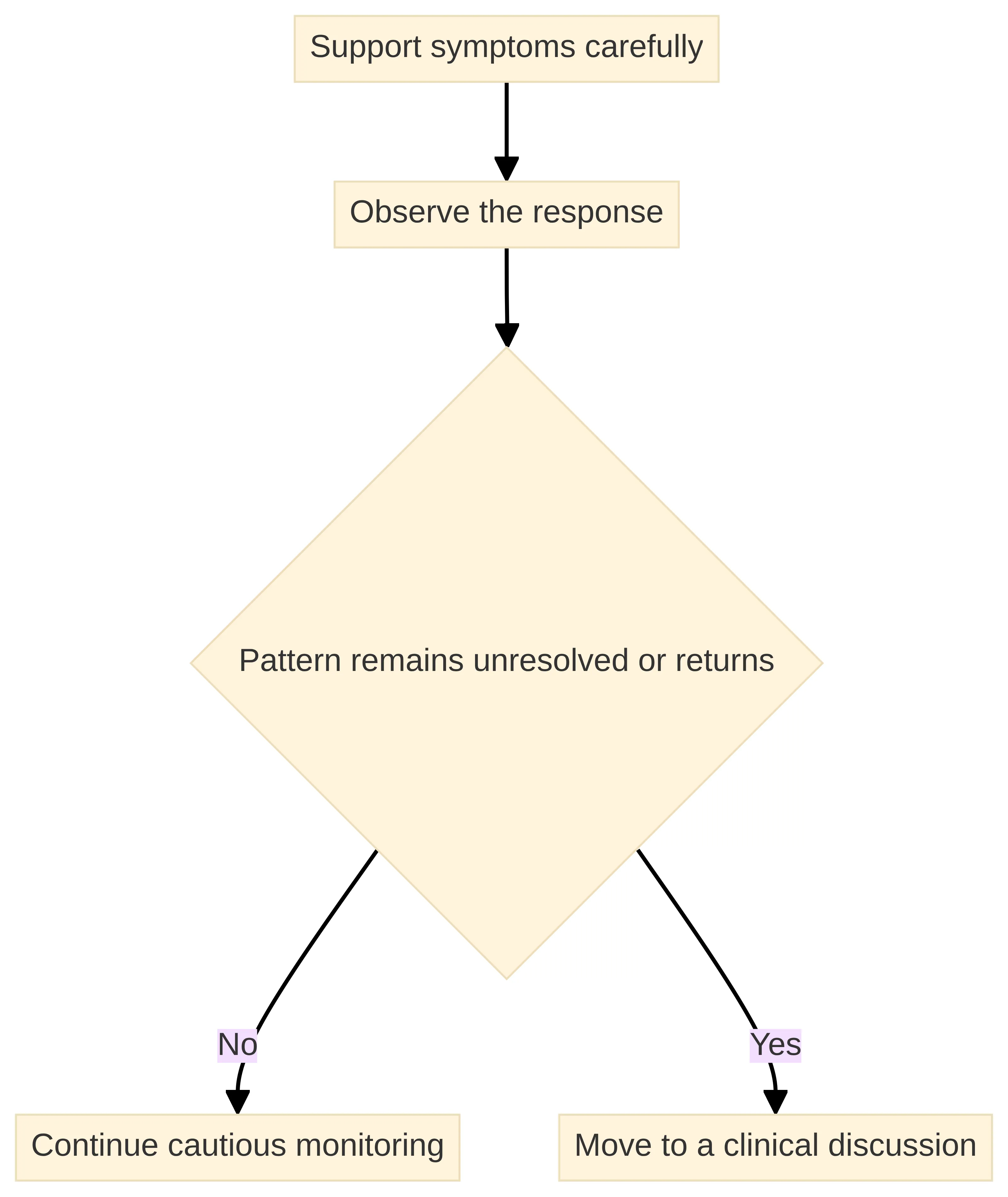
A practical sequence is to support symptoms carefully, observe the response, and use a clear boundary for evaluation. Rehabilitation protocols for IT band syndrome should be adjusted to examination findings, symptoms, progress, and tolerance rather than applied as one fixed plan. Research in athletic populations has not established one clearly superior treatment approach, and a review of conservative treatment for runners describes limited scientific support for some recommendations and recurring symptoms.
That combination leads to a measured decision. You can begin with general symptom-management measures when the pattern is mild and understandable, but you should not use short-term improvement to confirm a diagnosis. If the pattern remains unresolved, comes back, or interferes with activity, move to a clinical discussion.
A cautious conservative starting point
Conservative care is a common starting category for suspected IT band syndrome, but conservative care does not mean ignoring symptoms or following a universal home program. General measures may include ice, stretching, strengthening exercises, and temporarily avoiding activities that aggravate the pain. The appropriate combination depends on your symptoms and how your knee responds.
Begin by identifying the activity that most clearly increases the discomfort. You might reduce the duration, distance, hills, resistance, or repetition rather than continuing the same load. If running causes the pain, do not use repeated runs to test whether it is gone. If squats, stairs, cycling, or uneven surfaces provoke symptoms, reduce that particular demand while you observe ordinary function.
A cautious starting point should remain reversible. You should be able to tell what changed and what happened afterward. Avoid turning several simultaneous changes into a permanent treatment plan because that makes your response difficult to interpret.
Use a simple symptom-management record:
- Write down the activity that produced the symptoms.
- Record whether the pain eased after stopping or continued with routine movement.
- Note whether ordinary walking and stairs remained manageable.
- Change one major activity demand at a time when practical.
- Reassess the pattern before returning to the same intensity.
This record is a practical aid, not a promise of prevention, improvement, or complete recovery. Conservative care may help, but evidence for some treatment recommendations is limited and symptoms can recur. If the discomfort keeps returning when you resume activity, treat that response as a reason to discuss the problem with a clinician.
A general home measure should not replace assessment when the pattern is unclear. Non-operative rehabilitation guidance is intended to be adapted to examination findings, clinical judgment, progress, and tolerance. That means a fixed online list cannot determine whether a particular stretch, strengthening exercise, or activity level is appropriate for your knee. Use general information to organize your next decision, not to assign yourself a diagnosis or a complete rehabilitation plan.
Adjust rehabilitation to symptoms and tolerance
Rehabilitation for suspected IT band syndrome should follow your examination findings, symptoms, progress, and tolerance. A protocol may be time-based, criteria-based, or both, but it should not be treated as a calendar that overrides how your knee responds. A fixed number of days does not establish that you are ready to increase activity.
Physical therapy may address strength, flexibility, gait retraining, and a gradual return to activity. Those categories are broader than a single stretch or exercise. A therapist may consider how you move, which activities reproduce symptoms, how your strength and flexibility affect the task, and whether your return to running, cycling, rowing, work, or sport should be gradual.
Your response supplies useful information. Pain that intensifies over time, returns with the same load, or begins to affect ordinary activity should change the conversation rather than simply prompt more repetitions.
When you are monitoring a rehabilitation approach, separate three questions:
- Tolerance: Can you perform the movement without a meaningful increase in symptoms during or after it?
- Function: Can you walk, use stairs, work, or complete ordinary tasks at the same level?
- Progress: Is the activity pattern becoming easier over time, or are symptoms appearing sooner or lasting longer?
These questions do not create an individualized exercise prescription. They help you recognize when a plan is not matching your response. If symptoms worsen or function declines, do not force progression because a general schedule says you should advance. Arrange an evaluation and bring the record of what you tried.
A gradual return to activity should be discussed in relation to the activity that matters to you. Returning to a Chicago running route, an Ohio cycling route, a recreational league, or winter indoor training may involve different loads and surfaces. The goal of a discussion is to identify the demands that your symptoms tolerate, not to promise a particular return date.
Because symptoms can recur, improvement during a reduced-load period does not settle whether the problem is resolved. Resume activity in a way that lets you observe the response, and use recurrence as a clear boundary for reassessment rather than repeatedly restarting the same cycle.
What the evidence can—and cannot—promise
A review of 10 studies involving athletic populations reported that combined conservative care—rest for 2–6 weeks, stretching, pain management, and modification of running habits—produced a 44% complete cure rate, with return to sport at 8 weeks and a 91.7% cure rate with return to sport at 6 months. Those figures describe the populations and treatment combination examined in that review; they are not an individualized prediction for your knee.
The review also reported return-to-sport outcomes for surgical treatment in the studies it examined. Those results should not be read as a reason to choose surgery, because the treatment groups, case selection, diagnosis, and clinical circumstances matter. A result from an athletic-population review cannot establish what will happen to an adult with a different activity level, a different cause of outer-knee pain, or a different diagnosis.
The evidence has two important limits for your decision. First, the athletic-population review states that the best management options are not clearly established and that there is no consensus on one treatment approach. Second, a review of conservative treatment for runners states that scientific support for some recommendations is limited and that high recurrence rates raise doubts about their causal effectiveness.
The practical meaning is simple: use research to understand the range of options and the uncertainty around them, not to select a treatment from a percentage. A study result can describe what happened in a defined group. It cannot diagnose your pain, determine whether you have IT band syndrome, or guarantee that your response will match the reported outcome.
Your personal decision still depends on the clinical question. If the symptom location and activity pattern fit a possible IT band problem, conservative care may be discussed. If the pain could reflect a meniscal, hip, or other condition, the treatment conversation may need to change. If symptoms persist, recur, worsen, or limit activity, an evaluation becomes more informative than applying a study result directly to yourself. To use evidence responsibly, separate five questions before using a study to influence your next step: who was studied, what combination of care was used, what outcome was measured, what comparison was made, and what limitations did the authors identify? Here, the population was athletic, the conservative intervention combined several elements, and the reported outcomes included cure and return to sport. That does not tell you whether one element, such as stretching or activity modification, was responsible for the result. It also does not answer whether the same approach fits an adult whose main concern is walking, work, stairs, or daily function rather than sport. Treat the reported percentage as a description of that review, not as a personal probability. A return-to-sport result also should not be silently converted into proof that pain has resolved, that recurrence will not occur, or that the same plan is appropriate for a different cause of outer-knee pain. This reading approach helps you ask a more useful question during evaluation: which parts of the evidence actually resemble my symptoms, diagnosis, activity demands, and goals, and which parts remain uncertain?
Why there is no single proven best approach
Research has not established one clearly superior treatment approach for IT band syndrome. The review of athletic-population treatments describes the best management options as not clearly established, while the review of conservative treatment for runners notes limited support for some recommendations and recurring symptoms. This does not make treatment choices meaningless. It means the choice must account for the diagnosis, your activity pattern, your response, and the degree of uncertainty.
A treatment name alone cannot answer those questions. Rest, activity modification, stretching, strengthening, physical therapy, procedures, and surgery occupy different places in a decision sequence. The sequence should change when the diagnosis changes or when your response shows that the starting approach is not resolving the problem.
Use these criteria when comparing a possible next step with a clinician:
- Diagnostic fit: What finding makes this option relevant to the suspected source of pain?
- Current function: What can you do now, and what activity is limited?
- Response: What changed after the previous measure, and did symptoms return?
- Uncertainty: What other conditions could produce the same outer-knee or outer-hip pattern?
- Progression: What would indicate that the plan should be adjusted or reassessed?
These criteria keep the conversation tied to your situation without turning general information into an individualized plan. They also reduce the risk of choosing a procedure or exercise simply because it sounds more advanced.
The appropriate action is to choose a starting category that can be reassessed. If symptoms are mild and clearly linked to a change in activity, discuss or use general conservative measures within the limits of your situation. If symptoms recur, intensify, or remain unexplained, stop treating uncertainty as evidence that you need a stronger treatment and arrange professional evaluation instead. A question-to-option map can make that choice clearer. If the immediate question is whether a recent change in load is contributing to symptoms, a cautious change in that activity can provide context, but it cannot identify the painful structure. If the question is how to rebuild movement, strength, flexibility, gait, or activity tolerance after the clinical picture is understood, rehabilitation or physical therapy may be the relevant discussion. If the question is what is causing the pain or whether another knee or hip condition needs consideration, a history and physical examination address that uncertainty more directly than selecting a treatment by name. If the question is whether a procedure or surgery belongs in the conversation, the diagnosis, response to non-operative care, and reason for escalation should be clear first. This map does not choose an option for you. It prevents different categories from being treated as interchangeable and gives each proposed step a defined purpose. Before accepting a plan, ask what problem it is meant to address, what response would make it worth continuing, what information would cause it to change, and when the unresolved question should be reassessed.
Key Highlights
The main decisions for outer-knee pain can be reduced to these points:
- Outer-knee pain may fit IT band syndrome, but the location does not confirm the diagnosis.
- IT band syndrome is associated with repetitive knee bending and straightening and may be aggravated by running, rowing, cycling, repeated squatting, or uneven and hilly surfaces.
- Outer-knee or outer-hip pain can resemble other conditions, including knee meniscal or hip labral pathology, so self-diagnosis is not recommended.
- Conservative care may include temporarily avoiding aggravating activity, ice, stretching, and strengthening exercises.
- Rehabilitation should respond to your examination findings, symptoms, progress, and tolerance rather than follow one fixed schedule.
- Research has not established one clearly superior treatment approach, and symptoms can recur.
- A review of 10 athletic-population studies reported specific outcomes for combined conservative care, but those findings do not guarantee your result.
- Persistent, recurrent, worsening, or activity-limiting symptoms should move the decision toward professional evaluation.
Use these highlights as a decision aid, not as a diagnosis checklist. The immediate question is whether your symptoms are settling with a cautious change in activity or whether the pattern is continuing to return. If the answer is unclear, write down what happens during ordinary movement and bring that record to a clinician. The record is useful because it connects the treatment discussion to your actual activity pattern rather than to a label alone.
Set a reassessment boundary
A reassessment boundary can help keep a cautious trial from becoming indefinite self-management. Arrange professional evaluation when outer-knee pain persists, returns after activity resumes, worsens over time, or limits ordinary activity or exercise. These patterns matter because conservative treatment is commonly used but symptoms can recur, and a rehabilitation approach should be adjusted to your symptoms, progress, tolerance, and examination findings.
Do not wait for a familiar label to appear before deciding that the problem deserves attention. A clinician can help determine whether the pattern is compatible with IT band syndrome or whether another knee or hip condition needs consideration. The longer the symptoms remain unresolved, the more useful it becomes to bring the activity record and discuss the full pattern.
Monitoring is more reasonable when you can identify a clear aggravating activity, basic movement remains manageable, and the symptoms are not continuing to intensify. Even in that situation, monitoring should have a defined purpose: observe whether reducing the provoking load changes the pattern and whether the problem returns when activity increases.
It can help keep temporary relief from becoming the only reason you delay evaluation. Compare the pattern across ordinary activities and the activity that first aggravated it. A quieter response during one reduced-load session is different from a consistent improvement in function when walking, using stairs, working, or returning to the relevant exercise. Likewise, a return of symptoms when the same demand is reintroduced is useful information even if the pain had eased while you were resting. Record the trend without turning it into a diagnosis: what you did, what you noticed during the activity, what remained afterward, and whether the same pattern appeared again. This makes the reassessment decision less dependent on a single unusually good or bad day. If the record shows that the symptoms are becoming harder to interpret, appearing with more ordinary activities, or repeatedly returning at a similar point in the activity, bring that pattern to a healthcare professional rather than continuing to test the same limit on your own. The purpose of monitoring is to decide whether the pattern is settling or whether more information is needed, not to prove that the iliotibial band is the source.
Promptly discuss symptoms with a healthcare professional when you cannot tell whether the pain is coming from the outer knee, outer hip, or another area, or when the activity pattern no longer explains the level of discomfort. Persistent symptoms should not be repeatedly tested through the same aggravating activity. An evaluation can replace guesswork with a history and physical examination directed at the pattern you are experiencing.
What a clinician can clarify
The pattern of pain, its triggers, and its onset provide context when considering possible explanations. Looking beyond pain location alone can clarify which questions matter next.
You may be asked about running, cycling, rowing, squatting, hills, stairs, work demands, and changes in training. You may also be asked whether the symptoms affect ordinary walking or persist after the activity stops. These questions help define the pattern; they do not mean that every person with an activity-linked symptom has the same diagnosis.
An evaluation can help clarify:
- Whether the pain location and movement pattern are consistent with possible IT band syndrome.
- Whether the hip, knee, or nearby structures need broader consideration.
- Which activity demands appear to aggravate the symptoms.
- Whether a conservative rehabilitation approach should be adjusted to your findings and tolerance.
- What change in symptoms or function should lead to reassessment.
- How a gradual return to your work, exercise, or sport should be discussed.
These questions are more useful than asking for a treatment name before the source of pain is understood. They also help separate a treatment that fits the clinical question from one chosen only because it is available.
An evaluation does not automatically establish that a procedure, regenerative treatment, or surgery is appropriate. It establishes a clearer clinical question and may identify what should happen next. Because research has not found one clearly superior IT band syndrome treatment, the value of the visit is the reasoning that connects the findings, your goals, and the available categories of care.
What to discuss during an evaluation
Your activity and symptom record can make an evaluation more focused. Bring the date or situation when the pain began, the exact location, the movements that reproduce it, and what happens when you stop. Include changes in distance, pace, hills, surface, resistance, footwear, gym exercises, work demands, or time away from activity when those details seem relevant.
Also describe whether symptoms recur after improvement and whether the pain affects walking, stairs, work, sleep, exercise, or sport. You do not need to translate the pattern into a diagnosis. Clear observations allow the clinician to compare your experience with the examination findings.
One way to organize this information is a short timeline. Start with the first noticeable symptom, then list changes in training or routine, the activities that brought it on, what you changed, and what happened afterward. Mark the point at which ordinary movement or valued activity became limited, if that occurred. Keep observations separate from conclusions: “pain after hills” is an observation, while “the band is injured” is a conclusion the record cannot establish. Include questions you want answered and any prior evaluation or treatment information you have available. This structure helps compare the initial pattern with the current one and reduces the chance that a temporary improvement or a single aggravating activity becomes the entire story. It also gives the clinician a concise starting point for discussing diagnosis, conservative care, rehabilitation, and whether other categories deserve consideration.
Questions you can bring to the appointment include:
- What findings support or weaken the possibility of IT band syndrome?
- What other causes of outer-knee or outer-hip pain should be considered?
- Which activity should I change first, and what response should I monitor?
- Would physical therapy address strength, flexibility, gait retraining, or a graded return to activity in my situation?
- What would count as meaningful progress, and what would indicate that the plan needs adjustment?
- If symptoms recur, what should I do next?
- Which treatment options have evidence relevant to my diagnosis, activity level, and goals?
- What remains uncertain after the examination?
The last question is useful because uncertainty should shape the next step rather than be hidden by a treatment label. You can make the answers easier to compare by writing each recommendation under four headings: the finding it is responding to, the goal of the recommendation, the alternative options that remain open, and the point at which the plan should be reconsidered. For example, a recommendation may be intended to reduce an aggravating load, improve movement or strength, clarify the source of pain, or address a condition identified during the evaluation. Those purposes are not interchangeable. Ask which purpose applies before judging whether a treatment is appropriate. Also ask whether the supporting evidence concerns the diagnosis actually identified or only a similar symptom label, and whether the recommendation is based on your examination findings, your activity demands, or a general option discussed for the condition. If a procedure or regenerative option is raised, ask what conservative choices remain, what timing and cost details apply, what outcome is being pursued, and what would lead the clinician to reconsider the approach. If surgery is mentioned, ask what finding makes it relevant and what other categories have been considered. Writing these answers down keeps the conversation focused on fit, alternatives, and uncertainty rather than on which treatment sounds most advanced or most reassuring.
If you discuss the problem with REGEN Orthopedic Medicine, bring the same symptom and activity information and ask what the evaluation can establish before discussing treatment. We also offer free consultations for knee, hip, or shoulder pain.
Those facts describe what we offer; they do not establish that regenerative treatment fits your outer-knee pain. The relevant question remains whether the evaluation supports that category after the possible source of pain and your goals have been considered.
Where procedures and surgery fit
Surgery is usually considered only when symptoms do not respond to conservative care, and it is uncommon for IT band syndrome. The reviewed surgical procedures included excision or release of the affected distal portion of the iliotibial band or bursectomy. Those details describe options reported in the literature; they are not a recommendation for your symptoms.
A surgical discussion belongs after the diagnosis, the response to non-operative care, and the reason for considering an operation are clear. If the pain has not been shown to come from the iliotibial band, choosing a procedure based on the location of pain alone would skip an important part of the decision. If symptoms persist despite a thoughtful conservative approach, evaluation can clarify whether surgery belongs in the discussion at all.
Procedures and injections should also be discussed in relation to the actual diagnosis rather than as automatic steps between home care and surgery. The available evidence does not establish one clearly superior IT band syndrome treatment, and conservative treatment recommendations have limited support in some areas. That uncertainty makes it especially important to ask what problem a procedure is intended to address, what evidence applies to that problem, and what alternatives remain.
A treatment may sound more advanced without being more appropriate. Ask for the connection between the examination finding, the proposed procedure, the expected decision point afterward, and the possibility that the pain has another source.
The athletic-population review reported favorable return-to-sport results for certain surgical studies, but those findings should not be used as a promise for your outcome. Study participants, case selection, procedures, follow-up, and the cause of pain all affect how results should be interpreted. If surgery is discussed, ask how your situation compares with the population and treatment examined rather than relying on a headline percentage.
Keep regenerative care in the right category
Regenerative treatment should be considered only after the cause of the symptoms and the suitability of that option have been evaluated. That service description does not establish that any of these options are appropriate for iliotibial band syndrome or for your particular outer-knee pain.
The first question is still what is causing the symptoms. A treatment discussion becomes more meaningful after the pain pattern, examination findings, activity limits, and available alternatives have been considered. You should be able to ask what condition the proposed treatment is intended to address, what is known about that use, and what remains uncertain.
We state that if regenerative treatment is unlikely to help your joint, we provide an honest assessment and direct you to what may help. We also explain the options, timing, and cost details if regenerative treatment is appropriate. These are descriptions of our approach, not a conclusion about your eligibility or expected result.
If you are considering this category, keep the decision specific. Ask whether the evaluation supports regenerative treatment for the condition actually identified, how the option compares with conservative care or other appropriate choices, and what would lead you away from it. Do not treat the availability of a treatment as evidence that it is the right treatment.
REGEN Orthopedic Medicine offers free consultations for knee, hip, or shoulder pain, and we provide physician-led non-surgical regenerative care for those joints. An evaluation can help organize the discussion, but it cannot guarantee a diagnosis, candidacy, or treatment result. If surgery is deemed necessary, we inform the patient. That boundary keeps regenerative care in the broader conversation rather than presenting it as a universal substitute for other care.
What an evaluation request can establish
Before you request an evaluation, prepare a short description with:
- The exact location of the pain and whether it is in the outer knee, outer hip, or both.
- The activity that first brought it on and any later changes in distance, hills, surface, pace, resistance, or repetition.
- What happens when you stop the aggravating activity.
- Whether ordinary walking, stairs, work, exercise, or sport is limited.
- What you have already changed and whether symptoms returned.
- The questions you want answered about diagnosis, conservative care, rehabilitation, procedures, and regenerative options.
This information does not determine your treatment. It gives the evaluation a clear starting question and helps keep the discussion connected to your actual goals.
Approach any treatment conversation with caution: an evaluation can clarify the problem and support a discussion of options, but it does not promise that one category of care will fit. If surgery is deemed necessary, we inform the patient rather than presenting regenerative treatment as the only direction.
Request an evaluation when the question remains unresolved
Outer-knee pain that persists, recurs, worsens, or limits your activity deserves a clearer answer than repeated self-testing. Start with the activity pattern, support symptoms cautiously, and use your response to decide whether monitoring remains reasonable. When the diagnosis is uncertain or the problem keeps returning, arrange professional evaluation so the next step can reflect your examination findings, tolerance, goals, and alternatives.
A qualified healthcare professional should determine individual suitability, diagnosis, and treatment. If you are near an Ohio or Chicago REGEN Orthopedic Medicine location, you can bring your symptom record and discuss whether an evaluation is appropriate for your situation.
Questions readers may have about IT band syndrome knee pain treatment
What are common treatment options for iliotibial band syndrome knee pain?
Common treatment options include conservative measures such as rest, ice, stretching, strengthening exercises, and temporarily avoiding aggravating activities. Rehabilitation may also involve physical therapy to address strength and flexibility.
When should I seek professional evaluation for iliotibial band syndrome?
You should seek professional evaluation if your outer-knee pain persists, returns after activity, worsens over time, or limits your ability to perform daily activities.
What factors should I consider before deciding on treatment for iliotibial band syndrome?
Consider the location of your pain, the activities that trigger it, how your symptoms respond to changes in activity, and whether the pain affects your daily function.
How can I prepare for an evaluation regarding my knee pain?
Prepare by documenting the exact location of your pain, the activities that trigger it, any changes in your routine, and how your symptoms respond to different activities.
What should I discuss with a healthcare provider during an evaluation for knee pain?
Discuss the specific symptoms you are experiencing, any changes in activity that may have triggered the pain, and what treatments you have already tried.
What should I do if my symptoms improve temporarily but then return?
If your symptoms improve temporarily but return, it is advisable to arrange a professional evaluation to determine the underlying cause and appropriate treatment.
Free consultation
Find out whether regenerative treatment is right for you.
Most consultations begin as a telehealth call with a physician specialist, so you can start without travelling to a clinic. No referral needed.