
knee joint pain treatment
Knee Joint Pain Treatment: How to Choose Your Next Step
Start with the treatment decision, not a treatment promise
Knee joint pain treatment is a decision pathway, not a promise that one procedure will work for every person. The useful first step is to clarify what may be causing the pain, how much it affects walking and daily activity, whether any feature calls for timely clinical attention, and which options fit the findings.
You can use four questions to organize the decision:
- What problem needs to be explained? Pain, stiffness, swelling, and difficulty walking can occur with knee osteoarthritis, but symptoms alone do not establish that diagnosis.
- How serious or limiting is the problem? Treatment choices can change with symptom severity and functional effect.
- What is each option meant to do? Prescribed exercise, physiotherapy, pain medicines, injections, regenerative approaches, and surgery have different purposes and limitations.
- What should be decided by a clinician? A clinical evaluation is needed when the diagnosis, severity, or next step is uncertain.
Osteoarthritis care is not a fixed sequence that applies identically to every person. The American College of Rheumatology describes a range of educational, behavioral, physical, pharmacological, and other approaches that may be selected or changed as symptoms change. Clinical practice guidelines likewise are not fixed protocols; care should reflect your circumstances and a clinician’s independent judgment.
That framework keeps the decision grounded. You can compare options without assuming that an attractive treatment name is the same as a diagnosis, an indication, or a likely result.
What knee joint pain may be signaling
Knee joint pain is a symptom that can occur when the structures inside the joint have changed, and knee osteoarthritis is one condition that may explain it. NICE describes knee osteoarthritis as progressive deterioration of the joint’s articular cartilage and menisci, commonly associated with trauma and wear and tear. Symptoms may include pain, stiffness, swelling, and difficulty walking.
Those features can help you describe the problem, but they do not tell you by themselves whether osteoarthritis is present, how advanced a joint change may be, or which treatment should come next. The same symptom can also have more than one possible explanation, so a treatment decision based only on the word “pain” is incomplete. A useful record should capture:
- where the pain is located in or around the knee;
- when the pain began and whether it followed trauma or increased activity;
- whether stiffness, swelling, or difficulty walking is present;
- which movements or activities change the symptoms; and
- how the problem affects work, exercise, sleep, stairs, or ordinary walking.
The record is a communication aid, not a home diagnosis. Bring it to a healthcare professional so the pattern, severity, and functional effect can be considered together. Treatment depends in part on symptom severity, and that severity cannot be determined reliably from a treatment advertisement or a single symptom description.
Knee osteoarthritis may be a relevant explanation when pain, stiffness, swelling, or walking difficulty fit the clinical picture, but the appropriate next step remains a question of evaluation and individual circumstances. You do not need to choose an injection or surgery before that question is addressed.
Use evaluation to clarify the problem before comparing treatments
A clinical evaluation can clarify whether your symptoms fit osteoarthritis, whether another diagnosis or complication needs consideration, and which treatment categories are reasonable to discuss. NICE guidance says suspected osteoarthritis may be diagnosed clinically without routine imaging, while imaging may be considered when another diagnosis or complication is suspected. That does not mean imaging is never useful. It means the clinical question should guide whether testing adds information.
Clinical guidelines also leave room for individual judgment. AAOS guidance states that guidelines are not fixed protocols because some patients may need different diagnostic or treatment approaches. Your evaluation may therefore focus on the history and physical examination, or it may lead to additional testing when the findings create a specific reason to investigate further.
Questions can make the appointment more useful:
- What findings support the working explanation for my knee pain?
- Does the pattern suggest osteoarthritis, an injury-related problem, or another diagnosis?
- How are symptom severity and walking difficulty affecting the treatment choice?
- Would imaging answer a specific question in my situation?
- What is the purpose of each proposed treatment?
- What limitation, cost, or uncertainty should I weigh before choosing it?
- What change would lead you to adjust the plan?
The answers should connect the diagnosis to the option. If a treatment is proposed without explaining what problem it addresses, ask how the treatment fits the clinical findings. If the diagnosis remains uncertain, clarification belongs before a commitment to a procedure. An evaluation should produce a reasoned discussion of choices, not pressure to select a particular intervention. Before leaving, summarize the plan in your own words: the working explanation, the reason any test is being considered, the purpose of the proposed treatment, and the point at which the plan will be reviewed or changed. This summary helps separate a diagnostic question from a treatment choice and gives you a practical basis for comparing conservative care, an injection, a regenerative approach, or surgery later.
An evaluation also protects against an evidence mismatch. The guidance cited in this article addresses suspected or established osteoarthritis; it should not be treated as a diagnosis for every knee symptom. If the working explanation is different, the relevant options and evidence may differ as well. For the same reason, evidence or limitations described for one injection should not be transferred automatically to another. Before comparing treatments, identify the condition being discussed and ask whether the cited evidence applies to that condition. This keeps a treatment comparison tied to a clinical question rather than to a familiar label.
Create a safety checkpoint before routine treatment planning
NICE describes pain, stiffness, swelling, and difficulty walking among possible symptoms of knee osteoarthritis and notes that treatment depends on symptom severity. When symptoms are severe, surgery may be considered.
NICE guidance says imaging may be considered when another diagnosis or complication is suspected. Clinical evaluation can place symptom severity and possible complications in context when treatment options are discussed.
This information does not specify which knee-pain symptoms require urgent or emergency care, so it should not be used as an emergency triage guide.
Begin with the least invasive reasonable pathway
Conservative care can be a reasonable starting pathway when your clinical situation does not require a different approach, but the exact plan should match your symptoms and findings. NICE describes conservative options for knee osteoarthritis that include pain medicines, physiotherapy, and prescribed exercise. The American College of Rheumatology also describes educational, behavioral, physical, and pharmacological approaches that may be selected, reused, or changed as symptoms change.
“Least invasive” does not mean “ignore the problem.” It means starting with an option whose purpose and conditions have been discussed before moving to a procedure. A conservative discussion may cover:
- what prescribed exercise is intended to address;
- whether physiotherapy is appropriate for your movement and function;
- which pain-medicine options a qualified professional considers suitable; and
- what symptom or functional change should lead to a new evaluation.
Do not turn a general exercise or medication reference into an individualized plan. The sources describe treatment categories, not a dose, exercise schedule, medication choice, or personal safety determination for you. Ask a qualified professional about material conditions that apply to your health history, other medicines, and current symptoms.
Conservative care also has a boundary. If symptoms remain severe, walking becomes difficult, or the working diagnosis is uncertain, continuing the same approach without reassessment may not answer the underlying treatment question. AAOS guidance states that clinical guidelines are not fixed protocols and that care should reflect the patient’s circumstances and a clinician’s independent judgment.
The practical next step is to discuss a conservative plan with a clear purpose and review point. You can then compare later options based on how your symptoms and function change, rather than treating escalation as automatic or failure as proof that one specific procedure is needed.
One practical way to keep conservative care from becoming vague is to define its purpose before beginning. Is the immediate aim to address pain, support movement and function, or learn which activities and symptoms need review? The answer should be stated in the plan, along with the point at which the plan will be reconsidered. That does not predict an outcome or set a universal time limit. It simply gives you a basis for reporting whether the approach is addressing the problem it was chosen to address. If the purpose is unclear, ask the clinician to state it plainly before treating the category as a complete plan.
Understand what injections can and cannot do
Knee injections differ in their intended use, evidence, duration of benefit, preparation, and coverage, so the word “injection” does not identify a single treatment. A comparison should begin with the purpose of the injection and the limits described for that option.
Corticosteroid injections. Mayo Clinic guidance says steroid injections may provide temporary pain relief, do not work for everyone, and may become less effective with repeated use. That makes a steroid injection a time-limited symptom-management discussion, not an assurance of lasting improvement or a reason to repeat it indefinitely.
Hyaluronic acid injections. The same Mayo Clinic guidance describes weaker evidence for hyaluronic acid injections than for steroid injections, with exceptions for rare patients who do not respond to steroids. Insurance coverage may vary. Ask what evidence applies to your diagnosis and what cost or coverage conditions would apply before choosing this option.
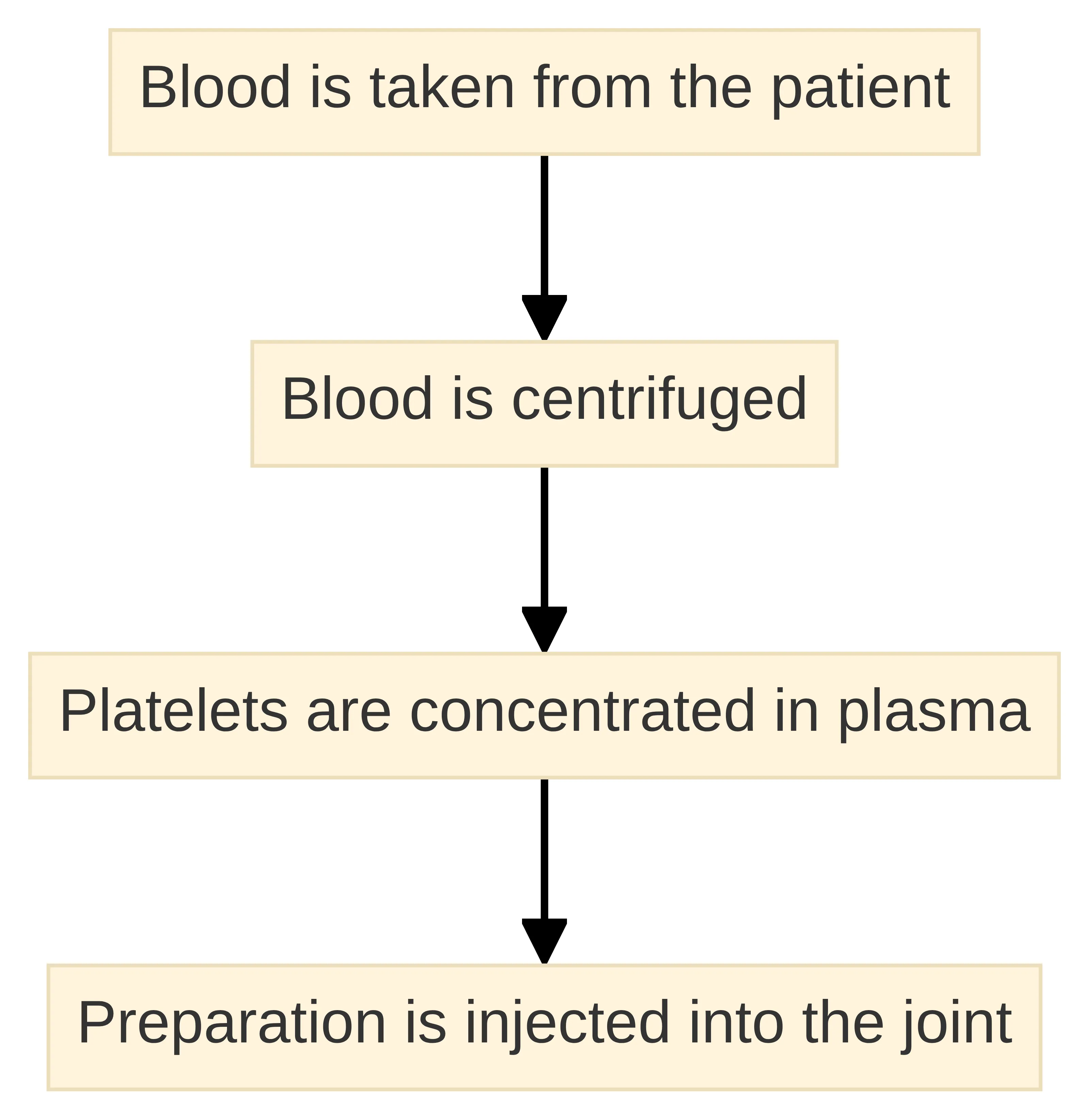
Platelet-rich plasma. PRP is prepared from your blood. The blood is processed to concentrate platelets in plasma before the preparation is injected into the joint, and preparation methods can vary. NICE describes differences in platelet concentration and contamination with red and white blood cells between preparation methods. Ask how the proposed preparation is made, what clinical question it is intended to address, and what uncertainty remains.
Use these questions for any injection conversation:
- What diagnosis or finding makes this injection relevant?
- Is the aim symptom relief, improved function, or something else?
- How long might the intended effect last, and what limitations should I expect?
- How many treatments are being discussed, and what would change the plan?
- What is the total cost, and what coverage conditions apply?
An injection should be judged by its purpose, evidence, trade-offs, and fit for your circumstances. No injection should be treated as a substitute for clarifying the diagnosis first.
These injection categories are therefore not interchangeable. The approved descriptions attach different decision facts to them: steroid injections are discussed in terms of temporary relief and reduced effectiveness with repeated use; hyaluronic acid in terms of comparatively weaker evidence and variable coverage; PRP in terms of blood-based preparation that can vary. Those differences do not establish which option is best for an individual. They do establish why the name of an injection is not enough: ask the clinician to connect the option to the diagnosis, intended purpose, preparation, expected limitation, and financial responsibility.
Treat regenerative approaches as an evidence and suitability question
Regenerative approaches require two separate questions: what the available clinical guidance says about the condition, and whether a particular option is suitable for your diagnosis and circumstances. A treatment being described as regenerative does not establish that it will relieve your pain, restore function, regenerate cartilage, or delay surgery.
Mayo Clinic guidance says injections marketed as regenerative medicine, including stem cells, PRP, and acellular biologics, are not recommended there for hip and knee osteoarthritis, are usually expensive, and are not covered by insurance. That is a consequential limitation for anyone comparing options for knee osteoarthritis. It should be discussed directly rather than replaced with a broad promise about biological repair.
REGEN Orthopedic Medicine provides physician-led, non-surgical regenerative medicine for the knee, hip, and shoulder, including stem cell therapy, exosome therapy, peptide therapy, and combination protocols. A combination protocol means that multiple regenerative modalities may be considered together as part of a plan tailored to the stated condition, anatomy, and goals. That service description explains what we offer; it does not establish that any one modality or combination is appropriate for you.
REGEN Orthopedic Medicine states that we provide honest assessments and guide patients toward what may help when regenerative treatment is unlikely to help a joint. That boundary matters. An evaluation should be able to address whether the proposed approach fits the clinical problem, what alternatives remain, and what uncertainty or cost you would accept.
Cost is part of the decision. Our regenerative treatments are self-pay, and we do not bill insurance for them. Ask for the financial terms before deciding, while keeping the clinical questions separate from the payment question.
A useful regenerative-treatment discussion covers the diagnosis, the proposed modality, the evidence relevant to that diagnosis, the intended purpose, limitations, alternatives, and total financial responsibility. You can request that discussion without presuming that regenerative treatment is the right endpoint.
Know when surgery belongs in the comparison
NICE describes surgery as a possible consideration when knee osteoarthritis symptoms are severe, while the Arthritis Foundation explains that joint replacement can improve pain and function.
That information does not mean that severe pain automatically requires replacement, or that considering surgery means you must choose it. An orthopedic surgeon determines the appropriate procedure based on the extent of joint damage. The comparison should therefore include the clinical findings that make surgery relevant, the purpose of the proposed procedure, and the alternatives that remain.
Ask a surgeon:
- What findings place surgery in the comparison for my knee?
- What procedure are you discussing, and what problem is it intended to address?
- Which non-surgical options remain reasonable for my circumstances?
- What would make you recommend waiting, changing the plan, or seeking another assessment?
- How should pain, walking difficulty, and daily function factor into the decision?
Surgery and non-surgical care should not be framed as moral choices or as proof that one pathway has succeeded and another has failed. They are different categories of treatment with different purposes and trade-offs. The decision should follow an evaluation of the joint and your circumstances, not a general claim that surgery is always necessary or that avoiding it is always the goal. AAOS guidance emphasizes that treatment and diagnostic approaches are not fixed protocols and should be based on independent clinical judgment applied to the individual situation.
If a clinician places surgery in the comparison, ask for the reason in plain language. If surgery is not being discussed, ask what findings would change that conversation.
Compare options with questions, not assumptions
A treatment comparison works best when every option is judged by the same questions: what is it intended to address, what limitation is already known, what condition must be present before considering it, and what would cause the plan to change?
| Option | Intended place in the discussion | Limitation or trade-off to examine | Question to ask |
|---|---|---|---|
| Self-management and conservative care | Pain medicines, physiotherapy, prescribed exercise, and other educational, physical, behavioral, or pharmacological approaches may be considered as symptoms and function are assessed. | The plan must fit your circumstances, and persistent severe or limiting symptoms call for reassessment. | What is the purpose of this plan, and when should it be reviewed? |
| Corticosteroid injection | May provide temporary pain relief for some people. | It does not work for everyone and may become less effective with repeated use. | What benefit is intended, and what is the limit on repeating it? |
| Hyaluronic acid injection | May be discussed in selected circumstances. | Mayo Clinic guidance describes weaker evidence than for steroid injections, and coverage may vary. | What evidence and coverage conditions apply to my situation? |
| PRP or another regenerative injection | Requires discussion of the diagnosis, preparation, proposed purpose, and relevant evidence. | What finding makes this option relevant, and what uncertainty remains? | |
| Surgery or joint replacement | May enter the comparison when symptoms are severe or joint damage makes it relevant; replacement can improve pain and function. | The appropriate procedure depends on the extent of joint damage and individual clinical judgment. | What findings support surgery, and which alternatives remain? |
The table does not rank the options. It gives you a consistent way to question them. Conservative care is not automatically appropriate for every situation, an injection is not automatically a middle step, regenerative treatment is not automatically restorative, and surgery is not automatically the first or last choice. Those boundaries follow from the differences in the approved clinical guidance and the limits of the service information.
Take the comparison to a qualified professional who can apply it to your symptoms, examination findings, and goals. The useful decision is the one that explains why an option fits, what it cannot establish, and what happens if the plan needs to change.
To use the table in an appointment, write the options in the order the clinician says they fit your findings, rather than in an assumed treatment ladder. For each, record the problem it addresses, the intended benefit, the main limitation, the cost or coverage question, and the condition that would lead to review. Then ask which statement is evidence about the treatment category and which is a judgment about your case. This separates general information from individualized suitability and leaves you with a decision record you can revisit if symptoms or function change.
If considering REGEN Orthopedic Medicine, request an evaluation first
An evaluation with REGEN Orthopedic Medicine can give you a place to discuss persistent knee joint pain, the working diagnosis, and possible next steps without presuming that a particular treatment is appropriate. We offer free consultations for knee, hip, or shoulder pain, and most of our consultations begin as telehealth calls, so you can start without traveling to a clinic.
Bring your symptom pattern and ask what diagnosis is being considered, what each proposed option is meant to do, what limitations apply, what alternatives remain, and what would change the plan. REGEN Orthopedic Medicine states that we provide honest assessments and guide patients toward what may help when regenerative treatment is unlikely to help a joint.
A qualified professional must decide individual suitability for any treatment, injection, medication, or surgery after considering your clinical circumstances. Use the evaluation to turn general information into a clear discussion of your own next step.
Frequently asked questions about knee pain treatment
What are the common symptoms of knee osteoarthritis?
Common symptoms of knee osteoarthritis include pain, stiffness, swelling, and difficulty walking. These symptoms can vary in severity and may affect daily activities.
When should I seek a clinical evaluation for knee pain?
You should seek a clinical evaluation if you experience severe or increasingly limiting symptoms, difficulty walking, or swelling that does not fit the expected explanation. A professional assessment can help clarify the diagnosis and appropriate treatment options.
What conservative treatment options are available for knee joint pain?
Conservative treatment options for knee joint pain may include pain medications, physiotherapy, prescribed exercise, and other educational or behavioral approaches. These options are often considered before more invasive treatments.
What is the role of injections in treating knee pain?
Injections, such as corticosteroids or hyaluronic acid, may provide temporary relief for knee pain. However, their effectiveness can vary, and they are not suitable for everyone. It’s important to discuss the intended purpose and limitations of any injection with a healthcare provider.
How does regenerative medicine differ from traditional treatments for knee pain?
Regenerative medicine, including treatments like stem cell therapy and platelet-rich plasma (PRP), aims to leverage the body’s own healing processes. However, these treatments are not universally recommended for knee osteoarthritis and may not be covered by insurance.
What factors should be considered before deciding on surgery for knee pain?
Factors to consider before surgery include the severity of symptoms, the extent of joint damage, and the potential benefits versus risks of the procedure. An orthopedic surgeon can help determine if surgery is appropriate based on individual circumstances.
How can I request an evaluation from REGEN Orthopedic Medicine?
You can request an evaluation by contacting REGEN Orthopedic Medicine directly. They offer free consultations for knee, hip, or shoulder pain, and many consultations begin as telehealth calls.
Free consultation
Find out whether regenerative treatment is right for you.
Most consultations begin as a telehealth call with a physician specialist, so you can start without travelling to a clinic. No referral needed.