
non-surgical knee relief seniors swear by
Non-Surgical Knee Relief Seniors Consider: How to Choose Your Next Step

Use an evidence map, not a popularity list
If you are looking for non-surgical knee relief, a treatment that many older adults mention can feel like an obvious place to start. Popularity can help you find options to discuss, but it cannot show whether an approach fits your pain, knee problem, health history, goals, or budget.
Use an evidence map instead of a popularity list. For knee osteoarthritis, sort options into four categories: guideline-supported foundation care, symptom tools with visible tradeoffs, injections with treatment-specific evidence, and regenerative options that require careful questions about evidence, fit, limitations, and cost. This map organizes a conversation; it does not diagnose your knee or select a treatment for you.
A review of 11 high-quality osteoarthritis guidelines identifies patient-centered care, exercise, education, and weight loss when appropriate as first-line components. These measures can help reduce pain and improve function and quality of life, although a clinician can help determine what is appropriate for your health and mobility. Guideline support does not make every foundation measure suitable for every person.
Other non-surgical options studied for knee osteoarthritis include topical or oral NSAIDs, injections, physical therapy, and bracing. The reviewed guidelines describe topical or oral NSAIDs as pharmacologic options after first-line care and before surgical interventions. Medication and device choices still need to be considered against your health history and the tradeoffs a clinician explains.
Injections need their own evidence label rather than a popularity label. A cited expert consensus describes PRP as an effective symptomatic treatment for early-to-moderate knee osteoarthritis, while noting that recommendations can differ among organizations. A systematic review reported pain and symptom improvements with PRP and corticosteroid injections, but also said PRP efficacy and safety remain debated. The studies used different PRP preparation methods, so those findings do not make every injection the same option.
Regenerative options belong on the same map. Ask what the proposed treatment is intended to do, what evidence and recommendations apply to that specific option and knee problem, what limitations or risks matter for you, and how cost will be handled. The treatment label alone cannot answer those questions.
Take the map into a clinical discussion by asking which category an option belongs to, what outcome it is intended to affect, what evidence applies to your situation, and what would prompt a different plan. That keeps your next step grounded in the option’s purpose and supporting evidence rather than in what other people happen to recommend.
Name the result you want from relief
Your desired result should shape the next conversation. Relief is not one single outcome, and a change in pain does not answer every question about the knee.
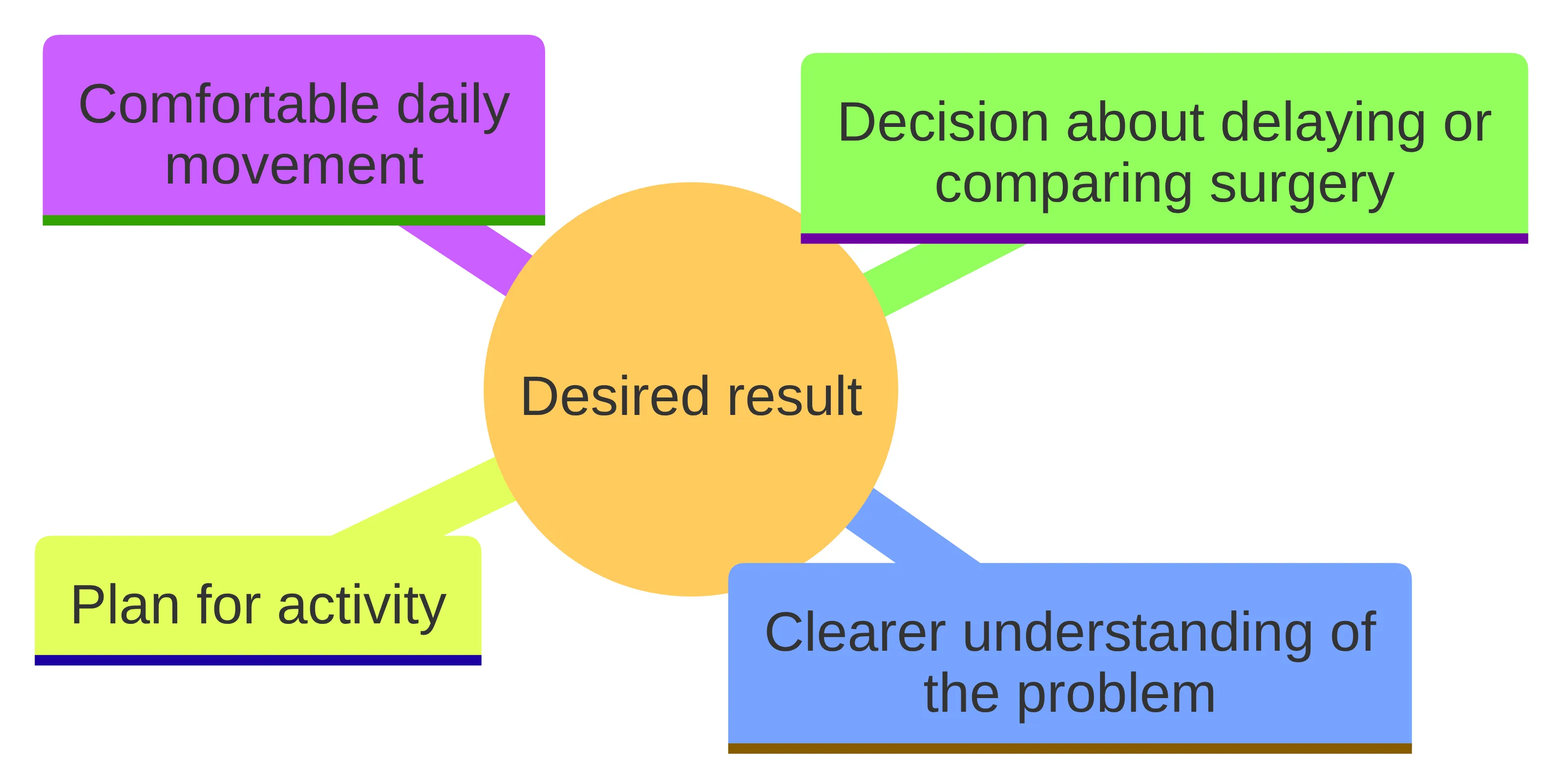
Start by choosing the result that matters most right now:
- More comfortable daily movement. You may want to walk around your home, climb stairs, shop, work, or sleep with fewer symptoms. Symptom-focused care is aimed at comfort and function; it should not be presented as proof that the source of pain has been established.
- A clearer understanding of the problem. If you are unsure whether osteoarthritis, cartilage wear, meniscus-related pain, or another issue is involved, the useful next step is a clinical discussion about what your pattern may require. You cannot establish the cause or severity from popularity, a product description, or one symptom alone.
- A plan for activity. Exercise therapy is identified as a first-line component in the reviewed osteoarthritis guidelines. You can ask a qualified professional how activity should be adapted to your symptoms, current function, and health history rather than copying a routine designed for someone else.
- A decision about delaying or comparing surgery. Non-surgical care can remain part of the discussion, but it cannot guarantee that surgery will never be appropriate. Your goal may be to keep exploring non-surgical choices, to understand what they can reasonably address, or to compare them with another pathway.
These goals can overlap, but they are not interchangeable. An approach that helps symptoms for a period may not clarify the underlying problem. An evaluation may clarify the treatment question without providing immediate relief. Write down the result you want before an appointment so you can ask whether the proposed option is intended to address that result and how you will judge the response.
A practical goal statement might be: I want to understand what could be contributing to my knee symptoms, which non-surgical options fit that question, and what tradeoffs come with each one. That keeps the conversation open without assuming that a particular treatment is already appropriate.
Use the established foundation before escalating
A sensible non-surgical plan usually begins with the measures that guideline reviews place near the foundation of osteoarthritis care. A review of 11 high-quality clinical practice guidelines identifies patient-centered care, exercise therapy, education, and weight loss when appropriate as first-line components. The AAOS guideline reviews evidence on non-surgical treatment of knee osteoarthritis and is intended to support clinician decision-making.
That foundation is not a demand to solve your knee pain alone. It is a way to avoid treating a named option as the starting point before your goals and limitations are clear.
What the foundation can include
- Exercise therapy: Ask how movement or strengthening work can be matched to your current function and symptoms. The guideline review reports that exercise can help reduce pain and improve function and quality of life.
- Education: Learn what your clinician thinks the treatment is intended to do, what response would count as meaningful, and when the plan should be reconsidered. Education is itself identified as part of first-line care.
- Weight loss when appropriate: The reviewed guidelines include weight loss when appropriate, not as a universal instruction or a judgment about your body. Ask whether it is relevant to your goals and health circumstances.
- Medication discussion: The guideline review describes topical or oral NSAIDs as pharmacologic options after first-line care and before surgical interventions. Whether either form fits your health history requires a professional discussion.
Physical therapy and bracing are also among the non-surgical options studied for knee osteoarthritis. Their presence in the treatment landscape does not tell you which one to use, how long to use it, or whether it addresses your particular problem. Ask what purpose the option serves and what would lead to a change in plan.
The useful boundary is simple: begin with a patient-centered discussion of the established categories, then escalate only when the purpose of the next option is clear. If a proposed treatment skips over your goal, alternatives, limitations, or follow-up plan, pause before treating the treatment name as the answer.
Add symptom tools with their tradeoffs visible
Symptom tools can be useful when you understand what they are meant to change and what they cannot establish. Commonly studied non-surgical options for knee osteoarthritis include NSAIDs, weight loss, intra-articular injections, physical therapy, and bracing. A list of options is not a ranking.
Use a purpose-and-tradeoff check for each category:
- Topical or oral NSAIDs: These are pharmacologic options that the reviewed guidelines place after first-line exercise, education, and appropriate weight loss and before surgical interventions. Ask a qualified healthcare professional whether one is suitable for your health history and what limitations apply.
- Physical therapy or exercise therapy: These approaches are connected to function and movement goals. Ask what the plan is expected to improve, how you should communicate a poor response, and when the plan should be reassessed.
- Bracing: Bracing is among the options studied for knee osteoarthritis. Ask what problem the brace is intended to address and what you should do if it changes comfort without improving the activity that matters to you.
- Intra-articular injections: An injection may be discussed as symptom-directed care, but the specific substance, intended result, evidence, risks, and cost all matter. Do not treat the word injection as a complete treatment description.
- Weight loss when appropriate: The guideline review includes it as a first-line component when appropriate and reports possible improvements in pain, function, performance, and quality of life. Its relevance to you should be discussed in the context of your overall health and goals.
Evidence for non-surgical knee osteoarthritis treatments is not equally settled. That means you should hear both the potential benefit and the uncertainty, not only the favorable part of a description. It also means that a treatment that helped someone you know may still require a different discussion for you.
Symptom management can be a reasonable part of a broader plan. It should not be used as a diagnosis, and a temporary change in discomfort should not be treated as proof that the suspected cause has been confirmed.
Separate temporary comfort from problem clarification
Pain relief and problem clarification answer different questions. A reduction in symptoms may help you move more comfortably, but it does not by itself prove what caused the pain, how severe a structural problem may be, or whether the change will last.
Before accepting a symptom-focused option, ask what the treatment is intended to accomplish:
- Is the goal to reduce pain or improve function?
- Is the goal to create time for exercise or another part of a care plan?
- Is the goal to clarify how your symptoms respond to a particular intervention?
- What information would still need to be established by a clinician?
The distinction matters if you are hoping to avoid or delay knee replacement. In a randomized trial of people eligible for unilateral total knee replacement, replacement produced greater pain relief and functional improvement after 12 months than non-surgical treatment alone. The same trial reported more serious adverse events with replacement, while most people assigned to non-surgical care had not undergone replacement by the 12-month follow-up.
Those findings describe a specific trial population and a 12-month comparison. They do not mean that surgery is required for every painful knee, and they do not mean that non-surgical care will produce the same result for you. They show why the comparison needs more than a promise to avoid surgery: you need to understand the expected benefit, the burden and risks of each path, and what matters most in your daily life.
If a proposed treatment makes you feel better but leaves your main question unanswered, keep the questions separate. Ask what has been learned, what remains uncertain, and what the next clinical checkpoint will be. Relief can be one outcome without becoming a diagnosis.
Build a clinical checkpoint before an injection
An injection should enter the conversation after you understand its purpose, not because the treatment name sounds less invasive than surgery. The AAOS guideline is intended to help appropriately trained clinicians integrate evidence into knee osteoarthritis decisions, and a review of non-surgical treatments emphasizes weighing potential benefits and risks because agreement about effectiveness varies across modalities.
Before an injection, ask for a checkpoint that covers:
- The clinical question: What knee problem is the injection intended to address, and what findings support discussing it?
- The target result: Is the goal symptom relief, improved function, time for another part of care, or something else?
- The evidence: What is known about this substance for the relevant knee condition, and where is the evidence uncertain?
- The alternatives: What could you do instead, including continuing the established foundation, monitoring, or discussing another treatment category?
- The risks and limits: What adverse effects, restrictions, or reasons to reconsider apply to the proposed option?
- The follow-up: How will you decide whether the treatment helped, and what happens if it did not?
- The cost: What is included, what is separate, and is the treatment covered or self-pay?
These questions are especially useful when an injection is presented as a package rather than a defined clinical choice. The substance, preparation, number of injections, guidance method, and follow-up plan can all affect what you are actually being asked to consider. Do not assume that two options are equivalent because both are called injections.
A clinician-led checkpoint does not force you toward treatment. It gives you a clear boundary: proceed with a discussion only when you understand the purpose, alternatives, uncertainty, risks, and financial conditions.
Read the PRP evidence without turning it into a promise
The available evidence contains differing signals, so the details matter when you discuss PRP with a clinician.
A French-speaking expert consensus describes intra-articular PRP as an effective symptomatic treatment for early-to-moderate knee osteoarthritis. The same consensus says a PRP treatment sequence may include one to three injections, prefers leukocyte-poor PRP, and recommends not mixing PRP with an anesthetic or an intra-articular corticosteroid. It also identifies level 5 evidence for the leukocyte-poor preference and says the appropriate plan depends on clinical evaluation.
A separate systematic review of randomized clinical trials searched studies published from 2019 through 2024 and found six eligible studies. Those studies included 36 to 80 participants and used different PRP preparation methods. The review reported pain and symptom improvements with PRP and corticosteroid injections while also stating that PRP efficacy and safety remain debated.
These points do not cancel each other out. They tell you that:
- PRP has supportive findings for symptom outcomes in some knee osteoarthritis discussions.
- Preparation methods and study sizes varied, so the label PRP does not describe one identical intervention in every setting.
- Expert recommendations may differ in strength and certainty across details such as preparation and administration.
- Improvement in pain or symptoms is not a guarantee, and it does not establish that PRP is appropriate for your knee.
Ask the clinician to describe the proposed preparation, the reason for choosing it, the expected result, the number of planned injections, and the evidence supporting that plan. Ask specifically whether anything will be mixed with the PRP and why. The cited consensus recommends not mixing PRP with an anesthetic or intra-articular corticosteroid, so the formulation deserves a direct conversation rather than an assumption.
The responsible conclusion is neither that PRP always works nor that it has no place. It is a clinician-guided option with meaningful uncertainty that should be compared with your goals, alternatives, risks, and cost.
Keep regenerative options in the uncertainty category
At REGEN Orthopedic Medicine, we provide physician-led, non-surgical regenerative medicine for the knee, hip, and shoulder. We offer options that include stem cell therapy, exosome therapy, peptide therapy, and combination protocols. We describe using the body’s own biology, including stem cells, exosomes, and peptides, in treatment without surgery.
A combination protocol means that more than one regenerative modality may be considered together in relation to your condition, anatomy, and goals. It should not be treated as a default package or a reason to skip the clinical checkpoint. Ask why each component is included, what outcome it is intended to support, and what evidence and uncertainty apply to the combination.
You should also ask what happens when regenerative treatment is not likely to help. We provide honest assessments and direct people to alternative treatments when regenerative treatment is unlikely to help their joint. That boundary matters because a consultation should help you decide whether the option fits, not pressure you to select it.
Cost belongs in the same conversation as medical uncertainty. REGEN Orthopedic Medicine is a self-pay practice and does not bill insurance for regenerative treatments. When regenerative treatment is appropriate, we provide details about options, timing, and cost. Those facts describe our practice; they do not make regenerative treatment appropriate for every knee or establish an outcome for you.
If you are near Ohio or Chicago and considering this category, bring the same questions you would bring to any injection discussion: What is the clinical goal? What alternatives remain? What is known for the relevant condition? What is uncertain? What would make you stop, change course, or choose another path?
Know when non-surgical care is no longer the whole comparison
Non-surgical care does not have to be treated as a permanent vote against surgery. If symptoms, function, or uncertainty continue to shape your decisions, surgery may belong in the comparison even when you still prefer to explore non-surgical options.
The relevant trial evidence is specific. Among people eligible for unilateral total knee replacement, replacement followed by non-surgical treatment produced greater pain relief and functional improvement after 12 months than non-surgical treatment alone. Replacement was also associated with more serious adverse events, and most people assigned to non-surgical treatment had not undergone replacement before the 12-month follow-up.
That comparison gives you several questions rather than a predetermined answer:
- What features made someone eligible for the trial’s replacement comparison, and do they apply to your situation?
- What benefit would you hope to gain from continuing non-surgical care?
- What burden or risk would each path create for your daily activities and priorities?
- What would count as an acceptable response, and when would you revisit the decision?
- Are you comparing a defined non-surgical plan with a defined surgical option, or are you comparing a treatment name with a fear of surgery?
The trial does not show that replacement is the right choice for every person with knee pain. It also does not show that remaining in non-surgical care indefinitely is always the right choice. It shows why a serious comparison should include expected improvement, serious adverse events, timing, function, and your goals.
You can still ask about injections, therapy, medication, bracing, or regenerative options while keeping surgery in view as a separate pathway. The boundary is clarity: do not let the desire to delay surgery prevent you from learning what the full comparison involves.
Use a stop-and-escalate safety checkpoint
Safety comes before treatment preference. A general guide cannot decide whether your symptoms need prompt medical attention, and an injection comparison is not the right route for a situation that feels urgent or is changing quickly.
Use a stop-and-escalate checkpoint:
- If you believe your knee problem needs prompt attention, contact a qualified healthcare professional or an appropriate urgent medical service rather than choosing a treatment from an article.
- If a new symptom or change makes you uncertain about whether routine planning is appropriate, describe that change when you seek medical advice.
- If a treatment discussion leaves you unsure about a serious potential adverse effect, pause and ask the treating clinician to explain the risk and the action it requires.
- If you cannot explain what the proposed treatment is intended to do, stop before scheduling it and ask for clarification.
This checkpoint is intentionally about routing, not diagnosis. The AAOS guideline is designed to support appropriately trained clinicians who manage knee osteoarthritis; it is not a substitute for a clinician deciding what your symptoms require.
Once a qualified professional has determined that routine treatment planning is appropriate, return to the goal-and-tradeoff questions in this guide. Do not let a popular treatment or a desire to avoid surgery override a symptom that needs a different timeline.
Ask questions that expose fit, evidence, and cost
A useful consultation should help you explain what you are considering and why. Bring a written list so the discussion does not narrow too quickly to a treatment name.
Use the answers to build a comparison you can explain in your own words. For each option, note the intended result, what it can and cannot establish, the evidence that supports discussing it, the uncertainty, and the point at which the plan will be reconsidered. This keeps a symptom-focused change from being mistaken for confirmation of an underlying problem and keeps an evaluation from being treated as a promise of immediate relief.
A practical way to prepare is to separate the decision into four parts. First, describe the daily activity or function that matters to you and the time frame in which you hope to judge a response. Second, ask which clinical question the proposed option addresses and which questions it leaves open. Third, compare it with continuing the established foundation, monitoring, another non-surgical category, or a surgical discussion when that comparison is relevant. Fourth, record the financial terms and the follow-up arrangement before you decide whether the option is workable for you.
The answers should also make the treatment itself more specific. “An injection” does not identify the substance, preparation, number of injections, guidance method, or intended outcome. For PRP, ask how the proposed preparation relates to the available evidence, whether anything will be mixed with it, and why the clinician recommends that plan. The cited consensus recommends not mixing PRP with an anesthetic or an intra-articular corticosteroid, while the broader review reports improvements but says efficacy and safety remain debated. Those details are reasons to ask focused questions, not reasons to assume that every PRP plan is equivalent.
For a regenerative discussion, ask what role each modality would play if a combination is proposed, what uncertainty applies to the relevant condition, and what alternative would be considered if the clinician thinks the option is unlikely to help. A self-pay decision also requires the full cost, what is included, and whether additional visits or treatments are separate. A clear answer can still leave the decision open; uncertainty is information to weigh, not a reason to fill gaps with a favorable assumption.
The same approach applies when a proposed option is described as a way to delay surgery. Ask what benefit you would hope to gain during that period, how function would be assessed, what limitations would remain, and when the comparison should be revisited. Continuing non-surgical care is not the same as proving that surgery will never be appropriate, and considering surgery is not the same as deciding to undergo it. Keeping those questions separate makes the conversation more precise.
That record also helps distinguish an unanswered question from a poor result. If symptoms improve, ask what was learned and whether the change meets the stated goal. If symptoms do not improve, ask whether the plan should be continued, adjusted, or reconsidered and what information supports that next step. A change in discomfort does not by itself establish the cause or severity of a knee problem.
Before leaving the conversation, make sure you can state the proposed goal, the main alternative, the material risks or limitations, the follow-up measure, and the cost in plain language. If one of those remains unclear, the next step can be another question rather than a treatment commitment. This approach keeps the consultation focused on fit and informed comparison while leaving the clinical decision with a qualified healthcare professional.
Questions about the problem
- What possible knee problems are you evaluating?
- What does the examination or available information clarify, and what remains uncertain?
- Is the proposed treatment intended to relieve symptoms, improve function, clarify a response, or address another goal?
- What findings would make this option a poor fit?
Questions about the evidence
- What evidence supports this option for the condition you are considering?
- How closely does that evidence match your age, symptoms, and knee problem?
- What parts of the evidence are debated or limited?
- What result is realistic to measure, and over what period will you assess it?
- What alternatives should you compare, including exercise therapy, education, medication, physical therapy, bracing, monitoring, or surgery?
Questions about an injection or PRP
- What substance and preparation will be used?
- How many injections are being considered, and why?
- Will anything be mixed with the treatment?
- What risks, restrictions, and follow-up steps apply?
- What will you do if symptoms do not improve?
Questions about regenerative treatment and cost
- Which modality or combination is being proposed, and what role does each part have?
- What is known and uncertain for my condition?
- What alternatives would you recommend if regenerative treatment is unlikely to help?
- What is the full self-pay cost, what does it include, and are additional visits or treatments separate?
- What would prompt a change in the plan or a different option?
These details can help you prepare for a conversation; they do not decide whether a treatment fits your symptoms.
Choose the goal that guides your next knee-care conversation
Non-surgical knee relief is best approached as a match between your goal, the clinical question, the available evidence, the risks, and the cost. A goal-based comparison asks whether you want symptom relief, clarification of an underlying problem, or information about available treatment choices. A qualified healthcare professional decides whether an individual option is suitable for you.
At REGEN Orthopedic Medicine, we provide physician-led, non-surgical regenerative medicine for knee concerns.. A consultation can give you a place to discuss your symptoms, priorities, alternatives, and possible next steps without assuming that a particular treatment is the answer.
Questions older adults commonly ask about non-surgical knee relief
What are the common non-surgical options for knee osteoarthritis?
Common non-surgical options for knee osteoarthritis include exercise therapy, weight loss when appropriate, non-steroidal anti-inflammatory drugs (NSAIDs), physical therapy, intra-articular injections, and bracing.
How can I determine the right next step for my knee pain?
Start by identifying your primary goal, such as reducing symptoms, understanding the underlying problem, or planning for activity. Discuss these goals with a qualified healthcare professional to explore appropriate options.
What should I ask my healthcare provider before considering an injection for knee pain?
Inquire about the specific substance and preparation for the injection, the expected outcomes, potential risks, and what alternatives are available. It’s also important to understand the follow-up plan and costs involved.
What is the role of platelet-rich plasma (PRP) in treating knee osteoarthritis?
PRP is considered a symptomatic treatment for early-to-moderate knee osteoarthritis, but its efficacy and safety are still debated. It’s important to discuss the specific preparation and expected outcomes with your clinician.
What factors should I consider when evaluating non-surgical treatments for knee pain?
Consider the expected benefits, limitations, risks, and costs of each treatment option. It’s also important to discuss how each option aligns with your personal goals and health circumstances.
Free consultation
Find out whether regenerative treatment is right for you.
Most consultations begin as a telehealth call with a physician specialist, so you can start without travelling to a clinic. No referral needed.