
regenerative medicine for sports injuries
Regenerative Medicine for Sports Injuries: How to Decide Whether an Evaluation Makes Sense
Start with the decision behind the treatment search
The decision to explore regenerative medicine for a sports injury should begin with the injury, not with a treatment name. You may be looking for an option before considering surgery, trying to understand why symptoms persist, or deciding whether a physician-led discussion is worth your time. Those are different questions, even when they lead you to the same search results.
A treatment list cannot tell you whether a particular approach fits the tissue involved, the severity of the injury, your activity demands, or the care you have already tried. An evaluation can organize those questions. It can also make clear when regenerative care is not the appropriate next step.
Use this decision path:
- Identify what needs to be clarified about the injury and its effect on your activity.
- Ask what information applies to that specific injury rather than to sports injuries in general.
- Discuss potential benefits, limitations, risks, recovery demands, alternatives, and follow-up.
- Treat cost and logistics as part of the decision, not as proof that a treatment works.
- Keep rehabilitation, other non-surgical care, monitoring, and surgery or another clinically appropriate option in the conversation when relevant.
The practical question is not whether regenerative medicine sounds promising. The practical question is whether a qualified clinician can connect a specific diagnosis to a specific option while being clear about uncertainty. That is the standard to bring to an evaluation.
Regenerative medicine is a category, not a single procedure
Regenerative medicine is a category used for several approaches rather than the name of one procedure. In a sports-injury discussion, you may hear about platelet-rich plasma, stem cell therapy, exosome therapy, peptide therapy, or a combination protocol. Each label raises a different question about what is used, where it is placed, why it is being considered, and what information applies.
Platelet-rich plasma, or PRP, is a treatment category discussed in sports medicine. Cell- or tissue-derived approaches may be described in terms of stem cells or other biological materials. Exosome therapy and peptide therapy are additional terms you may encounter. A combination protocol uses more than one modality in a planned approach; combining treatments does not remove the need to establish whether each part fits your condition.
At REGEN Orthopedic Medicine, we provide combination protocols for knee, hip, and shoulder care. We also use the body’s own biology, including stem cells, exosomes, and peptides, to treat conditions without surgery. Those are descriptions of what we offer, not a conclusion that any listed approach suits your injury.
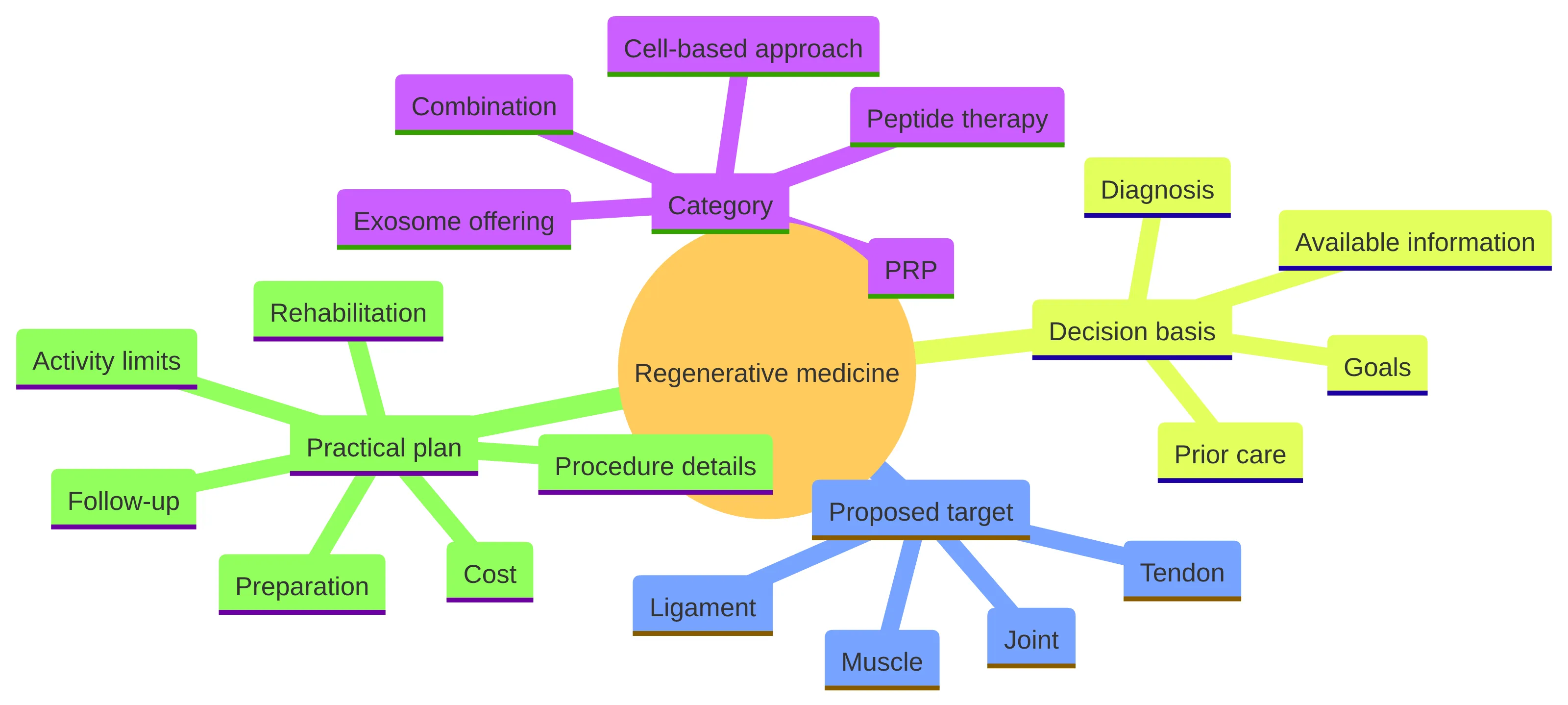
A useful conversation separates four levels:
- The category: PRP, a cell-based approach, an exosome offering, peptide therapy, or a combination.
- The proposed target: the tendon, ligament, muscle, joint, or other structure being discussed.
- The decision basis: the diagnosis, available information, prior care, and your goals.
- The practical plan: preparation, procedure details, activity limits, rehabilitation, follow-up, and cost.
Do not choose from the category name alone. Ask the clinician to connect the proposed treatment to the structure and problem identified in your evaluation.
Match the conversation to the injury being evaluated
The injury under evaluation should determine the treatment conversation. A label such as sports injury covers many different situations, so the same modality should not be treated as a general answer for every athlete or physically active adult.
Start by describing the pattern as precisely as you can. Include when the problem began, whether it followed a specific movement or developed over time, which activity brings it on, and what you can no longer do comfortably. Note whether the problem affects a knee, hip, shoulder, or another body area. Also bring information about prior treatment, rehabilitation, injections, imaging, medications, and changes in training or work demands when those details are available.
The clinician should connect the discussion to the suspected tissue and the level of structural or functional disruption. Ask how the proposed treatment relates to:
- the location and type of tissue involved;
- the severity and duration of the problem;
- your current activity, sport, or work demands;
- the result you want to assess, such as less limitation, improved function, or a clearer plan; and
- what has already been attempted and how you responded.
Your goal does not need to be a promise of returning to a particular sport by a particular date. A more useful goal may be understanding the diagnosis, deciding whether a procedure belongs in the plan, or comparing it with rehabilitation and other care. Keep those goals separate. A treatment can be discussed without being selected, and an evaluation can be useful even when regenerative treatment is not recommended.
Ask for the reasoning in plain language: What is injured? What supports that conclusion? What would this approach be intended to address? What other path would be reasonable? Those questions keep the discussion tied to your situation rather than to the popularity of a modality.
Bring the same level of specificity to your activity goals. “Get back to sports” can mean walking without limitation, returning to recreational running, completing a work shift, or competing at a particular level. The treatment discussion is easier to judge when the goal is concrete and the clinician explains how progress would be assessed.
Use examination and imaging to clarify the problem
A sports-injury evaluation should connect your history and physical findings with the question that needs to be answered. Before discussing a regenerative procedure, ask what the clinician is trying to distinguish: a tendon or ligament problem, a joint-related problem, a soft-tissue injury, a training-related pattern, or another explanation.
Medical imaging can help identify an injury’s severity and location and inform a targeted treatment plan. Imaging is therefore a tool for clarifying the clinical question, not an automatic reason to choose a particular procedure.
Bring any relevant reports and images you already have, but do not assume that an old scan answers a new question. Ask:
- What does the examination suggest?
- What does the imaging show, and what does it leave uncertain?
- Does the finding match the symptoms and activity limitation I described?
- Is more testing needed before treatment is considered?
- Would the proposed treatment address the finding, the symptoms, or both?
A clear answer should also explain what would change the plan. The discussion may shift if the suspected tissue, extent of injury, or activity goal differs from what was initially assumed. You do not need to interpret a scan independently. You do need enough explanation to understand why a treatment is being considered and what alternative conclusions remain possible.
If the diagnosis is still unclear, make clarification the immediate objective. Selecting a modality before the problem is identified reverses the order of the decision.
Imaging also needs to be interpreted alongside your symptoms and examination. A finding on a scan is not, by itself, a complete treatment plan. Ask what part of the finding matters to your limitations and what part does not change the next step.
Read the PRP evidence without turning promise into certainty
PRP has shown promise for some sports injuries, including tendon and ligament injuries. A review also reports effectiveness for tennis elbow, golf elbow, jumper’s knee, and runner’s knee. The second statement is specific to the conditions described in that review; it does not establish that PRP has the same effect across every sports injury.
Use that distinction when you discuss PRP. Ask whether the information being presented concerns the same body area, tissue, diagnosis, severity, and outcome that matter in your case. A result involving one condition should not be silently transferred to another simply because both occur in athletes.
Questions that make the PRP discussion more specific include:
- What diagnosis is the proposed PRP treatment intended to address?
- Which outcome was studied or reported: symptoms, function, tissue findings, or another measure?
- How similar were the people in the information being discussed to my injury and activity level?
- What treatment details affect the comparison, such as preparation, placement, or number of sessions?
- What uncertainty remains about whether the reported findings apply to my situation?
The review’s conclusion also says that further research is needed to optimize PRP protocols and clarify how PRP works in sports injuries. That means the word promise should remain connected to conditions and protocols, not expanded into a guarantee.
A careful PRP discussion should end with a decision boundary: either the clinician can explain why it is a reasonable option to consider for the diagnosed problem, or the discussion should return to another path. Ask what would count as a meaningful change and when the plan would be reassessed. That keeps the proposed treatment connected to an observable purpose rather than a broad expectation.
Keep cell-based approaches in the evidence-and-suitability discussion
Cell-based approaches need the same diagnosis-first discipline as PRP. A review of mesenchymal stem-cell applications for chronic tendon and ligament injuries reports clinical improvement and tissue integrity in published studies, but those findings do not establish suitability for every injury.
Ask the clinician to define the proposed approach before discussing whether it fits. The phrase stem cell treatment can hide meaningful differences in the source of the cells or material, preparation, delivery, treatment target, and follow-up plan. You should be able to understand what is being proposed without relying on the category name alone.
Use these questions:
- Is the discussion about a tendon, ligament, joint, or another structure?
- Does the information involve chronic injuries, and does that match the duration of my problem?
- What outcome would be assessed after treatment?
- What are the known uncertainties for this specific application?
- What alternatives would remain available if the proposed approach is not suitable or does not meet the agreed assessment goal?
The relevant comparison is not cell-based treatment versus doing nothing. It may include rehabilitation, other non-surgical care, monitoring, a different procedure, or surgery when clinically appropriate. Ask for the reasoning behind the comparison rather than treating a biological label as a decision.
If the information applies only indirectly to your injury, keep that limitation visible. A discussion can still be worthwhile, but the degree of uncertainty should influence whether and how you proceed. Ask what part of the proposed approach is supported for your diagnosis and what part depends on an assumption from a different injury or population.
Make uncertainty part of the treatment decision
Treatment uncertainty is a decision factor, not a footnote. For PRP, further research is needed to optimize protocols and clarify how PRP works in sports injuries. A review of mesenchymal stem-cell treatment also says randomized controlled trials are still needed to confirm its potential.
Those two limits concern different approaches. The PRP limitation relates to protocol refinement and how the treatment works in sports injuries. The cell-based limitation concerns the need for randomized controlled trials to confirm potential in the applications discussed. Keep both distinctions visible instead of combining them into a single broad statement about regenerative care.
Ask the clinician to separate three parts of the conversation:
- what is known about the diagnosed injury;
- what is uncertain about the proposed treatment; and
- what decision would follow if the treatment is not selected or does not meet the agreed assessment goal.
A clear explanation should also tell you how uncertainty affects the practical plan. That may include the number of visits, activity changes, rehabilitation, follow-up, or the point at which another option would be reconsidered. Uncertainty does not automatically answer the treatment question in either direction, but it should remain visible when you weigh the choice.
Do not let a biological explanation substitute for a specific discussion of fit. The useful question is not whether a treatment sounds regenerative. It is what the available information supports for the injury being evaluated and what remains unknown.
Compare regenerative care with the full clinical pathway
The full clinical pathway should remain visible when regenerative care is discussed. Rehabilitation, other non-surgical care, monitoring, and surgery or another clinically appropriate option may each have a place depending on the diagnosis, severity, goals, and prior treatment. Keeping those paths in view does not decide which one you need; it prevents a single procedure from becoming the entire comparison.
Ask the clinician to explain the role of each relevant path:
- Rehabilitation: What would a structured rehabilitation plan involve, and what would be monitored?
- Other non-surgical care: What options address symptoms, function, or the suspected cause without a regenerative procedure?
- Monitoring: What would make observation reasonable, and when would the plan be reassessed?
- Regenerative care: What specific problem would the procedure be intended to address, and what uncertainty remains?
- Surgery or another intervention: If this belongs in the discussion, what finding or functional concern makes it relevant?
The comparison should include practical consequences. Ask about time away from activity, rehabilitation requirements, follow-up, and what happens if the intended result is not reached. Those details may matter as much as the treatment label.
At REGEN Orthopedic Medicine, we direct patients to alternative treatments when regenerative treatment is unlikely to help the joint. That business practice supports a boundary: an appointment should be used to decide whether regenerative care fits, not to assume that it will be selected.
Keep the alternatives specific. Ask what each option is intended to address, what participation it requires from you, how progress would be followed, and what would cause the plan to change. A comparison becomes more useful when every path has a purpose and a reassessment point.
Separate routine research from symptoms needing prompt attention
The safety decision comes before the treatment comparison. Routine treatment research is not the right route if your symptoms require prompt or urgent medical attention.
If you believe your symptoms need timely assessment, seek that assessment rather than waiting for a routine consultation or continuing to compare treatment categories.
If your symptoms do not seem urgent, record the onset, activity trigger, location, functional limitation, and changes over time. That information can support a routine evaluation. Do not use temporary symptom improvement as proof that the underlying question has been settled, and do not use the ability to continue an activity as proof that a significant injury is absent.
The boundary is simple: symptoms that require prompt attention belong on a timely clinical route; non-urgent symptoms can be organized for a diagnosis-led discussion. Regenerative treatment should enter the second conversation only after the first boundary has been considered.
When you contact a clinical service, describe what changed, when it changed, and how it affects your ability to use the injured area. That account helps the person directing your care understand why you are seeking attention and whether routine planning is appropriate.
Turn a consultation into a structured comparison
A consultation becomes more useful when you bring questions that require a specific answer. Write them down before the appointment so the discussion covers diagnosis, information for the specific injury, treatment details, recovery, alternatives, follow-up, and cost rather than stopping at a procedure name.
Use this checklist:
- Diagnosis: What structure is injured, and what findings support that conclusion?
- Fit: Why is this modality being considered for this injury rather than another option?
- Information: What information applies to this diagnosis, and what outcomes does it address?
- Procedure: What material or product is used, how is it prepared, and how is it delivered?
- Risks: What procedure-specific risks, side effects, or reasons to change the plan should I understand?
- Recovery: What activity restrictions, rehabilitation, and follow-up are part of the plan?
- Alternatives: What would rehabilitation, other non-surgical care, monitoring, or surgery involve if relevant?
- Assessment: How and when would we decide whether the plan is helping?
- Contingency: What would happen if the expected result is not reached?
For elite athletes, an American Academy of Orthopaedic Surgeons report says physicians should discuss orthobiologics early in treatment when possible. The same report says that without early guidance, athletes may turn to less reliable sources or medical tourism without knowing possible risks and outcomes.
Early discussion does not mean early treatment. It means you can ask informed questions before committing to a plan or looking outside the United States. Keep the answers specific to your injury, and ask the clinician to identify where uncertainty remains.
Bring a written list of prior treatments, changes in training, and questions about follow-up. If the discussion changes from one treatment category to another, update the comparison rather than assuming that the new label answers the original concern.
Clarify practical details before agreeing to treatment
Treatment logistics should be part of the decision before you agree to a procedure. Ask when treatment would occur, what preparation is required, how follow-up is handled, what activity changes are expected, and how the plan would fit your work, training, or competition schedule.
If regenerative treatment is appropriate, we provide options, timing, and cost details. Use that conversation to separate three questions: whether the treatment fits the diagnosis, what the treatment plan involves, and what it will cost. A clear price does not answer the first two questions.
For regenerative treatments, we are a self-pay practice and do not bill insurance. Plan your financial questions around the complete course of care, including the procedure, follow-up, rehabilitation, imaging, and any other services the clinician says are relevant.
Ask for clarity on:
- the number and timing of planned visits;
- what is included in the quoted cost;
- whether follow-up is part of the plan;
- what additional care could be needed;
- what happens if the diagnosis or treatment plan changes; and
- how the practice handles questions after treatment.
Keep payment information separate from treatment information. Cost and convenience help you judge feasibility; they do not establish effectiveness or suitability. You should also understand which logistics are fixed and which may change if the diagnosis, procedure, or follow-up plan changes.
What a physician-led evaluation covers
A physician-led evaluation can organize the diagnosis, treatment options, uncertainty, and practical plan, but it cannot turn a general treatment category into an automatic recommendation. At REGEN Orthopedic Medicine, we provide physician-led, non-surgical regenerative medicine; an evaluation can help determine whether it fits the condition being discussed.
An evaluation can help you understand:
- what the clinician believes is being evaluated;
- which treatment categories may be relevant or irrelevant to that problem;
- what information and uncertainty apply;
- what preparation, recovery, follow-up, and cost would involve; and
- which alternatives should remain under consideration.
An evaluation cannot promise healing, pain relief, a faster recovery, or a return to sport. Keep that boundary in place even when a treatment sounds compatible with your goals.
The useful outcome of the appointment may be a treatment plan, a recommendation for another form of care, a request for more clarification, or a decision to monitor the problem. Each outcome gives you a clearer basis for the next step than selecting a modality from a general list.
Choose the next step without assuming the outcome
The next step is a professional discussion when you need your injury, treatment information, alternatives, and practical choices considered together. Prepare a short symptom timeline, bring relevant reports and images, and use the question list to ask what the proposed treatment would address, what remains uncertain, and what other paths should be considered.
REGEN Orthopedic Medicine offers free consultations for knee, hip, or shoulder pain. Most of our consultations begin as a telehealth call, so you can start without traveling to a clinic.
Use the consultation to reach a clearer decision, not to assume a particular procedure in advance. If regenerative treatment is unlikely to help, remain open to the alternative plan that better fits the findings and your goals. A qualified healthcare professional must decide individual suitability after considering your clinical circumstances.
Questions to ask before discussing regenerative treatment
What types of regenerative medicine treatments are available for sports injuries?
Regenerative medicine treatments for sports injuries include platelet-rich plasma (PRP), stem cell therapy, exosome therapy, peptide therapy, and combination protocols that utilize multiple modalities tailored to the patient’s specific condition.
How can I determine if regenerative medicine is appropriate for my sports injury?
A qualified clinician can evaluate your injury by considering its severity, the specific tissue involved, your activity demands, and prior treatments. This evaluation helps determine if regenerative medicine is a suitable option.
What should I ask during a consultation about regenerative medicine for my sports injury?
Prepare questions about your diagnosis, the proposed treatment’s fit for your injury, potential risks, recovery expectations, and alternative treatment options. This will help ensure a comprehensive discussion.
What is the cost structure for regenerative medicine treatments?
Regenerative treatments at REGEN Orthopedic Medicine are self-pay and do not bill insurance. It’s important to discuss the total costs, including any follow-up care and rehabilitation, during your consultation.
How does imaging play a role in evaluating sports injuries?
Medical imaging helps identify the severity and location of a sports injury, guiding healthcare providers in designing a targeted treatment plan.
Free consultation
Find out whether regenerative treatment is right for you.
Most consultations begin as a telehealth call with a physician specialist, so you can start without travelling to a clinic. No referral needed.