
exosome therapy for pain
Exosome Therapy for Pain: How to Evaluate the Evidence, Safety, and Next Steps

Start with the decision you are actually making
Your first decision is whether a careful clinical discussion is warranted, not whether an injection should be chosen from a treatment description or a persuasive promise. If you have persistent hip, knee, shoulder, or other musculoskeletal pain, start by separating three questions: what may be causing the pain, what outcomes have actually been studied, and whether the proposed product and procedure fit your situation.
Chronic pain deserves attention even when you are exploring a non-surgical option. NCCIH advises you not to use an unproven product or practice to postpone care, and to discuss the product’s safety, use, and likely effectiveness with a health care provider. General information can help you prepare, but it cannot establish that exosome treatment fits your diagnosis.
A responsible evaluation should leave you with clearer questions rather than pressure to commit. You should be able to ask what condition is being treated, why exosomes are being considered, what alternatives exist, what risks apply to the specific product, how the procedure would work, and what the full cost would be.
Use this guide as a decision path:
- Separate proposed biology from measured human outcomes.
- Match the evidence to your condition, product, injection site, and goal.
- Ask about regulatory status, product identity, risks, alternatives, recovery, and cost.
- Decide whether to request an evaluation only after those questions have a place in the conversation.
What exosomes are proposed to do
Exosomes are being studied as biological signaling particles that may participate in communication between cells. A systematic review describes exosome-related signaling in processes connected with bone remodeling, cartilage homeostasis, and inflammatory responses, including processes involved in osteoarthritis.
That description explains why researchers are interested in exosomes. It does not show that an exosome product will relieve your pain, restore cartilage, repair a labral tear, or change the course of arthritis. A biological pathway is a proposed explanation for how a treatment might act; a patient outcome is a measured result after treatment. Those are different levels of evidence.
Use that distinction when you hear language about inflammation, cartilage, or tissue repair. Ask which outcome was measured in human patients, for which condition, with what product, by what route, and over what period. If the answer describes laboratory findings or a proposed mechanism instead of patient results, treat it as background rather than as a treatment promise.
A useful biology question is, “What is this product intended to do?” A useful clinical question is, “What result has this exact product produced in people with my condition?” The first question addresses rationale. The second addresses evidence.
Before you compare treatment claims, ask for the exact product identity and the evidence that applies to that product. Keep the proposed biology in its proper place: it can explain the rationale for studying exosomes, but it cannot answer whether treatment is suitable for your pain.
What the human pain evidence actually covers
Human clinical translation of exosomes in pain management remains in an early stage and has focused primarily on neuropathic pain and low back pain. That scope matters if your concern is hip arthritis, a suspected labral tear, knee cartilage wear, or another joint problem, because findings from one condition cannot automatically be transferred to another.
The useful question is not whether exosomes have ever been studied for pain. The useful question is whether the available human evidence matches all of the following:
- Your suspected diagnosis or confirmed condition.
- The product and source being proposed.
- The injection site and route of administration.
- The outcome you want to change.
- The follow-up period you need in order to judge that outcome.
A study of low back pain may inform a conversation about uncertainty, but it does not establish an answer for hip or knee pain.
A low-back-pain review searched multiple databases for English-language studies published through March 18, 2024, and included only two articles that met its predefined criteria. That narrow result does not make the treatment useless, but it limits how confidently you can generalize the findings.
Study count is only one part of the evaluation. You also need to know whether the studies were designed to measure pain, function, imaging changes, or another outcome; whether follow-up lasted long enough to address your goal; and whether the treatment used in the study resembles the product being discussed with you.
When a claim is presented as evidence for joint pain, ask where the condition-to-condition connection comes from. If the evidence concerns a different body region, different diagnosis, or different product, describe it as related background rather than direct proof for your situation.
Read early findings without turning them into a promise
A review reports that prospective studies found significant improvements in pain scores and functional disability after certain injections of bone-marrow-mesenchymal-stem-cell-derived exosomes, with short-term follow-up of one to three months. The finding is specific: it concerns certain injections, particular study populations, and a short follow-up period.
The result is not a guarantee of pain relief for you. It does not establish durable relief, tissue repair, avoidance of surgery, or suitability for every hip, knee, shoulder, or back condition. It also does not tell you whether a different source, preparation, dose, injection route, or follow-up schedule would produce the same result.
Before treating an early result as a forecast, ask:
- What did the study measure, and how was it measured?
- How many people were studied, and what condition did they have?
- How closely does the study treatment match the product and procedure being proposed?
- Was the follow-up long enough to answer your question?
- What happened to people whose symptoms did not improve?
A registered trial of intradiscal peripheral-blood-derived exosomes had been completed, but its specific data had not yet been publicly released. A completed trial is not the same as a publicly demonstrated treatment benefit. Until the relevant findings are available and can be examined, you cannot use that trial as proof of an outcome.
Ask any practice discussing exosomes with you to distinguish published human results from registered studies, proposed mechanisms, laboratory findings, and marketing language. Each category answers a different question. Registration may show that a study was planned or conducted; it does not by itself show that the treatment worked or that the findings apply to you.
A separate review reported that exosome administration was safe and potentially effective for low back pain based on the studies that met its inclusion criteria. The wording matters: the conclusion applies to the included low-back-pain studies, not automatically to every product, every condition, or every person.
Use early findings as a reason to ask better questions, not as a reason to skip evaluation. A realistic conversation should cover what the evidence measured, what it did not measure, how long participants were followed, and what uncertainty remains after those results. No study result can promise that your pain will improve, that a damaged structure will repair, or that surgery will not later become part of your choices.
Treat the product and regulatory pathway as part of the treatment question
The proposed product is part of the treatment, so product identity deserves the same attention as the injection site. Ask what the product is called, where it comes from, how it is processed and stored, how its contents are characterized, and whether the clinical evidence involves that same product. You should also ask who handles it and what information you will receive about the procedure.
Write down the answers. A product name alone may not answer questions about source, preparation, handling, or the evidence supporting the proposed use.
Two answers can sound similar while supporting different decisions. A general statement that a product is regenerative does not identify its source, preparation, or the evidence that applies. The useful record therefore keeps those items separate: product name; source and handling information supplied by the practice; condition and route studied; and the outcome measured. If one item is unavailable, mark that as an unanswered question rather than filling the gap with a general claim. The purpose is not to make a regulatory judgment from an article. It is to make the proposed use specific enough for a qualified discussion and to notice where the available information does not connect the product to the condition or outcome under consideration.
In the United States, the FDA regulates regenerative medicine products, including exosomes. Before you proceed, ask what regulatory pathway applies to the proposed product and what the treatment is authorized or approved to do.
Do not treat a product’s availability for purchase or its description as proof that it suits the condition being discussed. Ask for a plain explanation of the product’s regulatory status, the condition it is intended to address, and the evidence supporting the specific use being discussed.
A complete answer should connect four things: the product, the intended condition, the claimed purpose, and the applicable regulatory pathway. If those parts are discussed separately, ask how they fit together before making a decision.
Put safety uncertainty ahead of enthusiasm
The FDA says it has received reports of blindness, tumor formation, infections, and other problems associated with unapproved regenerative medicine products, including exosomes. They do establish why product identity, regulatory status, informed consent, and follow-up should be direct parts of your discussion.
Ask which risks are known for the specific product and procedure, which risks are uncertain, how complications would be recognized, and who would manage follow-up. Ask whether your medicines, medical history, prior procedures, or the suspected cause of your pain change the assessment. Do not accept a general statement about regenerative medicine as a substitute for product-specific answers. Treat the FDA material as a reason to demand specificity, not as a substitute for it. There are two separate questions to record: what the FDA has reported in connection with unapproved regenerative medicine products, and what the clinician can explain about the exact product, procedure, and follow-up being proposed. The first question explains why caution is warranted; the second must be answered before you can judge whether the discussion is sufficiently informed.
You can use the answers to set a practical pause point. If the product cannot be identified clearly, its regulatory pathway is not explained, or the response to a possible complication is vague, do not convert that uncertainty into an assumption that treatment is appropriate. Ask for clarification and keep other care options open. Investigating an option should not replace attention to the condition causing your pain or delay a needed conversation with a health care provider. The goal of the safety checklist is not to label a product from a distance. It is to make the proposed intervention specific enough that its known risks, unanswered questions, and follow-up responsibilities can be discussed before consent.
The FDA asks health care professionals and consumers to report adverse events related to exosome products or other unapproved products through MedWatch. You should know how an adverse event would be documented and who would respond if a problem occurred.
NCCIH also advises you not to use an unproven product or practice to postpone care for chronic pain. Discuss the proposed treatment’s safety, use, and likely effectiveness with a health care provider before making a decision. A calm evaluation is more useful than a promise that leaves those questions unanswered.
You can make safety the first checkpoint rather than the last question. If you cannot get a clear explanation of the product, its regulatory status, known risks, possible complications, and follow-up plan, pause the treatment decision and seek clarification.
Build the clinical-fit record before discussing an injection
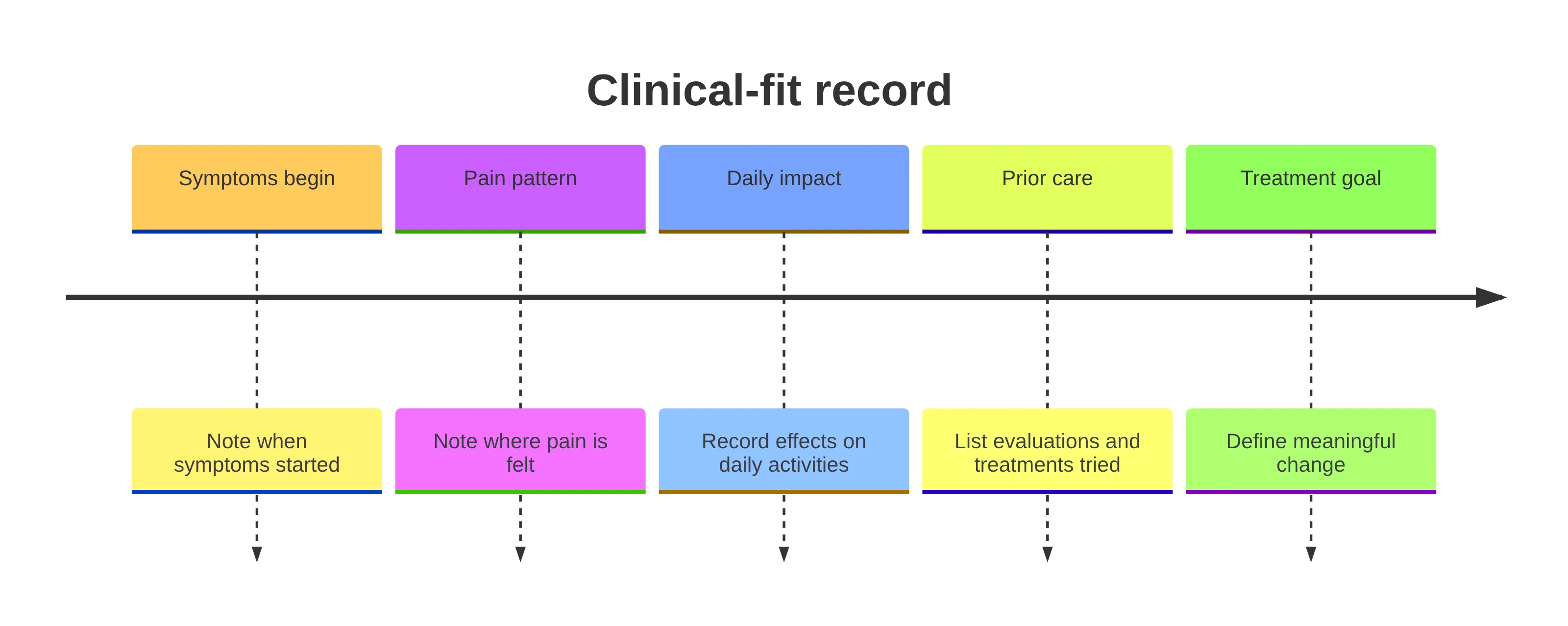
Your clinical-fit record should explain the pain problem before it addresses a treatment choice. Bring a short account of when the pain began, what activities change it, how it affects sleep or function, what care you have already tried, and what outcome you want to discuss. Include relevant imaging reports, procedure records, and medication information that you already have.
Organize the information into a short timeline:
- When symptoms started and whether the onset followed an injury or gradual change.
- Where you feel the pain and which movements or activities affect it.
- How symptoms affect walking, work, exercise, sleep, or other daily activities.
- What evaluations, medications, therapy, or procedures you have already tried.
- What you want to improve and how you would recognize meaningful change.
Ask how the diagnosis was established and what other explanations remain possible. Ask why exosomes are being considered for that diagnosis rather than for pain in general. Ask what outcome would count as meaningful improvement, when it would be assessed, and what would happen if the expected change did not occur.
A clinical-fit record is also a way to keep the consultation from starting with a product name. The same pain description can lead to different questions about diagnosis, goals, and alternatives, so the record should be factual and personal rather than a conclusion about eligibility. It can show what you want clarified without asserting that exosomes are indicated. Keep the desired outcome concrete enough to discuss, such as a change in pain or function, while recognizing that the article cannot set a threshold for meaningful improvement for you. The clinician can then explain which parts of the history, examination, imaging, or prior care affect the discussion. This preserves the boundary between preparing for care and choosing care.
NCCIH advises people with chronic pain to discuss a complementary product or practice with their health care providers, including its safety, use, and likely effectiveness. Use that advice as a practical standard for the conversation.
A useful clinical-fit conversation should answer these questions:
- What diagnosis is being considered, and what findings support it?
- What other explanations should be considered before selecting an injection?
- What is the proposed treatment intended to change: pain, function, inflammation, or another outcome?
- What evidence applies to this condition and this product?
- What alternatives should be considered before an injection?
- What risks, uncertainties, and follow-up requirements apply to the proposed procedure?
- When will the result be assessed, and what is the plan if the desired change does not occur?
You are not trying to select a treatment from a general article. You are trying to understand the reasoning that connects your condition, your goals, and the proposed option. If the discussion cannot make that connection, keep the gap open rather than filling it with a general treatment claim.
Use a pre-visit due-diligence checklist
Your pre-visit checklist should turn broad interest into specific questions you can ask and record. Use it before the appointment and take notes during the discussion. For each answer, mark whether it is supported by written information, explained during the conversation, or still unanswered. This simple record helps you distinguish a specific response about the proposed product and procedure from a broad description of regenerative medicine. It also gives you a clear list of points to revisit before deciding whether the evaluation has answered your main questions.
Diagnosis and rationale
- What condition is being treated?
- What examination, imaging, or history supports that diagnosis?
- Why are exosomes being considered for this condition?
- What result is the treatment intended to change, and how will that result be measured?
Evidence and uncertainty
- Which human studies apply to this condition and proposed procedure?
- Were those studies performed with the same type of product and route of administration?
- How long were participants followed?
- Which outcomes were measured, and which outcomes remain uncertain?
- What result cannot reasonably be promised?
Product and regulatory status
-
What is the exact product being proposed?
-
What is its source, and how is it processed, stored, and characterized?
-
What regulatory status applies to this product and this intended use?
-
What written information will you receive before consenting?
A systematic review also describes unresolved technical issues involving standardization and production in exosome translation. That context makes product-specific answers more useful than a broad statement that exosomes are a regenerative treatment.
Risks and procedure
- What risks are associated with this product and injection site?
- What symptoms should prompt a call after treatment?
- Who provides follow-up, and for how long?
- What activity restrictions or recovery expectations apply?
- What happens if the intended improvement does not occur?
Alternatives and cost
- What non-injection options should be considered?
- What other procedures or treatments might address the same goal?
- What are the relevant benefits, limitations, and risks of each alternative?
- What is the complete self-pay cost, including consultation, product, procedure, follow-up, and any additional care?
- What payment or insurance assumptions should you avoid making?
NCCIH advises you to discuss safety, use, and likely effectiveness with a health care provider and not to postpone care with an unproven product. If an answer is unclear, write down the uncertainty and ask for clarification before deciding.
A checklist is a conversation tool. It does not establish eligibility, compare treatments on its own, or replace an individual clinical assessment.
Separate the practice’s offering from independent evidence
REGEN Orthopedic Medicine offers stem cell therapy, exosome therapy, peptide therapy, and combination protocols for knee, hip, and shoulder care in its Ohio and Chicago practice context; this does not establish that any one option is suitable for your condition or that it will produce a particular result.
A service offering and independent clinical evidence answer different questions. The evidence and your clinical evaluation must address whether the proposed treatment matches your diagnosis, goals, risks, and alternatives. Keep those questions separate when you review any practice’s information.
REGEN Orthopedic Medicine provides honest assessments and directs you to alternative treatments when regenerative treatment is unlikely to help your joint. That position gives you a question to ask during an evaluation: if the proposed option does not appear to fit, what alternatives would you discuss instead?
You do not need to treat a consultation as a commitment to an injection. Use it to ask for the reasoning behind the recommendation, the limits of the available information, and the alternatives that remain open. An offering is a starting point for a conversation, not evidence that a treatment is right for you.
Know what an evaluation can clarify before you commit
An evaluation can organize the decision around your condition, your goals, and the treatment options being discussed. If regenerative treatment is appropriate, we provide options, timing, and cost details.
Those details can help you compare the proposed path with alternatives before you commit. They do not guarantee pain relief, tissue repair, long-lasting results, avoidance of surgery, or any other specific outcome. Use the appointment to identify what is known, what is uncertain, and what decision remains yours after the discussion.
A useful evaluation should clarify at least four points:
- Whether the proposed treatment is connected to the condition being assessed.
- What outcome is being pursued and how it will be judged.
- Which alternatives remain available and how their tradeoffs differ.
- What the process, follow-up, timing, and total financial commitment involve.
REGEN Orthopedic Medicine is a self-pay practice and does not bill insurance for regenerative treatments. Ask for the complete amount before proceeding and ask which services, follow-up visits, or additional care are included.
Cost should be considered alongside diagnosis, evidence, risks, recovery, and alternatives. A lower or higher price cannot establish medical suitability or treatment effectiveness. The useful financial question is whether you understand the total self-pay commitment well enough to compare it with the other paths discussed.
NCCIH advises you to discuss a product’s safety, use, and likely effectiveness with a health care provider and not to use an unproven product to postpone chronic-pain care. Carry that boundary into the appointment: an evaluation should improve your understanding of the decision, not pressure you to treat before your questions have been answered.
A cautious next action for Ohio and Chicago readers
Your next action can be a prepared clinical conversation rather than a treatment commitment. Gather your symptom timeline, relevant records, prior imaging, current medications, and the checklist questions about diagnosis, evidence, product status, risks, alternatives, recovery, and total cost.
We offer free consultations to discuss knee, hip, or shoulder pain. If you are near Ohio or Chicago and want to discuss whether an evaluation is appropriate, bring your questions and keep the decision contingent on the clinical discussion.
A qualified health care professional must decide whether a proposed treatment is suitable for your individual condition. General information cannot make that decision for you, and no evaluation can promise a particular outcome.
Questions readers may still have about exosome therapy for pain
What is exosome therapy and how is it proposed to help with pain?
Exosome therapy involves using biological signaling particles that may facilitate communication between cells. Researchers are studying their potential role in processes related to bone remodeling and inflammation, which are relevant to conditions like osteoarthritis. However, this does not guarantee that exosome products will relieve pain or repair tissue.
What should I consider regarding the safety of exosome therapy?
The FDA has reported adverse events associated with unapproved regenerative medicine products, including exosomes. It’s important to ask about the specific risks related to the product being proposed, how complications would be managed, and what follow-up care is available.
What questions should I ask during a consultation about exosome therapy?
Prepare questions about your diagnosis, the rationale for using exosomes, the evidence supporting their use for your condition, potential risks, alternatives, and the total cost of treatment.
How does REGEN Orthopedic Medicine approach evaluations for exosome therapy?
REGEN Orthopedic Medicine provides honest assessments and will direct patients to alternative treatments if regenerative therapy is unlikely to help. They offer free consultations to discuss options, timing, and costs.
What is the regulatory status of exosome products in the United States?
The FDA regulates regenerative medicine products, including exosomes, which require licensure or approval to be marketed for treating diseases. It’s essential to understand the regulatory pathway for any proposed product.
Are there any limitations to the current evidence on exosome therapy for pain?
Clinical translation of exosomes in pain management is still in early stages, primarily focusing on specific conditions like neuropathic pain and low back pain. The evidence may not directly apply to other conditions such as hip or knee pain.
What should I know about the costs associated with exosome therapy?
REGEN Orthopedic Medicine operates as a self-pay practice and does not bill insurance for regenerative treatments. It’s important to inquire about the total costs involved, including consultations, procedures, and follow-up care.
Free consultation
Find out whether regenerative treatment is right for you.
Most consultations begin as a telehealth call with a physician specialist, so you can start without travelling to a clinic. No referral needed.