
knee pain going up stairs treatment
Knee Pain When Going Up Stairs: How to Choose Your Next Step

Start with what stair ascent can—and cannot—tell you
Knee pain when going up stairs is a symptom pattern, not a diagnosis. Stair ascent makes your knee bear weight while bent, so pain during that movement can bring several knee problems to the surface. A physical therapist can help with knee strength, flexibility, and stair technique..
That distinction matters whether the stairs are in a Chicago walk-up, an Ohio workplace, or your home. Pain during the climb gives you useful information to describe, but it does not tell you to start a particular treatment. Use the pattern to organize what you notice, check whether any warning signs change the timeline, and decide whether monitoring or an evaluation makes more sense.
The direct answer is simple: knee pain on stair ascent deserves context before it receives a label. Front-of-knee pain during a bent, weight-bearing movement can fit patellofemoral pain, but clinicians generally consider that diagnosis after other causes have been excluded. A symptom description can guide the questions you bring to an appointment; it cannot replace an examination.
Start by recording what the pain feels like, where it sits, when it began, and whether the knee functions normally between stair episodes. Then separate a mild, stable pattern from pain accompanied by swelling, instability, locking, or difficulty bearing weight. That separation provides a safer next-step decision than assuming that every painful climb reflects cartilage wear or that every painful climb needs the same treatment.
Read the location and movement pattern without treating it as proof
Front-of-knee pain during stair ascent can fit more than one patellofemoral pattern. Patellofemoral pain syndrome can cause pain around the front of the knee when the bent knee bears weight, including during stair climbing or squatting. The same clinical description does not prove that you have that syndrome, because clinicians generally treat it as a diagnosis of exclusion after other joint and soft-tissue causes have been considered.
Pain location can still improve the history you give a clinician. Describe whether the discomfort is directly behind or around the kneecap, along the joint line, on the inner or outer side, or difficult to localize. Also describe whether the pain feels sharp, aching, burning, or like pressure. Those descriptions do not diagnose the problem, but they help distinguish the experience of stair ascent from a general statement that your knee hurts.
Knee osteoarthritis more broadly involves cartilage wearing down over time and may cause inflammation, pain, stiffness, and swelling that make everyday activities harder. These descriptions can overlap with other causes, so a stair-specific pattern should remain a clue rather than a conclusion.
Clinical estimates for patellofemoral pain syndrome in the United States have been reported between 3% and 6%. That figure describes incidence in a population; it does not calculate your personal likelihood from a single symptom. Your age, activity changes, injury history, examination findings, and other symptoms still matter.
A useful comparison is whether the symptom appears only when you climb or also when you squat, rise from a chair, sit with the knee bent, walk on level ground, or run. Pain limited to stairs or chair rising can occur with a patellofemoral problem, including isolated patellofemoral arthritis. Pain during several bent-knee activities may also fit patellofemoral pain. Neither pattern is specific enough to settle the question on its own.
Use the comparison to make your account more precise. Do not use it as a home test that confirms arthritis, a cartilage problem, or a particular syndrome.
Keep the possible causes in broad categories
Knee pain when you climb stairs can belong to several broad categories, and keeping those categories open prevents the symptom from doing too much diagnostic work. The practical question is not which label sounds most familiar. The practical question is which features should you record and which features should move you toward an evaluation.
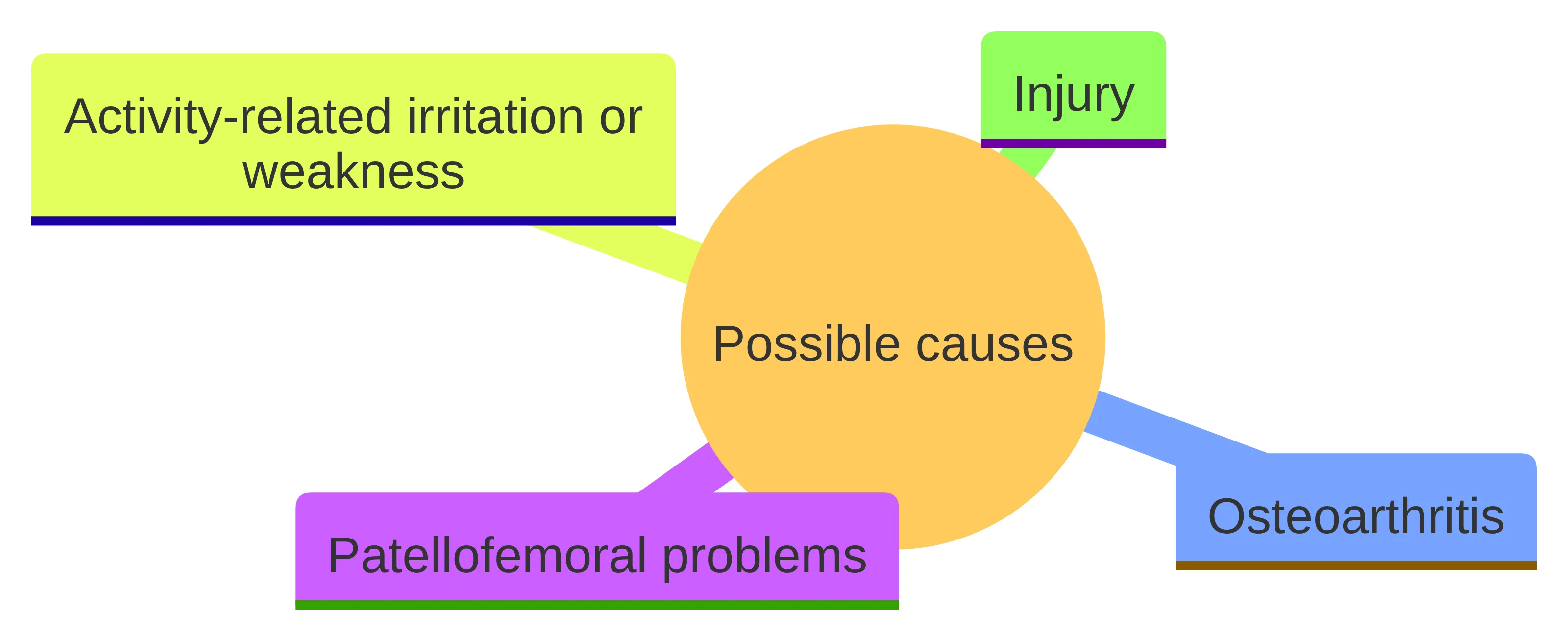
Possible categories include:
- Patellofemoral problems. Patellofemoral pain can produce front-of-knee pain when a bent knee bears weight. Patellofemoral arthritis can produce a similar location and may become noticeable during stairs or when standing from a chair.
- Osteoarthritis. Knee osteoarthritis involves cartilage wearing down over time and may bring pain, stiffness, swelling, or inflammation that affects everyday activities. A stair symptom does not establish that osteoarthritis is present.
- Activity-related irritation or weakness. Patellofemoral pain can be associated with running or jumping overuse, a sudden increase in activity, muscle imbalance or weakness around the hip and knee, or changes in how the knee moves during activity.
- Injury. A kneecap injury, cartilage injury, meniscal problem, ligament injury, or fracture can require a different route from a gradual activity-related pattern. The timing of swelling and the ability to bear weight help determine how promptly you should seek professional advice.
The activity category deserves a careful history. Tell a clinician if you recently added running, jumping, sports practice, hill walking, repeated stair use, or another demanding activity. Also mention whether the pain followed a twist, fall, direct blow, awkward landing, or sudden change in load. A connection with activity can be useful context, but it does not prove that overuse or weakness is the cause.
The injury category deserves the same caution. Pain that starts after an event and is accompanied by swelling or a change in function should not be managed as ordinary exercise soreness without considering an evaluation. Keep the categories broad until the examination clarifies which questions matter most.
Use onset and associated symptoms to change the route
The timing of knee pain and swelling changes how seriously to treat the pattern. A gradual ache that appears only during a particular movement is different from pain that begins suddenly after an injury, especially when the knee cannot function normally. Timing does not diagnose the problem, but it can determine whether monitoring remains reasonable.
- Pain and swelling that develop over many hours may indicate a meniscal or cartilage injury. Record when the symptoms appeared and whether function changed as swelling developed.
- Instability, giving way, popping, or grinding can be associated with cartilage or meniscus tears. These symptoms deserve more than a conclusion based on pain location alone.
- Locking, meaning the knee cannot fully straighten, is described in the clinical material as almost always due to torn cartilage. Do not treat a knee that cannot fully straighten as an ordinary stair-climbing annoyance.
A prompt professional assessment may help minimize or prevent further injury when a patellofemoral joint problem is involved. The same timing and function questions also help separate a possible injury pathway from a gradual pattern. If your knee has changed suddenly, cannot move through its usual range, or gives way, choose prompt professional advice instead of waiting for the stair symptom to explain itself.
Check whether the symptom is isolated to stairs
The activities that reproduce knee pain help you describe the pattern without proving its cause. Stair ascent is one useful detail, but the difference between climbing and other movements can make your account more specific. Note whether the pain also appears during squatting, standing from a chair, sitting with your knee bent, level walking, running, or stair descent.
Ask yourself a few focused questions:
- Does the pain begin with the first step up, after several stairs, or only near the top?
- Does climbing hurt more than descending, or do both directions cause symptoms?
- Does the pain stop when you reach level ground, or does it continue afterward?
- Does standing from a chair reproduce the same front-of-knee pain?
- Can you walk on level ground and perform ordinary activities without pain?
- Did the pattern begin after a new workout, sports activity, fall, twist, or direct impact?
These answers can show whether the symptom is tightly tied to a bent, weight-bearing movement or is part of a wider change in knee function. Record the answers rather than using them to assign yourself a diagnosis.
Front-of-knee pain with stair climbing or squatting can occur with patellofemoral pain, while front-of-knee pain during stairs or chair rising can occur with isolated patellofemoral arthritis even when level walking or running does not hurt. Those overlapping patterns explain why the comparison is useful for an appointment but insufficient for treatment selection. Let the activity record improve the clinical conversation, not replace it.
While deciding, reduce aggravation without prescribing a personal program
Temporary symptom management should make your next decision easier, not turn a generic exercise list into your personal program. While you are deciding what to do, avoid repeatedly using painful stair climbs as a test. Choose movement you tolerate and reduce the particular activity that clearly aggravates the knee rather than forcing yourself through repeated painful repetitions.
A mild symptom pattern without warning signs can be observed while you record changes. A worsening pattern, new swelling, loss of function, or uncertainty about what is happening should move you toward professional advice. There is no need to turn self-care into a commitment to a fixed exercise plan before you know whether the plan fits your knee.
General symptom management has a narrow purpose: reduce repeated aggravation while you gather information and decide whether an evaluation is appropriate. Reducing an activity that clearly worsens the symptom is different from deciding that the activity is permanently harmful. Likewise, feeling better during one activity does not identify the cause of the pain, and discomfort during another does not by itself prove an injury. Treat your response as information about what to report, not as a home diagnostic test. If the pattern changes, especially through new swelling, instability, loss of movement, or reduced ability to use the knee, update the next-step decision rather than simply increasing or changing exercises on your own.
When osteoarthritis is part of the clinical picture, guidance recommends several types of exercise, including aerobic, strengthening, neuromuscular, and aquatic exercise. Supervised exercise may be more effective, so working with a physical therapist may be worth considering. This is a category of care, not a prescription for a particular routine.
The examples described in clinical exercise guidance include hip flexor stretches, straight leg raises, and hamstring stretches, depending on where the pain is felt. Those examples do not establish that any one exercise is suitable for you. Your pain pattern, range of motion, recent injury, and other findings affect what should be attempted.
Online knee self-help information is not a substitute for professional help, and exercises may not suit everyone. Treat an online list as general information rather than as an individualized rehabilitation plan. If you have concerns or problems while trying to manage the symptom, seek professional advice instead of adding more exercises or increasing the difficulty on your own.
Choose between watching and arranging an evaluation
Monitoring is the limited option for a mild, stable stair pattern without concerning features. You can note the symptoms, avoid repeatedly provoking them, and watch whether the knee remains functional during ordinary activities. Monitoring does not mean deciding that the cause is harmless; it means keeping the pattern under observation while you decide whether it is changing.
Arrange an evaluation when the symptom persists, becomes more frequent or intense, limits ordinary function, or leaves you uncertain about the cause. Persistent stair pain can have several explanations, and the symptom alone cannot identify which treatment would fit. The absence of a warning sign does not require you to keep waiting if the problem continues to affect your activities.
Because no fixed duration threshold is supplied here, use persistence, change, and function as practical monitoring checkpoints rather than relying on a particular number of days. Note how often the symptom appears, whether the painful activity is expanding beyond stairs, and whether the knee remains usable for ordinary tasks. If the pattern stays mild and stable, those observations can support a measured decision to continue monitoring. If it becomes more frequent, more limiting, or harder to explain, the same record supports arranging an evaluation. This gives monitoring an exit condition: it is a temporary way to observe change, not a conclusion that the knee is normal or that a particular cause has been ruled out.
Use this route comparison:
- Monitor for now when the pain is mild, tied to stairs, and not accompanied by swelling, giving way, locking, difficulty bearing weight, or a meaningful loss of movement. Record the pattern and change the route if any of those features appear.
- Arrange an evaluation when the symptom keeps returning, begins to limit walking or other ordinary activities, changes without a clear explanation, or remains difficult to interpret. Bring the stair-specific account rather than choosing a treatment from the symptom alone.
- Seek prompt professional advice when injury signals or mechanical changes appear. Prompt attention may help minimize or prevent further injury in patellofemoral joint problems.
This approach avoids two opposite errors: treating every stair symptom as an emergency, or assuming that a symptom without dramatic swelling never deserves an evaluation.
Use prompt professional advice when function or injury signals change
Knee pain with a mechanical or injury-related change belongs on a prompt-advice route rather than a watch-and-wait route. The route depends on a change in function or an injury-related event, not simply on pain intensity.
If a warning sign changes your knee’s function, do not keep climbing stairs to see whether the symptom settles or use a home exercise list to work around the change. Choose prompt professional advice and describe exactly when the change began.
This is general routing information, not an exhaustive urgent-care checklist. The supplied symptom descriptions can suggest that professional attention is important, but they cannot establish urgency or account for every possible problem through an article. If a change is severe, rapidly worsening, or difficult to interpret, contact a qualified clinician or follow applicable local clinical or emergency guidance rather than relying on this article alone. Do not treat the absence of one listed feature as proof that evaluation is unnecessary.
Bring a stair-specific account to the appointment
A stair-specific account gives a clinician a clearer starting point than the statement that your knee hurts. Since several conditions can produce pain during stair ascent, write down the pattern before the appointment. Include what happens during the movement and what happens afterward.
Bring these details:
- Direction: Record whether going up, going down, or both directions cause pain.
- Location: Note whether pain is at the front of the knee, around the kneecap, along the joint line, on the inner or outer side, or hard to localize.
- Onset: Write when the symptom began and whether it followed a fall, twist, impact, new sport, running increase, jumping, or heavier stair use.
- Timing: Note whether pain starts with the first step, builds during the climb, or appears later. Record whether swelling begins immediately or over several hours.
- Other triggers: Include squatting, standing from a chair, sitting with the knee bent, level walking, running, and other movements that reproduce the symptom.
- Function: Record giving way, instability, popping, grinding, locking, difficulty bending, difficulty straightening, or difficulty bearing weight.
- Change over time: Note whether the pattern is improving, stable, spreading to more activities, or limiting ordinary movement.
- Prior care: List treatments, exercises, medicines, procedures, or activity changes you have already tried and what happened afterward.
Do not edit the account to make it fit a familiar diagnosis. A front-of-knee symptom may occur during stairs or chair rising, while injury-related swelling, instability, or locking can point toward a different evaluation path. The value of the checklist is its detail: it lets you report the full pattern without claiming that the pattern proves a cause.
If the knee changes before the appointment, update the account. A new inability to fully straighten, new difficulty bearing weight, or new swelling changes the route from routine planning to prompt professional advice.
To make the account easier to use, separate observations from conclusions. Write “pain starts after several steps and is gone on level ground” rather than “stairs damaged my cartilage.” Write “swelling appeared over several hours” rather than naming a tear. Include what you can still do, not only what hurts: level walking, standing from a chair, bending, straightening, and bearing weight. This gives a clinician a functional comparison without asking you to interpret it. Also note the change that matters most to you, such as reaching a work area, using stairs at home, exercising, or completing ordinary household tasks. A detailed description of the change supports a more focused conversation while preserving the necessary boundary: the account describes the problem, but the evaluation determines which explanation and treatment discussion fit.
Let the examination determine which treatment discussion fits
Knee treatment choices make more sense after the clinical question is clearer. A stair symptom can point toward several categories, but it cannot tell you whether the relevant issue is patellofemoral pain, osteoarthritis, an injury, activity-related irritation, or another problem. The findings from an evaluation, along with your goals and daily demands, should shape the treatment discussion rather than the keyword you used to describe the pain.
There is no single best treatment for everyone with knee osteoarthritis. Treatment choices should account for potential benefits and risks as well as your values, goals, and lifestyle. A treatment that fits someone who wants to return to running may not fit someone whose main goal is comfortable work, household activity, or stair access.
Think of the evaluation as a sorting step rather than a search for one keyword. The history describes whether the problem is linked to a new activity load, an injury, bent-knee movements, or ordinary function. The clinician can consider those details alongside location, swelling, instability, locking, and movement limits. Each detail changes the questions that deserve attention, even when none identifies a diagnosis alone. This prevents a treatment category from being selected simply because its name appears in a search result. It also keeps the discussion open when more than one explanation remains plausible. The useful outcome is a clearer account of what may be contributing, what function needs support, and which options’ potential benefits and risks should be compared. If the findings do not support a particular treatment, that is a reason to continue clarifying the clinical question rather than assuming that the option failed or that surgery is automatically the next step.
A conservative discussion may include exercise categories and rehabilitation support. For osteoarthritis, guidance recommends aerobic, strengthening, neuromuscular, and aquatic exercise. Supervised exercise may be more effective, and a physical therapist can help with strength, flexibility, and stair technique. The relevant program depends on the findings and on how your knee responds; a general list of exercises is not a personal plan.
A clinician may also discuss symptom-directed medication when appropriate. Medication is one of the options identified for knee osteoarthritis, but your health history, other medicines, and individual risks affect whether a particular option belongs in the discussion. Do not choose medication from a stair symptom alone.
An injection may also be part of a clinician’s discussion. Whether it fits depends on the cause identified through evaluation, examination findings, your goals, and an individualized discussion of potential benefits and risks. Compare that option with rehabilitation, medication, and—when relevant—surgery rather than choosing it from the stair symptom alone.
If osteoarthritis worsens substantially, joint surgery can become part of the treatment discussion. That does not make surgery an automatic endpoint for stair pain. The relevant comparison depends on symptoms, function, likely benefits, potential risks, personal goals, and lifestyle. A clinician should explain how the findings support each option and what question each treatment is intended to address.
Use these questions to keep the conversation specific:
- What possible problem is this treatment intended to address?
- Is the goal symptom reduction, improved function, rehabilitation, or another defined outcome?
- What benefits and risks matter for my activities and health history?
- What would make you change the plan?
- How does this option compare with supervised exercise, physical therapy, medication, or surgery when those categories are relevant?
The direct action is to let the clinical findings establish the comparison before you select a treatment. Do not let the phrase “knee pain going up stairs” become a treatment recommendation by itself.
These questions are not interchangeable; each protects against a different shortcut. Asking what problem an option addresses prevents the phrase “knee pain going up stairs” from being treated as an indication for treatment. Asking about the goal separates symptom reduction from support for a specific function and keeps a hoped-for improvement from being mistaken for reversal of the underlying condition. When osteoarthritis is part of the assessment, this distinction matters because the cited guidance describes treatment as symptom-focused and does not identify a therapy that stops or reverses it.
Asking about alternatives turns the visit into a comparison rather than a search for the most familiar treatment name. It gives the clinician an opportunity to explain why supervised exercise, physical therapy, medication, an injection, or surgery may or may not fit the findings. Asking what would change the plan acknowledges that the initial explanation may remain uncertain and makes the next decision easier to understand.
This framework is especially useful if an injection is mentioned. Treat its mention as the start of a discussion, not as a recommendation for everyone with stair pain. Ask which clinical finding makes it relevant, what problem it is intended to address, and how it compares with other options when those are appropriate. Suitability depends on the confirmed cause, examination findings, your goals, and an individualized discussion of potential benefits and risks. If the cause is not yet clear, ask what remains uncertain before treating the procedure as the next step. The purpose of the visit is to connect the findings and your functional priorities to a treatment discussion, not to choose a procedure from the symptom label alone.
Keep expectations realistic about osteoarthritis and treatment choices
Osteoarthritis treatment focuses on symptom reduction because no therapy has been identified in the cited clinical guidance that can stop or reverse osteoarthritis. Options mentioned for knee osteoarthritis include exercise, weight management, medication, and joint surgery if the condition worsens substantially. These categories describe possible discussions, not a promise that any option will relieve your pain or change the joint in a particular way.
This distinction helps separate two questions. The first is whether you can move through daily activities with less difficulty. The second is what is happening in the joint itself. Improvement in symptoms would not by itself prove that cartilage has been restored, and persistent symptoms would not by themselves prove that surgery is required.
Before an appointment, describe the function you want to preserve in concrete terms: climbing the stairs at home, completing work, walking a chosen distance, exercising, sleeping, or taking part in another ordinary activity. A specific example gives the clinician a clearer outcome to discuss than a general request to fix the knee.
Also note what has changed since the symptom began and what you have already tried. Bring that record to the visit, but do not turn it into a conclusion about the cause. The purpose is to connect the evaluation to the function that matters to you while leaving the treatment choice open until the findings are clearer. If more than one activity matters, list them separately so the discussion can address how the knee affects daily life rather than focusing only on the stair symptom.
If osteoarthritis is involved, treatment can be symptom-focused without being a guarantee of disease reversal. If the cause is something else, the relevant options may differ. Keep the diagnosis question separate from the treatment question until an evaluation provides enough information to discuss both.
Treat one stair study as context, not a personal forecast
A 24-month observational analysis examined stair-climbing volume and cartilage progression. Participants with low-volume stair climbing served as the reference group. After adjustment for factors including body mass index, sex, and age, middle-volume stair climbing was associated with an odds ratio of 3.217 for surface cartilage progression and 3.068 for any cartilage progression compared with the low-volume group. Both results were statistically significant.
The reported 95% confidence interval was 1.105–9.368 for surface cartilage progression and 1.230–7.652 for any cartilage progression. The intervals show the range reported around those associations; they do not convert the findings into a personal prediction for you.
The study also reported that results for patellofemoral thickness with middle-volume stair climbing and cartilage with high-volume stair climbing were not statistically significant. That detail matters because the findings were not uniform across every stair-volume comparison or every cartilage measure.
Most importantly, an observational association does not establish that stair climbing caused cartilage progression, and it does not show that your stair pain reflects cartilage progression. The analysis compared groups over time; it did not examine your knee, determine why your pain occurs, or forecast how your symptoms will change. Do not use the numbers as a reason to stop all stair use, and do not use them as proof that stairs are damaging your knee.
Use the study for context rather than for a treatment decision. If stairs hurt, describe the pain, timing, location, swelling, and function. If your activity changed before the symptoms began, record that change. If your knee gives way, locks, swells, or becomes difficult to load, follow the prompt-advice route rather than trying to interpret the study.
The practical boundary is clear: population-level cartilage findings cannot identify the cause of an individual stair symptom. An evaluation is the route for deciding whether your pattern fits a rehabilitation discussion, symptom-focused care, another treatment category, or a need for further assessment.
Make the next step match the pattern
Knee pain when going up stairs calls for a route that matches the pattern, not an automatic diagnosis. Seek prompt professional advice when pain and swelling begin with difficulty bending or bearing weight, when the knee locks, or when instability and other mechanical changes alter function. Arrange an evaluation when the symptom persists, limits ordinary activities, or remains unclear. Monitor a mild stair-only pattern without warning signs while recording changes and avoiding repeated aggravation.
Use this article to organize what you notice and what you want to ask. A qualified professional should decide whether a particular exercise, medication, procedure, or surgery is suitable for you after considering your history and examination. Keep the decision tied to safety, function, uncertainty, and the goals you want your knee care to address.
Free consultation
Find out whether regenerative treatment is right for you.
Most consultations begin as a telehealth call with a physician specialist, so you can start without travelling to a clinic. No referral needed.