
hip pain management
Hip Pain Management: How to Choose the Right Next Step
Start with the decision, not a treatment name
Persistent hip pain can make every choice feel urgent: keep managing it at home, schedule an evaluation, or ask about a nonsurgical treatment. A useful decision does not begin with a procedure name. It begins with the pattern of your symptoms, the effect on your movement and daily activities, and whether anything about the situation needs immediate attention.
Use this sequence:
- Separate severe, sudden, or concerning symptoms from routine planning.
- If the pain persists or limits function, move beyond indefinite self-management and arrange professional evaluation.
- Use the evaluation to clarify what may be causing the symptoms and which tests, if any, address the clinical question.
- Compare conservative care, conventional treatment discussions, and nonsurgical regenerative options only after the problem and your circumstances have been reviewed.
- Treat a consultation as a way to decide what deserves discussion next, not as a promise that a particular treatment will help.
That sequence applies whether you live near an Ohio or Chicago office, are traveling from elsewhere in the United States, or are still deciding whether professional review is warranted. You do not need to choose a regenerative treatment before you understand what your hip pain may represent.
The next-step decision is not simply, “Which treatment sounds appealing?” It is, “What information do I need before choosing what to do?” If you cannot explain when the pain began, what changes it, how far you can walk, or which activities have become difficult, begin by recording those details. If the symptoms are severe, sudden, or concerning, skip routine planning and seek immediate medical attention.
For persistent or function-limiting symptoms that do not require immediate attention, an evaluation can create a more useful basis for comparison. It may help you discuss the source of the pain, the role of imaging, the boundaries of continued self-management, and whether a nonsurgical option is even relevant to your situation.
You can also separate two questions that are often blended together: “Do I need to be evaluated?” and “Which treatment should I choose?” The first question concerns timing and information. The second belongs after the relevant history, examination, and available records have been reviewed.
Separate immediate concerns from routine planning
Severe, sudden, or concerning hip symptoms change the timeline. When that pattern is present, seek immediate medical attention rather than waiting for a routine consultation or trying to settle on a treatment category first. The broad description matters here because a symptom pattern should not be turned into an emergency diagnosis from an article alone.
If your symptoms are not severe, sudden, or concerning, you can use a different path: document the pattern, consider whether daily function is changing, and arrange routine professional evaluation when the problem persists or remains unclear. That distinction keeps two decisions separate. One decision is how quickly you need medical attention. The other is which treatment discussion makes sense after the cause and extent of the problem have been assessed.
Hip-pain planning should account for more than pain intensity. Has the problem changed your walking, sleep, work, exercise, household tasks, or willingness to move? If the answer is yes and the change continues, routine evaluation deserves a place in your plan. If the answer is no but the pain remains unexplained or keeps returning, evaluation can still help replace guesswork with a clearer discussion.
Do not use the absence of one dramatic symptom as proof that home management is enough. You also do not need to identify the cause yourself before asking for help. Describe what you notice, how quickly it changed, and what you can no longer do comfortably. Those details help determine whether the next conversation should be immediate, routine, or focused on continued observation.
A symptom note can help you act on this checkpoint. Write down what changed and how quickly it changed. Record any severe, sudden, or concerning feature in plain language, and seek immediate medical attention when that description fits. For everything else, move to the next question: how long has the problem continued, and what has it changed?
Use persistence and function to end indefinite self-management
Persistent hip pain deserves a decision point rather than an open-ended cycle of trying one home measure after another. Ask whether the symptoms are settling, staying the same, or becoming more limiting. Ask whether you know what you are trying to manage. If you do not know, self-management is a starting category, not a diagnosis.
Function gives the question practical meaning. Note whether you can sit, stand, climb stairs, walk, work, exercise, and sleep as you usually do. A change in one activity may matter more to you than a change in a numerical pain score. Include that priority in your decision. An evaluation is especially useful when the symptoms interfere with a task you need to perform or an activity you want to keep doing.
Persistence does not automatically identify the cause or determine which treatment is appropriate. It does tell you when repeating the same uncertain approach is no longer answering your main question. If the pain keeps returning, your range of movement changes, or your daily routine becomes narrower, shift from asking whether you can tolerate the symptoms to asking what information is needed next.
A self-management checkpoint can be short:
- Is the pain improving, unchanged, or worsening?
- Has your walking distance or range of movement changed?
- Are you avoiding work, exercise, driving, sleep positions, or household tasks?
- Can you describe what started the problem and what makes it better or worse?
- Have you already tried anything, and if so, how much did it help and for how long?
- Are you continuing an activity because it helps, because it is required, or because you are unsure what else to do?
These questions do not identify the cause. They help you decide whether you have enough information to keep monitoring or whether professional review should replace indefinite trial and error. Keep the answers factual rather than trying to make them fit a diagnosis.
The next step depends on what the checkpoint shows. If pain persists but daily function remains stable, use the information below to prepare for a routine discussion rather than selecting a procedure from a list. If function is changing, the uncertainty is substantial, or the problem continues despite your efforts, arrange an evaluation. If symptoms become severe, sudden, or concerning, use immediate medical attention instead of routine planning.
You can continue to document symptoms while arranging an appointment. Documentation and evaluation are not competing choices; the record can make the evaluation more focused.
Treat self-care as a starting category, not a diagnosis
Self-care can be a reasonable category to discuss while you gather information, but it cannot tell you why your hip hurts. Avoid turning a home measure into proof that you have arthritis, a tendon problem, a labral problem, or another specific condition. Keep the activity, symptom response, and functional change separate from the question of diagnosis.
Exercise illustrates why expectations need to stay measured. For people with hip osteoarthritis, exercise probably improves pain and joint function only slightly. One review found pain scores 7.2 points better on a 0-to-100 pain scale and joint-function scores 8.8 points better on a 0-to-100 function scale, below the cited meaningful-change thresholds of 12 points for pain and 13 points for function.
That finding does not tell you which exercise, intensity, frequency, or progression is appropriate for you. It also does not establish that your hip pain is caused by osteoarthritis. Use it to keep expectations proportionate, not to build an individualized program from a general result.
Exercise evidence for hip osteoarthritis also has an important limitation. The evidence is uncertain about whether exercise causes more unwanted events than dummy treatment, no treatment, or usual care in people with hip osteoarthritis. More and better-designed studies focused specifically on hip osteoarthritis are needed to draw firmer conclusions about exercise.
That uncertainty has a practical implication: do not interpret discomfort during or after activity as a reliable diagnosis, and do not assume that pushing through symptoms is automatically appropriate. If an activity repeatedly aggravates your pain or changes your function, record the pattern and bring it to a clinician. If you are unsure whether movement is appropriate, ask for guidance rather than treating a general exercise finding as personal clearance.
A general result can inform a discussion without settling your individual decision. The useful question is not whether exercise is universally good or bad. It is what role, if any, a particular activity should have after your symptoms and physical findings have been considered.
A self-care record can stay simple:
- Write down the activity and the hip symptoms you noticed.
- Note whether your walking, sleep, work, or other function changed afterward.
- Record how long any improvement or aggravation lasted.
- Note whether the same response occurred more than once.
- Stop treating the record as a diagnosis; its purpose is to make the next conversation more specific.
If the problem is persistent, unexplained, or function-limiting, use that record to support an evaluation. Self-care can remain part of the conversation without becoming the entire plan.
What an evaluation is meant to clarify
A hip-pain evaluation may include your medical history, a physical examination, X-rays, and—when needed—other tests such as MRI to assess bone and soft tissues. During an orthopedic evaluation, the surgeon may assess your hip mobility, strength, and alignment.
That sequence gives you more than a label. It creates a structured discussion about what you feel, what the examination shows, and whether imaging adds information that changes the decision. It can help determine which questions should be answered before an injection, regenerative option, or other intervention is discussed. The exact components depend on the clinical question and the information already available.
An evaluation can also clarify what remains uncertain. A symptom may be real and limiting even when the first discussion does not produce a complete explanation. Ask what the current findings establish, what they do not establish, and what information would change the next step.
Your symptom history matters beyond the painful spot. A clinician evaluating joint symptoms may ask about symptoms outside the joint and about systemic symptoms because those findings can provide clues to an underlying systemic disorder.
Be direct about changes that may seem unrelated, embarrassing, or too minor to mention. Include how the symptoms started, whether they followed an injury or activity change, what affects them, and how they have altered your routine. Mention whether the symptoms have changed over time rather than describing only how they feel on the appointment day.
The aim is not to diagnose yourself before the appointment. The aim is to give the clinician enough context to decide what needs closer attention. A complete history can be more useful than a confident guess about which structure is responsible.
An evaluation does not obligate you to accept a particular treatment. You can ask what the working explanation is, what remains uncertain, and which finding would change the plan. You can also ask whether more information is needed before discussing an injection, regenerative option, or other intervention.
If the evaluation indicates that a nonsurgical regenerative option is not a good fit, that is a clinically useful answer. A treatment conversation should begin after the problem has been assessed, not before. You can leave with a clearer question even when you do not leave with a procedure scheduled.
Match testing to the clinical question
Testing is most useful when you understand what question it is meant to answer. A medical history and examination may establish what needs to be investigated. X-rays can be part of a hip evaluation, while MRI may be considered when additional assessment of bone and soft tissues is needed.
That does not make every available scan necessary for every episode of hip pain. It means the test should fit the concern being evaluated. Before agreeing to additional imaging, ask what the test is intended to clarify and how the result could affect the next discussion. If you already have imaging, ask how it relates to your current symptoms rather than assuming an older image answers a new question.
The result is not the decision by itself. A scan, report, symptom history, and physical examination may each answer different parts of the discussion. Ask how they fit together and what would happen if the findings do not fully explain the pain.
Sports-related hip symptoms may call for a different imaging discussion. In that setting, clinicians may use MR arthrography to evaluate intra-articular pathology. Radiography, MRI, or CT can characterize bone abnormalities, while ultrasound can assess iliopsoas problems and guide a diagnostic anesthetic injection.
Those are examples of matching a test to a clinical question, not instructions for you to select a scan. Your activity history, examination, prior images, and current symptoms determine which questions deserve attention. If your pain began during sport or another demanding activity, describe the movement, load, and change in function clearly.
A recreational athlete in Ohio or Chicago may describe the problem differently from someone whose pain developed during work, walking, or household activity, but the decision principle is the same: explain the movement or task that changed and let the clinical question guide the testing discussion.
Testing decisions can stay connected to a practical choice:
- What problem is this test intended to examine?
- What can the test show, and what can it leave uncertain?
- Would the result change the treatment categories under discussion?
- Do you already have an image or report that the clinician needs to review?
- What should happen if the result does not explain the symptoms?
- Is the test being considered because of a new change, an old finding, or a question raised by the examination?
You are not choosing a test by choosing a treatment. You are asking for the information needed to compare the next options responsibly.
Bring information that makes the consultation useful
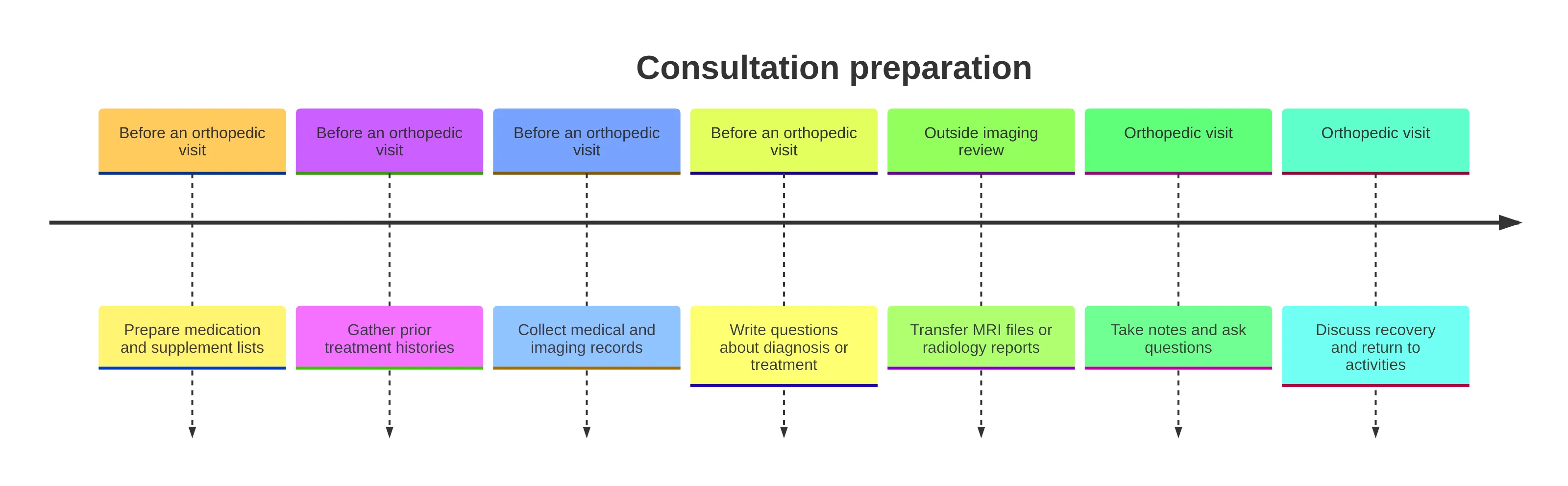
Preparation for an orthopedic visit can make the discussion more specific. At the visit, ask questions about your diagnosis or treatment. A concise record can include:
- Prescription medicines, over-the-counter medicines, herbal preparations, and vitamin supplements.
- The date or approximate period when the hip pain began.
- Activities, positions, or injuries associated with the onset or later changes.
- Earlier treatment, including what you tried, how much it helped, and how long any benefit lasted.
- Imaging reports and the location of any available image files.
- Your main goals, such as walking farther, sleeping more comfortably, returning to sport, or completing work tasks.
- Questions about diagnosis, treatment, recovery, and alternatives.
This preparation does not need to be polished. It needs to be complete enough that you do not have to reconstruct the history under pressure. A timeline is often easier to use than a long description written without dates or sequence.
Outside imaging can affect the practical timing of a consultation. If an outside orthopedic consultation cannot access relevant MRI files or radiology reports, review of the imaging and care may be delayed. Ask how the office wants records transferred, and bring the available report or image file when that is part of the requested process. Do not assume that an outside facility has already sent everything the consulting surgeon needs.
Keep the report separate from your interpretation of it. Bring the wording you received, then explain what has changed since the imaging was performed. That helps distinguish an imaging finding from the current reason you are seeking care.
An orthopedic visit works best when you are honest and complete about your symptoms and history. Take notes, ask for unfamiliar terms to be explained, and ask what to expect from the proposed treatment or procedure, including recovery and return to activities.
You can bring a short written list so the conversation does not become a test of memory. Start with the two or three questions that would most affect your decision. Then ask what information you should gather next if the evaluation remains inconclusive.
If you are comparing options, say what matters most to you: maintaining work, walking without a particular limitation, returning to an activity, avoiding a procedure for now, understanding the financial commitment, or having a clear timeline. Those priorities do not determine eligibility, but they make the discussion more relevant to the decision you actually need to make.
Compare the treatment pathways after evaluation
The three pathways below have different decision roles:
| Pathway | What it can help you decide | Boundary before you proceed |
|---|---|---|
| General self-management | Whether your symptoms are settling, stable, or becoming more limiting while you record the pattern | It does not establish the cause of hip pain or determine that a particular activity is appropriate for you |
| Professional evaluation and conventional treatment discussion | What the history, examination, and any needed imaging may clarify about the problem and the next treatment categories | The evaluation may identify uncertainty, additional questions, or a need to discuss options you had not considered |
| Nonsurgical regenerative consultation | Whether a regenerative option belongs in the discussion after your condition, needs, and available information have been reviewed | The category name is not proof of suitability, effectiveness, or a substitute for diagnosis |
This is a comparison of decision roles, not a ranking of treatments. The pathways can overlap. You may continue an appropriate form of self-management while arranging evaluation, and a clinician may discuss more than one treatment category after reviewing your history and examination.
The table also shows why choosing a treatment name too early can narrow the discussion. Self-management addresses what you do while observing the pattern. Evaluation addresses what needs to be clarified. A regenerative consultation addresses whether a particular nonsurgical category should be considered after that review.
Professional evaluation is the information-gathering step that keeps the rest of the comparison grounded. Professional evaluation may draw on your medical history and physical examination, with X-rays and, when needed, MRI used to assess bone and soft tissues. That information may change what you ask about, which options remain relevant, and whether more testing is needed before treatment planning.
A conventional treatment discussion does not necessarily mean that you have chosen surgery or medication. It can mean asking what established categories belong in the conversation, what each is intended to address, and what remains uncertain. Keep the discussion tied to your findings rather than treating the category as a universal recommendation.
A regenerative consultation is not a shortcut around evaluation. It is a discussion about whether a physician-led, nonsurgical option may be relevant to the condition being considered. We provide stem cell therapy, exosome therapy, peptide therapy, and combination protocols for hip, knee, and shoulder conditions.
You still need to discuss what is known about your symptoms, what remains uncertain, what the proposed option is intended to address, and what alternatives belong in the comparison. If the information does not support regenerative treatment, the responsible next step may be a different treatment discussion. Interest in avoiding surgery does not by itself establish that regenerative treatment is suitable.
The treatment comparison should answer the question you are facing today. If you are still mapping the symptoms, gather information. If persistence or function has changed the stakes, arrange evaluation. If you are considering regenerative care, bring the evaluation findings and ask about suitability rather than treating interest as eligibility.
You can leave a discussion with a treatment recommendation, a request for additional information, a recommendation to consider another pathway, or a decision to continue monitoring. Those are different outcomes, but each is more useful when the reason for it is clear.
Keep regenerative options in the suitability conversation
Regenerative options are categories to discuss, not a menu that determines your treatment by itself. We provide stem cell therapy, exosome therapy, peptide therapy, and combination protocols for knee, hip, and shoulder conditions.
A category name does not establish that an option fits your pain, the structure involved, the stage of a condition, your health history, or your goals. It also does not establish a promised level of pain relief, restored function, or avoided surgery. Keep those questions open until your condition and the available choices have been reviewed.
Ask what the proposed option is intended to address and which part of your evaluation supports considering it. Ask whether the discussion concerns the hip joint, nearby tissue, or another identified problem. If that connection cannot be explained clearly, pause before treating the treatment name as an answer.
Treatment suitability should connect the proposed option with your actual situation. We tailor each treatment option to your specific needs. In practical terms, the discussion should account for your symptoms, examination, available imaging, prior treatment, and goals rather than relying on a generic label.
Ask what the proposed treatment is intended to address. Ask what information supports considering it, what uncertainty remains, and what other options should stay in the comparison. Ask what would make the clinician advise against it. A candid answer may be more useful than a confident-sounding treatment description.
You can also ask whether the proposed plan is a single modality or a combination protocol, what each component is meant to address, and how the clinician will decide whether the discussion should proceed. Those questions seek clarity; they do not assume that a combination is preferable.
Regenerative care is not suitable or effective for every person with hip pain. The same phrase can cover different approaches, and your symptoms may not arise from a problem that the proposed option is meant to address. You may also need a different form of care if the evaluation points elsewhere.
The right next step can therefore be an evaluation that ends with more than one option, a recommendation to gather more information, or a decision not to pursue regenerative treatment. Each outcome keeps the choice tied to your circumstances rather than to a treatment trend.
Do not use a general description of stem cell, exosome, peptide, or combination treatment as an individualized recommendation. Ask for the limits of the proposed option, the alternatives, the relevant uncertainties, and the point at which the plan would be reconsidered.
Use surgeon-led review to test candidacy
Our fellowship-trained orthopedic surgeons plan and perform our treatments. That surgeon-led structure gives you a place to discuss whether the proposed treatment belongs in your care after the condition, symptoms, prior care, and goals have been reviewed.
Candidacy is not established by a single symptom or by your interest in avoiding surgery. It depends on the clinical discussion around your individual situation. Ask what the clinician believes the treatment is intended to address and what finding would change that view.
A surgeon-led conversation should leave you able to describe the proposed next step in plain language. If you cannot say what problem is being addressed, what alternatives remain, or what uncertainty still matters, ask for clarification before making a treatment decision.
Image-guided treatment has a specific place in the procedural discussion. We use image-guided precision injections under ultrasound or fluoroscopic guidance to target the tissue that hurts most. Ask how guidance relates to the proposed procedure, which tissue is being targeted, and what the clinician believes the procedure can and cannot address.
Those questions keep a technical feature connected to your actual treatment discussion. They also give you a way to distinguish how a procedure is performed from what outcome can reasonably be discussed. Guidance does not, by itself, establish that an injection is appropriate or that it will produce a particular result.
An honest assessment may direct you away from the treatment you first considered. We provide honest assessments and direct patients to alternative treatments when regenerative treatment is unlikely to help their joint. If that conclusion applies to you, it is not a failed consultation. It is information that can prevent you from treating an unsuitable option as the only path.
Use the review to ask for a clear explanation of the proposed next step, the alternatives, and the reason each remains under consideration. You can take time to compare those answers before deciding. A recommendation not to proceed should be explained with the same care as a recommendation to proceed.
Ask for benefits, risks, alternatives, timing, and cost
A treatment discussion becomes more useful when you ask for the conditions around the recommendation, not only the name of the treatment. Bring these questions:
- What problem is the proposed treatment intended to address?
- What benefit is realistic to discuss, and what result cannot be promised?
- What risks, unwanted effects, or uncertainties apply to my situation?
- What alternatives should I compare, including continuing self-management or pursuing another evaluation?
- What information led you to consider this option?
- What would make you recommend against it?
- What is the expected timing of the decision, treatment, and recovery discussion?
- What costs apply, and when will those details be provided?
- What will happen if the treatment does not produce the change we hoped to discuss?
You do not need to remember every technical term. Ask for plain language and write down the answer that would most affect your decision. If two options remain under consideration, ask for the same categories of information about both so the comparison is not based only on whichever option was described first.
Treatment details should follow the clinical review. If regenerative treatment is appropriate, we provide options, timing, and cost details. Ask how the plan relates to your evaluation and what alternatives remain if you decide not to proceed.
Ask when the discussion becomes a recommendation and what information supports that recommendation. You can also ask whether the plan would change if additional imaging, a new symptom, or a different examination finding became available. This keeps the decision connected to the information that supports it.
Surgery can remain part of an honest comparison without becoming an automatic conclusion. If surgery is deemed necessary, we will inform you. That statement keeps surgery within the conversation without treating it as either an automatic failure or an outcome that can be predicted from a general article.
Ask what led to that conclusion, what timing means, and which alternatives are still relevant. You can also ask what the proposed nonsurgical option is expected to address and how the discussion changes if it is not appropriate. The purpose is to understand the decision path, not to force every situation into a nonsurgical category.
Know what a REGEN Orthopedic Medicine consultation can confirm
A REGEN Orthopedic Medicine consultation can address whether your symptoms and available information support discussing a regenerative option, what other pathways belong in the comparison, and what additional evaluation may be needed. We tailor each treatment option to the patient’s specific needs.
If it is unlikely to help your joint, we provide an honest assessment and direct you to alternative treatments. These boundaries matter because a consultation is a suitability discussion, not a promise that treatment will relieve your pain or delay surgery.
Bring the information that makes the conversation concrete: your symptom timeline, functional changes, prior treatment, medication and supplement list, imaging reports, and the questions that would affect your decision. You do not need to arrive with a treatment choice.
Scheduling information can be handled through the consultation request process or by calling (833) 734-3648 for scheduling or general inquiries. Have your symptom timeline, prior treatment information, medication and supplement list, and available imaging details ready so the initial discussion can focus on your actual decision.
Confirm the financial structure before scheduling treatment
Treatment cost should be discussed alongside the clinical plan. When cost affects your decision, ask:
- Which proposed treatment or consultation does the amount cover?
- When would payment be due?
- Are follow-up visits, imaging, supplies, or other parts of the plan separate?
- What alternatives should you compare if the proposed option does not fit your budget?
- REGEN Orthopedic Medicine accepts major credit cards and bank transfers at every location.
Use the available cost and timing details to decide whether the proposed next step fits both your clinical questions and your financial circumstances. You can use those details to decide whether the proposed next step fits both your clinical questions and your financial circumstances. No general cost estimate can determine what your individual plan should be.
Write down the amount, timing, and included services in the same place as your treatment questions. That makes it easier to compare the financial commitment with the alternatives under discussion.
The financial decision does not establish clinical suitability, and a payment option does not establish that an outcome is likely. Keep the order intact: understand the problem, discuss suitability, compare alternatives, and then weigh the financial commitment.
That order helps keep cost from appearing only after you have formed an expectation about treatment. It also gives you a clear point at which to pause: if the proposed option, alternatives, timing, or cost are not understandable, ask for clarification before scheduling treatment.
Choose the next conversation, not a guaranteed outcome
Persistent hip pain calls for a sequence rather than a rushed treatment choice. Otherwise, use persistence and changes in function to decide when indefinite self-management should give way to routine evaluation. Bring your history, records, imaging, prior treatment results, and questions. Then compare self-care, conventional evaluation and treatment discussions, and nonsurgical regenerative options according to what your evaluation clarifies.
Only a qualified professional can decide whether a treatment is individually suitable for you. A consultation can help you discuss the condition, available options, alternatives, timing, and cost without assuming that any treatment will relieve pain, restore function, or avoid surgery. Use that information to decide what deserves your next conversation.
If you are in or near Ohio or Chicago and persistent hip pain has made the next step unclear, request a discussion that starts with your symptoms and goals. Bring the information that can be reviewed, keep the treatment decision open until suitability is addressed, and use the conversation to determine what should happen next.
Questions to ask before pursuing nonsurgical hip-pain treatment
What should I do if I experience severe, sudden, or concerning hip symptoms?
Seek immediate medical attention for severe, sudden, or concerning hip symptoms instead of waiting for a routine consultation.
How can I prepare for an orthopedic evaluation for hip pain?
Before your orthopedic visit, prepare a list of medications, prior treatments, relevant medical records, and questions about your diagnosis or treatment to make the discussion more specific.
What can a hip pain evaluation clarify?
A hip pain evaluation may clarify the source of your symptoms, the extent of joint involvement, and whether imaging or further tests are needed to inform treatment options.
What types of treatments does REGEN Orthopedic Medicine offer for hip pain?
REGEN Orthopedic Medicine offers physician-led, non-surgical regenerative treatments for hip pain, including stem cell therapy, exosome therapy, peptide therapy, and combination protocols tailored to individual needs.
What is the financial structure for treatments at REGEN Orthopedic Medicine?
REGEN Orthopedic Medicine is a self-pay practice that does not bill insurance for regenerative treatments, accepting major credit cards and bank transfers.
How can I request a consultation with REGEN Orthopedic Medicine?
You can request a consultation by scheduling through their website or by calling (833) 734-3648 for scheduling or inquiries.
What should I expect during a consultation at REGEN Orthopedic Medicine?
During a consultation, you can discuss your symptoms, treatment options, and whether regenerative treatments are appropriate for your condition.
Free consultation
Find out whether regenerative treatment is right for you.
Most consultations begin as a telehealth call with a physician specialist, so you can start without travelling to a clinic. No referral needed.