
hip pain doctor
How to Choose the Right Hip Pain Doctor and Decide on Your Next Step

Choose evaluation before choosing treatment
Persistent hip pain can make every decision feel urgent: keep adapting your routine, search for an injection, or look for a way to avoid surgery. If you are in Ohio or near Chicago, you may be trying to balance work, exercise, errands, and daily movement while deciding where to start. The most useful first decision is usually not a treatment choice. It is choosing an evaluation that can clarify the problem and the next question to answer.
A comprehensive history and physical examination can detect most hip-joint problems and help guide treatment planning. That makes professional assessment more useful than choosing a treatment from symptoms alone. An evaluation may organize the pattern of your pain, identify what needs closer attention, and show whether testing or a particular treatment discussion makes sense. It does not give you a diagnosis through an article or promise that any option will relieve your pain.
The right starting point is a doctor who can examine your hip and explain how the findings affect your choices. The quality of that conversation matters more than selecting a treatment before the source of pain is understood. Use this guide to decide what kind of clinician to seek, what an evaluation may clarify, how to prepare, and whether a physician-led nonsurgical consultation is a reasonable next step for you.
Match the doctor to the question
Choosing a hip pain doctor starts with matching the clinician’s experience and discussion style to the question you need answered. You are looking for an evaluation of a hip or musculoskeletal problem, not a product recommendation detached from your history. A useful clinician should be able to take a detailed history, perform an appropriate examination, explain what the findings may mean, and discuss both nonsurgical and surgical care when those paths are relevant.
The American Academy of Orthopaedic Surgeons guideline is intended to support trained clinicians managing surgical and nonsurgical treatment of hip osteoarthritis. That does not mean every person with hip pain has osteoarthritis or needs the same pathway. It does support choosing a clinician who can place your symptoms and examination in a wider treatment discussion rather than assuming one option fits every condition.
A practical selection checklist can help you compare potential clinicians before you schedule:
- Look for experience evaluating hip and broader musculoskeletal conditions.
- Choose a clinician who can explain what the examination is meant to clarify.
- Ask whether the discussion will include nonsurgical choices as well as the possibility of surgery when clinically relevant.
- Look for an explanation of why a test is being considered, rather than a test list without context.
- Pay attention to whether the clinician explains limits and uncertainty instead of presenting one treatment as a universal answer.
The ACR explains that clinical criteria support, rather than dictate, professional decision-making. Your clinician must apply the evaluation to your condition, risk factors, other health factors, available resources, and clinical presentation. Use that principle as a filter: you want a conversation that connects general guidance to your particular question.
Your next action is to write down the question you want the appointment to answer. Examples include: “What might be contributing to this pattern of pain?” “What examination findings matter?” and “What nonsurgical options should I understand before making a decision?” A focused question gives the visit a purpose and makes it easier to judge whether the explanation you receive is clear enough to guide your next step.
Also ask who will perform the evaluation and, if a procedure is discussed, who will plan and perform it. For regenerative care at REGEN Orthopedic Medicine, fellowship-trained orthopedic surgeons plan and perform treatments. This is a practical distinction: the person discussing an option should be able to connect it to your history and examination, rather than presenting a modality without that clinical context. It keeps the first appointment focused on assessment rather than selection from a preset menu.
Understand what the evaluation can clarify
A hip pain evaluation can clarify the pattern that a symptom label leaves unresolved. A comprehensive history and physical examination may include inspection, measurements, symptom localization, muscle-strength testing, and special tests. ACR guidance explains that most hip-joint problems can be detected through a thoughtful history and methodical examination, after which a treatment strategy can be considered.
That process gives you more useful information than asking whether one treatment is “good” in the abstract. The relevant question becomes whether a proposed option addresses the problem identified during your evaluation, and whether another path should be discussed first.
Your history gives the clinician context for the examination. Be ready to describe when the pain began, where you feel it, what activities change it, how it affects movement, and what you have already tried. A timeline does not diagnose the problem. It helps organize the information that the clinician will use alongside the physical examination and any available records.
Your prior treatment response also matters to the next conversation. Note what helped, how much it helped, and how long the change lasted. That record can prevent you from relying on a vague memory such as “nothing worked” or “the injection helped,” when the duration and degree of relief may affect the next question.
A general evaluation can help determine whether additional testing, conservative care, an injection discussion, a regenerative consultation, or a surgical discussion belongs in the next conversation. It cannot establish your diagnosis or treatment suitability before a clinician reviews your history and examination. The ACR also emphasizes that guidance must be applied with professional judgment and the details of your condition, so a general article cannot replace that step.
Let the clinical question guide testing
Testing should answer a clinical question rather than serve as a substitute for examination. The ACR describes its Appropriateness Criteria as evidence-based guidance for selecting imaging examinations and treatment options, while also stating that the treating healthcare team must apply the guidance to the patient’s condition, risk factors, comorbidities, available resources, and professional judgment.
That principle matters when you are deciding whether a doctor is taking a thoughtful approach. A test may be useful in one situation and unnecessary or differently timed in another. Ask what the test is intended to show, how the result could change the plan, and whether your history or examination makes it relevant.
Acute traumatic hip pain has a specific imaging point in ACR guidance: radiography is the initial imaging modality of choice. This statement applies to adults with acute traumatic hip pain; it does not establish an imaging sequence for every person with persistent or nontraumatic hip pain.
Your action is to describe any injury, fall, impact, or change in activity accurately and ask how that history affects testing. Do not assume that an MRI, CT scan, or other advanced study should come first simply because it sounds more detailed.
A useful testing discussion answers three questions: What clinical issue are you investigating? What information will the test add after the history and examination? How could the result change the next step? If the explanation does not connect the test to your situation, ask for that connection before treating the test as a decision.
Before agreeing to further testing, try to state the clinical question in one sentence, the information the test is expected to add, and how different results could affect the next discussion. You do not need to predict the result or choose imaging yourself. This check helps you recognize whether testing is connected to the history and examination, consistent with the ACR’s emphasis on applying guidance to the patient’s clinical presentation and professional judgment, rather than treated as an automatic step.
Bring the information that makes the visit useful
Preparing for an orthopedic visit gives you a better chance of having the relevant details available when questions arise. The American Academy of Orthopaedic Surgeons recommends preparing medication information, arranging records when the consultation is outside your usual health system, and bringing prior imaging materials when necessary.
Use this preparation list:
- Write down every prescription medicine, over-the-counter product, herbal preparation, and vitamin you take.
- Arrange transfer of medical records, imaging records, and imaging reports if the consultation is outside your usual health system.
- Bring the physical disk if you had an MRI or other advanced imaging elsewhere, because the surgeon may need it to upload and review the images.
- Create a timeline of prior pain management, bracing, physical therapy, injections, and related surgeries.
- Record how much each treatment helped and how long the benefit lasted.
- Write down your questions about diagnosis and treatment before the appointment.
A preparation list is useful only when you can use it during the conversation. Keep the medication list and treatment timeline in a format you can read quickly. Put your three most important questions at the top. If imaging was completed at another facility, identify the facility and confirm that the report and images are available for review rather than assuming they will arrive automatically.
Your immediate goal is not to build a complete medical history from memory. Your goal is to give the clinician a clear starting record and make it easier to discuss what has already been tried.
Your symptom timeline should connect changes in pain with changes in activity and function. Note when the problem started, whether it changed, which movements are difficult, and whether prior care changed the pattern. The clinician can then combine your account with examination findings, symptom localization, strength testing, and other special tests.
Bring questions that keep the discussion practical: What does the examination suggest should happen next? What information would make another option more or less relevant? Which prior treatment details should affect the decision? Written questions help you remember the discussion when the appointment covers several possible paths.
Compare options without assuming they fit
Comparing treatment options works better when you use the same questions for each option instead of searching for a universal answer. Ask what problem the option is intended to address, what the supporting evidence applies to, what its limits are, what alternatives belong in the discussion, and how your findings affect suitability.
The AAOS hip osteoarthritis guideline is based on a systematic review of published studies in adults and is intended to support trained clinicians managing surgical and nonsurgical care. That evidence base can inform a discussion, but it does not turn a general recommendation into an individualized treatment plan. Your evaluation still determines which questions are relevant to you.
Hip bursitis illustrates why the diagnosis and the option must stay connected. AAOS guidance lists activity modification, cautious short-term NSAID use, assistive devices when necessary, physical therapy, and corticosteroid injection among possible treatment options for hip bursitis. Those options are presented for that condition; the list does not establish that your hip pain is bursitis or that any one option fits you.
NSAIDs also require a separate safety discussion. AAOS notes that they can cause adverse effects for some people, especially when certain medical conditions or other medicines are involved. Discuss NSAID use with your doctor rather than treating an over-the-counter label as a personal recommendation.
A treatment example from an AAOS case study also shows why evidence must be read in context. In that case study, glucosamine sulfate was stopped because moderate evidence showed no better pain relief than placebo, while hyaluronic acid injection was discouraged because of strong evidence of ineffectiveness. A case study is not a diagnosis of your condition and does not settle every treatment decision. Use it as a reason to ask what evidence applies to your specific problem, not as a reason to copy someone else’s plan.
When a clinician cites a guideline or study, ask what condition it addresses, what outcome it measured, and whether that outcome matches the goal you need to discuss. The hip osteoarthritis guideline can inform clinicians managing surgical and nonsurgical care, but it does not answer every question about every cause of hip pain. If the evidence does not address your situation, name that limitation and ask what information would make the comparison more relevant.
A direct comparison can use five questions:
- What finding or condition is this option meant to address?
- What does the supporting evidence actually measure?
- What limits, side effects, or uncertainties should you understand?
- What nonsurgical and surgical alternatives should be discussed?
- What would make the clinician recommend a different next step?
Those questions keep you from treating “nonsurgical” as a guarantee of suitability. They also keep a regenerative option in the same decision process as other choices: tied to the evaluation, explained in context, and considered without a promise of pain relief or avoided surgery.
Assess REGEN Orthopedic Medicine as a consultation option
REGEN Orthopedic Medicine provides physician-led, nonsurgical regenerative medicine for hip pain. REGEN Orthopedic Medicine offers free consultations for hip pain. Most consultations begin as a telehealth call, so you can start without traveling to a clinic. This gives you a way to begin a professional conversation while you are deciding what kind of evaluation and next-step discussion you need.
REGEN Orthopedic Medicine provides physician-led, nonsurgical regenerative options for knee, hip, and shoulder conditions, including stem cell therapy, exosome therapy, peptide therapy, and combination protocols. These are options to discuss, not a menu that determines your treatment before your condition is assessed.
Our fellowship-trained orthopedic surgeons plan and perform treatments. We tailor each treatment option to your specific needs. That means the relevant question is not which named modality sounds most appealing; it is whether an evaluation supports discussing a particular option for your history, examination, anatomy, and goals.
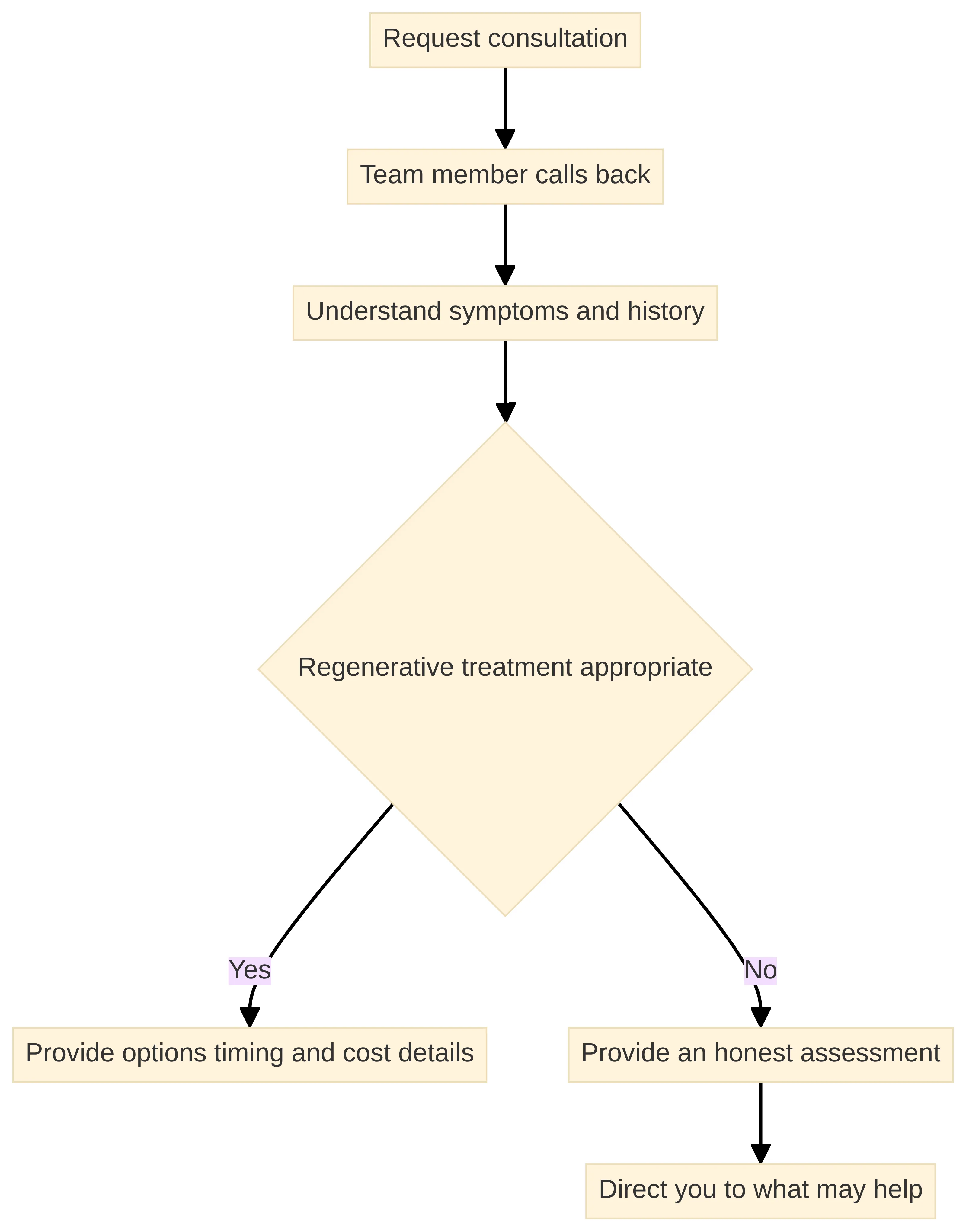
After you request a consultation, a member of our team calls back to understand your symptoms and history.
The conversation should not be treated as proof that a regenerative treatment will fit every cause or severity of hip pain.
Know what the REGEN consultation can and cannot establish
A consultation does not, by itself, establish that a regenerative treatment suits you, guarantee pain relief, or guarantee that surgery can be avoided. The ACR states that clinical guidance must be applied to your condition and clinical presentation using professional judgment. Your individual suitability therefore remains a clinical decision rather than a conclusion that can be made from a treatment name or a general description.
REGEN Orthopedic Medicine also states that an honest assessment can point you elsewhere when regenerative treatment is unlikely to help your joint. If surgery is deemed necessary, we will inform you. Those boundaries matter because a useful consultation should clarify the available path, including when the requested nonsurgical approach is not the appropriate direction.
Before the conversation, prepare the same information you would bring to any orthopedic evaluation: your symptom history, prior treatment timeline, medication list, imaging details, and questions about what the findings can establish. Clear preparation helps keep the discussion focused on your situation rather than on a generalized promise.
The decision point is straightforward: if you want a professional assessment of persistent hip pain and want to consider whether a physician-led nonsurgical option fits, a free consultation may be a reasonable next step. If you are not ready to discuss regenerative care, use the same preparation checklist and seek an evaluation that addresses the clinical question first.
To make the request specific, summarize how long the pain has lasted, how it affects movement, what care you have tried, and what you want clarified. You can request an evaluation through the consultation pathway; for scheduling or inquiries, call REGEN Orthopedic Medicine at (833) 734-3648. This gives the team a focused starting point for the follow-up about your symptoms and history.
Request the evaluation when you are ready to decide
Persistent hip pain that affects your daily life deserves a clearer question than “Which treatment should I try?” Start with an evaluation, prepare the information that makes the visit useful, and compare options according to the findings rather than choosing from a symptom description. A qualified orthopedic professional must decide whether an individual treatment is suitable for you.
If you want to consider REGEN Orthopedic Medicine, we offer free consultations for hip pain, and most consultations begin by telehealth. Prepare your symptoms, history, prior care, medication list, imaging information, and questions so the conversation can focus on your next decision. If surgery is deemed necessary, we will inform you; if regenerative treatment is unlikely to help, we provide an honest assessment and direct you to what may help.
The next useful step is a conversation that connects your symptoms, prior care, and goals to a clear clinical question.
Questions to ask before requesting a hip pain evaluation
What should I consider when choosing a hip pain doctor?
Look for a clinician with experience in evaluating hip and musculoskeletal conditions. Ensure they can explain the purpose of the examination and discuss both nonsurgical and surgical options when relevant.
How can I prepare for my appointment with a hip pain doctor?
Prepare a list of all medications, arrange for medical records transfer if needed, and bring any prior imaging results. Also, create a timeline of previous treatments and write down questions you want to ask.
What types of treatments does REGEN Orthopedic Medicine offer for hip pain?
REGEN Orthopedic Medicine provides physician-led, nonsurgical regenerative treatments, including stem cell therapy, exosome therapy, peptide therapy, and combination protocols tailored to individual needs.
How does the consultation process work at REGEN Orthopedic Medicine?
After requesting a consultation, a team member will call to discuss your symptoms and history. If regenerative treatment is appropriate, they will provide options, timing, and cost details.
What happens if regenerative treatment is not suitable for my hip pain?
If regenerative treatment is unlikely to help, REGEN Orthopedic Medicine will provide an honest assessment and direct you to alternative options that may be more appropriate.
Free consultation
Find out whether regenerative treatment is right for you.
Most consultations begin as a telehealth call with a physician specialist, so you can start without travelling to a clinic. No referral needed.