
what can cause hip pain in a woman
What Can Cause Hip Pain in a Woman? Common Patterns, Warning Signs, and Next Steps
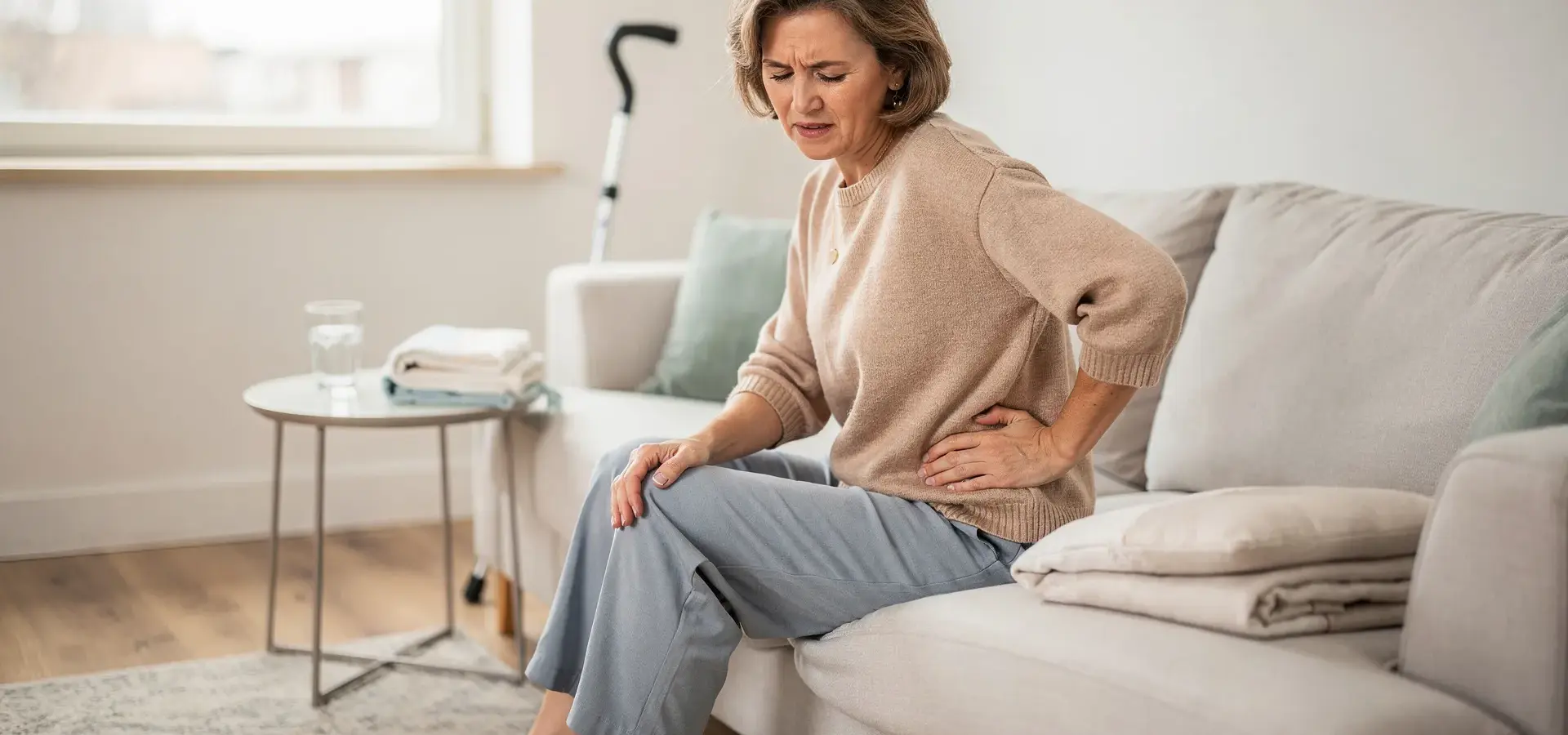
Start with a location-and-pattern map
Your hip-pain pattern gives you a useful starting map, not a diagnosis. Hip pain is commonly grouped as front, or anterior, outer, or lateral, and back, or posterior, hip pain. Each area contains several possible sources, so the map helps organize the question rather than answer it.
Pain from the hip or nearby structures may spread to the groin, thigh, lower back, knee, buttocks, or pelvis. The place where you feel pain does not always identify where the problem began, which is why a symptom pattern should not be treated as a diagnosis.
A location-and-pattern map is most useful when you pair it with onset, activity changes, stiffness, weakness, numbness, and any injury or illness. Hip-pain causes can arise inside or outside the joint and can also be nonorthopaedic, so overlapping symptoms may require a qualified evaluation.
A symptom location does not work like a label attached to a single condition. Front-of-hip pain can involve the joint or nearby tissues, outer-hip pain can involve several soft-tissue structures, and back-of-hip pain can relate to the spine or deeper tissues. Use the map to describe your symptoms clearly, then let the full history and examination determine what needs consideration.
Front-of-hip and groin pain can have several sources
Front-of-hip pain can come from tissues around the hip, structures inside the joint, or referred pain from the abdomen or pelvis. In younger adults, joint-related pain is often associated with a labral tear or femoroacetabular impingement; in older adults, osteoarthritis is often involved. These age patterns describe possibilities, not a cause that can be identified from age alone.
A front-of-hip or groin pattern may deserve evaluation when pain worsens with hip flexion or rotation, particularly in a young adult. Hip flexor strains, tears, and avulsion fractures can also cause front-of-hip pain, and the history often includes a sports-related or traumatic incident.
Front-of-hip pain can also reflect a problem outside the musculoskeletal system. Abdominal or pelvic causes may include a mass, appendicitis, hernia, bladder problems, or a female reproductive-system problem such as an ovarian cyst.
Hip and groin injuries represent 28% to 45% of all injuries among nonelite adult soccer players who are women, while they represent 49% to 55% of all injuries among nonelite adult soccer players who are men. Those figures describe the share of injuries in those specific player groups; they do not estimate the chance that any one person has a hip condition.
When front-of-hip or groin pain changes with flexion or rotation, follows a sports incident, or comes with abdominal or pelvic symptoms, arrange a clinical conversation rather than assigning yourself a joint diagnosis. A clinician can decide whether the pattern calls for further assessment.
Front-of-hip pain may be felt in more than one nearby area, including the groin, thigh, pelvis, or knee. A joint-related pattern and a referred abdominal or pelvic pattern can therefore feel similar at first. Record where the pain began, where it travels, and whether movement, meals, urination, or other symptoms change the pattern; share those details rather than assuming the pain must start in the hip.

Outer- and back-of-hip pain can overlap
Outer-hip pain can involve gluteal tendinopathy or iliotibial-band thickening. That syndrome can involve gluteal tendinopathy or tears, bursitis, iliotibial band friction, or external snapping hip. A sore outer hip therefore does not automatically mean that a bursa is the only structure involved.
Back-of-hip pain may be referred from the lower back or associated with deep gluteal syndrome, sacroiliac pathology, piriformis syndrome, or hamstring tendinopathy. Pain may also overlap between the back and outer hip, so location alone does not establish the cause.
Hip osteoarthritis affects 6.7% to 9.7% of adults older than 45 years. That range describes the share of adults older than 45 years with hip osteoarthritis, not the cause of every outer- or back-of-hip symptom.
When outer- and back-of-hip symptoms overlap, note whether the pain travels, changes with activity, or accompanies lower-back or knee symptoms. Arrange an evaluation if the pattern continues, worsens, or limits your movement instead of using the pain location to choose a diagnosis.
A clinician may need to consider the gluteal tendons, iliotibial band, lower back, sacroiliac region, deep gluteal tissues, and hamstrings together. Your description of the pain’s exact location and movement triggers is useful, but it cannot separate these possibilities on its own.
Hip pain can begin without an obvious injury
Hip pain can begin without an obvious injury. Possible causes include strains, sprains, inflammatory diseases, arthritis, conditions inside or outside the joint, and nonorthopaedic causes. Chronic hip pain can also occur alongside chronic lower-back or knee pain, which can make the original source harder to identify.
Hip osteoarthritis can cause pain in the groin or front of the thigh, stiffness after inactivity, loss of movement, and bone spurs. A gradual pattern or stiffness after sitting may fit that description, but those features do not establish osteoarthritis without an evaluation.
Rheumatoid arthritis can cause hip pain, stiffness, or swelling and usually affects the same joint on both sides of the body. Bilateral symptoms may be useful information to share with a clinician, but they do not identify rheumatoid arthritis by themselves.
Avascular necrosis, also called osteonecrosis, occurs when limited blood supply kills hip-bone tissue and can cause hip pain. Hip pain can also come from nonorthopaedic conditions, so pain without an injury still deserves attention when it persists, worsens, or changes your function.
Strains, sprains, inflammatory disease, arthritis, referred pain, and other conditions may begin without a memorable event. Share recent activity changes, illness, lower-back or knee symptoms, and the pace of onset with a clinician so the broader pattern is part of the evaluation.
Gradual stiffness, pain after inactivity, restricted movement, or a change in walking can occur with joint or bone conditions, but those features overlap across causes. A gradual course is a reason to describe the change carefully, not a reason to assume that arthritis is responsible.
Put women’s, pregnancy, age, and activity patterns in context
Pregnancy-related hip pain is common, especially during the second and third trimesters, and pelvic girdle pain is described as the most common cause of pregnancy-related hip pain. Pregnancy hormones relax ligaments and loosen the pelvic bones to prepare the body for childbirth, which can contribute to pain in the hips and pelvis.
Round ligament pain normally affects women in the second trimester and may cause sharp, stabbing, or pulling pain around the hips, groin, and abdomen. Sudden movement may worsen this type of pain. Pregnancy timing and symptom quality are useful details to share with your pregnancy-care professional, not proof of a particular cause.
Hip pain can affect adults of all ages and activity levels. A stress fracture can happen after a lot of physical activity and is more common among females, so a substantial change in training or activity belongs in your history when hip pain begins. Do not use that pattern alone to decide whether a stress fracture is present.
Among adults older than 45 years, 6.7% to 9.7% have osteoarthritis of the hip, and one in four adults will develop symptomatic hip osteoarthritis during their lifetime. The first figure measures the share of adults older than 45 years with hip osteoarthritis; the second describes the lifetime proportion of adults who develop symptomatic hip osteoarthritis.
Globally, women account for 60% of people with osteoarthritis, with a greater difference after age 40. The 60% figure measures women’s share of people with osteoarthritis worldwide, not the share of women with hip pain. The higher risk for women may be related to differences in joint anatomy, alignment, muscle strength, hormonal influences, obesity, and genetics, but those possible contributors do not make sex a diagnosis.
Age, pregnancy, sex, and activity can change which possibilities deserve attention, but none of those facts identifies the cause of your pain. A pregnant woman, an older woman, and an athlete may have different relevant categories to discuss, while the same symptom can still have more than one possible explanation. Use your personal context to improve the history you share, not to replace an evaluation.

Use symptom patterns as clues, not conclusions
Back-of-hip and outer-hip symptoms may resemble one another. Pain location, by itself, cannot reliably distinguish a tendon, bursa, joint, nerve, spine, or pelvic source when several structures can produce nearby symptoms.
Osteoarthritis and avascular necrosis may cause an altered or antalgic gait, pain with movement, or limited hip movement. These features can tell you that movement is affected, but they cannot tell you which condition is responsible.
Sciatica can cause sharp, shooting pain from the lower back down to the buttocks or leg, along with numbness or tingling in the leg or foot. A nerve-like pattern should be included in your history because the source may be outside the hip joint.
Increasing limp, night pain, pain that no longer changes with activity, new numbness, or new weakness are reasons to arrange medical attention. Use these changes to decide when to seek help, not to label the underlying condition yourself.
A short symptom log can make changes easier to describe. Record the day symptoms began, whether they are improving or worsening, what activities affect them, where they travel, and whether walking, sleep, numbness, or weakness has changed. This record organizes your observations; it does not determine the diagnosis.
Pain that changes with movement may involve a musculoskeletal source, while pain that travels or includes tingling may involve referred or nerve-related symptoms, but these patterns overlap. Treat them as questions to discuss rather than conclusions. New weakness, increasing limp, or night pain should move you toward medical attention.
Know which warning signs need prompt or emergency care
These signs call for prompt medical assessment rather than a routine appointment; depending on the circumstances, emergency care may be appropriate.
Hip pain with a hot, swollen hip, fever, chills, redness, warmth, or feeling generally unwell needs prompt medical attention because infection is possible. Seek emergency care if symptoms are severe or you feel seriously unwell.
Severe, sudden hip pain without a known injury requires urgent medical assessment. The absence of a fall does not make severe sudden pain appropriate for prolonged self-monitoring.
Tingling or numbness in the hip after a fall or injury requires urgent medical help. Share the injury, the time symptoms began, and whether you can bear weight when you seek care.
Warning signs take priority over trying to sort symptoms by location. If severe pain, inability to bear weight, a changed leg position, fever with a hot, swollen hip, or numbness after injury is present, seek prompt medical assessment rather than waiting to see whether a symptom map becomes clearer; emergency care may be appropriate depending on the circumstances.

Prepare for a focused hip-pain evaluation
A hip-pain evaluation considers your pain’s duration, location, severity, character, any trauma, steroid use, and possible referred pain, along with your history and physical examination. Before an appointment, organize those details in a short record:
- When the pain began and whether it started suddenly or gradually
- Where you feel it and whether it spreads to the groin, thigh, back, knee, buttocks, or pelvis
- What the pain feels like, how severe it is, and whether activity or rest changes it
- Any fall, training change, illness, pregnancy, steroid use, numbness, weakness, or altered walking
Your symptom history gives a clinician context for separating hip-joint, surrounding-tissue, spine, pelvic, and nonorthopaedic possibilities. Bring the pattern rather than a self-selected diagnosis, and mention symptoms in other areas because chronic lower-back or knee pain can occur alongside chronic hip pain.
A clinician may use an examination and imaging such as radiography, ultrasound, or MRI. Hip-and-pelvis radiography should be the initial imaging test, while other imaging may be considered when the clinical question calls for it.
Persistent or worsening hip pain may require treatment beyond home care. Arrange an evaluation when symptoms do not settle, worsen, or interfere increasingly with walking or daily activity rather than continuing to guess at the cause.

Arrange evaluation when pain persists or worsens
Use a simple decision path for your next step:
- When symptoms are mild, no warning signs are present, and the pattern is not worsening, cautiously monitor the pattern and record changes. If you are unsure, contact a qualified professional promptly; arrange care if symptoms persist, worsen, or affect function.
- Seek prompt medical assessment for severe pain after injury, inability to bear weight, a shortened or turned-out leg, or a hot, swollen hip with fever or feeling generally unwell; emergency care may be appropriate depending on the circumstances.
- Seek urgent assessment for severe sudden pain without a known injury or numbness after a fall or injury.
- Arrange a routine medical appointment when pain persists or worsens, your limp increases, night pain appears, or new numbness or weakness develops.
Do not use one symptom, one location, or one age-related pattern to identify the cause. Overlapping hip symptoms and possible nonorthopaedic sources make a focused history and examination more useful than a label chosen at home.
The absence of an emergency warning sign does not require you to ignore symptoms that persist or worsen. Use the severity, timing, functional change, and associated features to choose between urgent assessment and a routine appointment. If the pattern is changing, update the information you bring rather than relying on your first impression.
Choose a qualified next step for your hip-pain pattern
Your most useful next step is to match the urgency to the pattern: record the onset, location, activity response, associated symptoms, and changes in walking; seek prompt care for warning signs; and arrange medical attention when pain persists or worsens. A qualified professional decides individual suitability and the cause of your pain.
A symptom map can help you describe what is happening, but it cannot replace an examination when causes overlap. Bring your symptom record to the next clinical conversation so the discussion can begin with your actual pattern.
Questions about causes, warning signs, and evaluation
Can symptoms alone identify the cause of hip pain?
No. Pain from the hip, surrounding tissues, lower back, nerves, pelvis, or nonorthopaedic conditions can overlap. Location and features such as movement-related pain or tingling may help organize the history, but an examination may be needed to determine what requires consideration.
Does being a woman point to one specific cause of hip pain?
No. Sex, age, pregnancy, and activity can change which possibilities deserve attention, but none identifies the cause. Globally, women account for 60% of people with osteoarthritis, but that group includes people with osteoarthritis worldwide and does not mean that 60% of women have hip pain or that a woman’s pain is necessarily arthritis.
Free consultation
Find out whether regenerative treatment is right for you.
Most consultations begin as a telehealth call with a physician specialist, so you can start without travelling to a clinic. No referral needed.