
knee pain relief exercises
Knee Pain Relief Exercises: A Symptom-Aware Sequence for Starting Safely
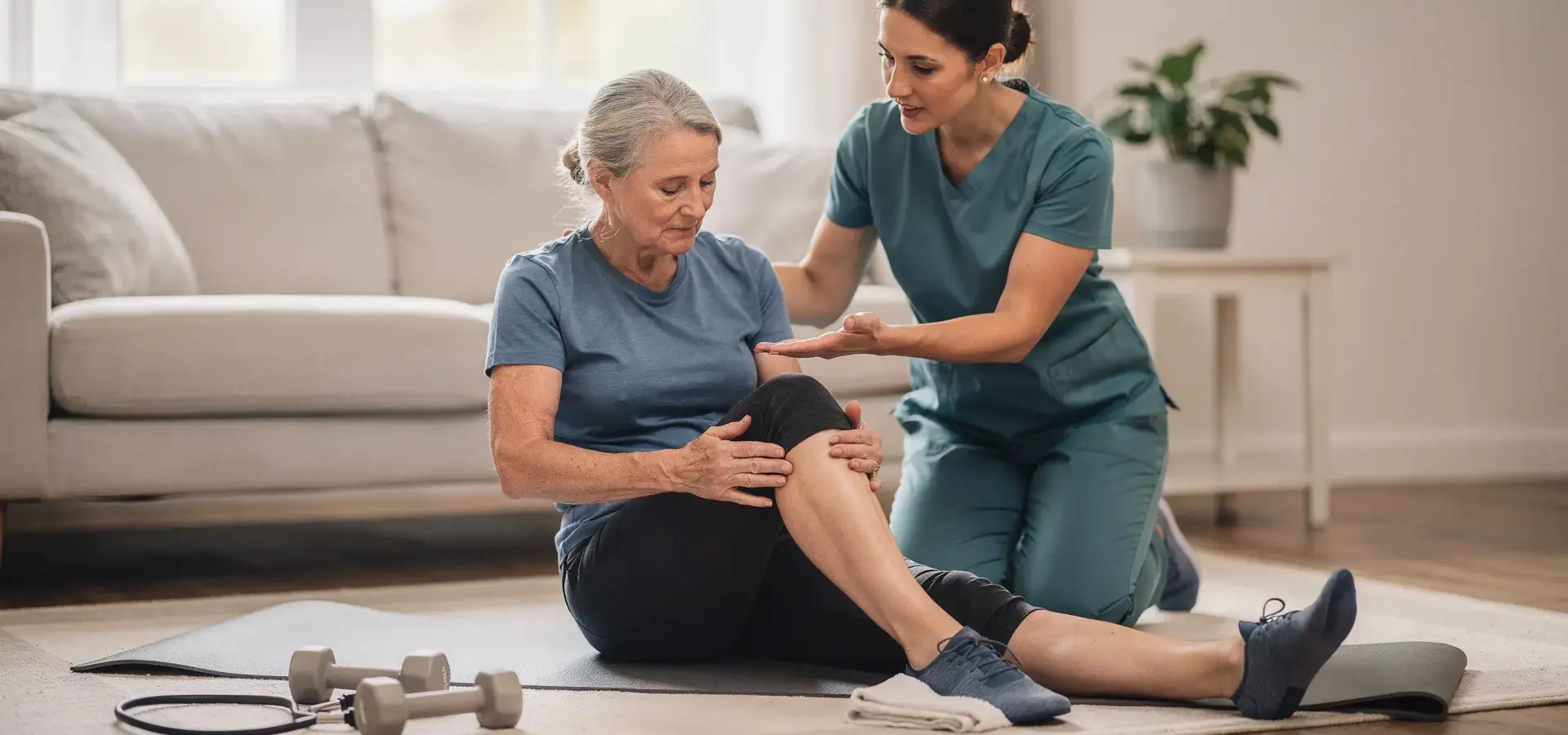
Start with movement that supports comfort and function
Exercise can reduce pain and improve physical function and quality of life for people with knee osteoarthritis. That finding supports movement as part of care, but it does not identify the cause of your knee pain or show that every exercise suits every knee. Your starting point should match your abilities, affected joints, current symptoms, other health conditions, preferences, goals, and access to equipment or facilities.
A network meta-analysis of 217 randomised controlled trials involving 15,684 participants with knee osteoarthritis found that exercise improved pain, function, gait performance, and quality of life. The comparison covered five exercise modalities, so the 217 trials and 15,684 participants describe the research population rather than a promise for an undiagnosed knee problem. At mid-term follow-up, the corresponding pain estimate was −1.19, with a range from −1.59 to −0.79. These are study measures, not a target you need to reproduce.
The same analysis reported mid-term function estimates for three exercise categories: 1.78, with a range of 1.05 to 2.51, for aerobic exercise; 1.07, with a range of 0.68 to 1.46, for mixed exercise; and 0.86, with a range of 0.53 to 1.18, for strengthening exercise. Those numbers describe measured changes in function within the knee osteoarthritis studies. They do not rank one routine for your symptoms or replace an assessment when your knee is swollen, unstable, injured, or difficult to use.
A useful starting rule is to choose movement you can perform with controlled form and without making your knee worse overall. Walking, cycling, water exercise, stretching, and strengthening can all fit into an activity plan, but the tolerable option depends on your symptoms and surroundings. A flat indoor route may be more workable than an uneven Chicago sidewalk after a flare; a pool or stationary bicycle may be easier than repeated stairs. In Ohio or Chicago, an indoor setting can also give you a more predictable surface when outdoor conditions make walking less comfortable. Begin with the least demanding version that lets you observe your response, then use the checkpoints below before adding load or duration.
Prepare the knee before strengthening
A knee exercise session can follow a simple order: warm up, stretch, strengthen, then stretch again. The AAOS knee conditioning program recommends 5 to 10 minutes of low-impact activity before the exercises, such as walking or riding a stationary bicycle. The warm-up should feel like preparation rather than a test; choose an easy pace and stop if the knee becomes painful or your general condition changes.
The stretching phase comes after the warm-up and before strengthening, with the stretches repeated at the end. This sequence gives you a way to begin with movement that requires little equipment before asking the thigh and hip muscles to work harder. Keep the movements controlled, avoid rushing through the transition, and use a chair, wall, or other stable support when balance is uncertain.
A cautious first session can stay simple:
- Warm up with 5 to 10 minutes of easy walking or stationary cycling.
- Use a supported stretch, keeping the range comfortable.
- Try a low-demand strengthening movement, such as a quadriceps set, if the knee tolerates it.
- Repeat gentle stretching at the end.
The purpose of this order is to help you observe tolerance, not to complete a fixed workout. If the warm-up already increases joint pain, pause there and do not progress to strengthening that day.
A general conditioning program’s schedule is not an individualized prescription. If a clinician has given you a different schedule, that direction takes precedence.
Use supported mobility work with controlled form
A standing quadriceps stretch uses a chair or wall for balance while you bring your heel toward your buttock. Hold the support, bend one knee, grasp the ankle if you can do so without twisting, and gently draw the heel closer to your body. Hold the position for 30 to 60 seconds, then repeat on the opposite leg. Keep your back relaxed and avoid arching or twisting it.
The standing quadriceps stretch should create a controlled stretch at the front of the thigh rather than sharp knee pain, forced pressure, or a balance challenge. Keep your standing leg stable and reduce the pull if the position causes discomfort. You can also perform the movement with less knee bend or with more support; a smaller, controlled range is preferable to forcing the heel higher.
A quadriceps set is a strengthening option that you can perform sitting or lying down. Tighten the thigh muscle, try to straighten the knee, and hold the contraction for 5 to 10 seconds. Repeat the exercise approximately 10 times during a 2-minute period, rest for 1 minute, and then repeat until your thigh feels fatigued. Stop rather than pushing through knee pain, and treat fatigue as a limit rather than a goal to exceed.
The AAOS conditioning material also describes increasing resistance for a strengthening exercise as it becomes easier, beginning with a 5-pound ankle weight and progressing gradually to a greater resistance, up to 10 pounds. That instruction applies to the exercise progression described in the program, not to the standing stretch. Do not add ankle weight simply because a stretch feels easy.
Add a supported straight-leg raise
A straight-leg raise begins with one leg straight and the other knee bent. Lie on your back, bend the uninvolved knee with its foot flat on the floor, and keep the working leg straight. Tighten the thigh muscle of the straight leg, then slowly raise it several inches. One set of instructions describes lifting the foot about 12 inches from the floor; another describes raising the affected leg 6 to 10 inches. Use the smaller lift if that is the amount you can control without pain or pelvic movement.
The straight-leg raise works the quadriceps, so you should feel the effort at the front of the thigh rather than a sharp sensation inside the knee. Keep the working knee fully straight, lift slowly, hold the raised position for 5 to 10 seconds, and lower the leg slowly. Keep your pelvis in contact with the floor and avoid swinging the leg. A shorter lift with steady control is a better starting point than a higher lift that changes your alignment.
The straight-leg raise instructions describe repeating the movement until the thigh feels fatigued, with the exercise taking about 3 minutes. That description gives the source program’s structure, not a requirement to continue when symptoms worsen. If your knee pain increases during the movement, stop, return to the quadriceps set or another tolerated option, and reassess your response before trying the raise again.
The straight-leg raise is not a pass-or-fail test of strength. Choose the version you can perform without jerking the leg or losing the bent-knee support position. You can begin with one slow lift to learn the pattern, then stop if the knee becomes more painful or the movement feels unstable. A qualified exercise professional can adapt the position when a general version is not tolerated.
Choose lower-impact substitutions when needed
Lower-impact activity can keep you moving when walking or land-based strengthening is uncomfortable. Water exercise can reduce stress on the knee joints while still providing cardiovascular and overall health benefits. Biking can improve range of motion, flexibility, and strength and is easier on the knees; add resistance gradually as tolerated. These options are substitutions to test, not obligations. Choose the one that your symptoms allow.
Walking can be adjusted by changing distance, surface, pace, or duration. If a 30-minute walk is too painful but shorter intervals feel better, try three 10-minute walks. If you have moderate to severe knee pain, do not walk too far or for too long, and choose an even surface without much uphill or downhill variation. A level indoor track, smooth path, or stationary bicycle may be more workable than an uneven or steep route.
Painful knees may not tolerate high-impact movements such as running, jumping, or deep squats that place substantial force through the joint. Choose gentler activity while you learn how your knee responds. Do not use a difficult movement to prove that your knee is strong enough; replace it with walking, cycling, water exercise, or a smaller-range movement that you can control.
One osteoarthritis activity recommendation lists 150 minutes per week of moderate aerobic activity plus 2 days of strengthening exercise, while the same review notes that as little as 45 minutes per week may be beneficial. The recommendation describes activity for people with osteoarthritis, not a starting demand for a painful or undiagnosed knee. If your knee currently tolerates only short intervals, begin there and use symptom response to decide whether continued activity is reasonable.
Use symptom response to adjust or stop
Knee exercises may increase symptoms slightly at first, but the movements should become easier over time and regular practice can improve knee movement. A small amount of short-term muscle soreness can occur as your body adapts to a new movement. Your existing knee pain should not become worse overall, and your knee should be no worse the morning after exercise. If the next-morning response is worse, reduce the range, duration, resistance, or frequency rather than repeating the same dose.
Pain during a movement is a reason to stop that movement rather than force the repetition. Modify the position or switch to a more joint-friendly option such as a glute bridge or wall sit only if the substitute is comfortable and appropriate for you. Stop knee exercises immediately if you start to feel unwell. Talk with a doctor or physical therapist if exercise causes pain, if the knee repeatedly reacts badly, or if you cannot find a tolerable version.
Use three checkpoints after each session:
- During the movement, stop for sharp pain, increasing joint pain, instability, or loss of control.
- Later that day, note whether swelling or pain is building instead of settling.
- The next morning, compare the knee with its usual baseline; a worse response means the routine needs to be reduced or paused.
These checkpoints help you adjust a general routine without treating symptoms as a diagnosis.
For adults with overweight or obesity and osteoarthritis, a review reports that weight loss can improve pain, physical function, mobility, and quality of life. The review describes guidance recommending weight loss of at least 5% of body weight and combining diet with exercise. That information concerns adults with overweight or obesity and osteoarthritis; it is not a reason to exercise through knee pain or to pursue a weight target without appropriate support.
A useful adjustment rule is to change one feature at a time. If the movement is comfortable but the next morning is worse, first reduce the range or duration. If that does not help, pause the movement and try a lower-impact option. If the knee stays at its usual baseline during the session and the following morning, keep the same version long enough to understand its response before adding resistance or time. This keeps a general routine responsive rather than turning it into a test of endurance.
Build consistency without forcing progression
Consistency matters more than proving that you can tolerate a difficult session. NICE guidance also says that long-term adherence to an exercise plan can increase benefits by reducing pain and increasing function and quality of life in people with osteoarthritis.
A practical progression changes one factor at a time: first establish a tolerable movement, then add a small amount of time, range, resistance, or frequency only when the knee remains at its usual baseline afterward. The activity review lists 150 minutes per week of moderate aerobic activity plus 2 days of strengthening as an osteoarthritis recommendation, but that figure is a general reference rather than an immediate requirement. A shorter routine that you tolerate is a more useful starting point than a larger routine that repeatedly worsens symptoms.
A simple record can help you make the next adjustment. Note:
- the movement or activity you performed;
- the surface, equipment, or setting;
- how the knee felt during the movement;
- whether pain or swelling changed later that day; and
- how the knee felt the next morning.
Keep the record focused on decisions, not perfect measurements. If one option repeatedly worsens the knee, remove it from the routine and test a gentler alternative rather than increasing effort.
Regular practice does not mean repeating the same exercise regardless of symptoms. A schedule that works for walking may not work for strengthening, and a movement that is tolerated on a level indoor surface may not be tolerated on stairs or hills. Whether you are exercising near Chicago or Ohio, let the knee’s response determine whether you keep, reduce, or replace the activity. A clinician’s different instruction takes priority over this general framework.

Know when knee pain needs professional evaluation
After an injury, seek urgent medical evaluation for severe pain, swelling, instability, or inability to bear weight. Seek medical care for an obvious deformity, marked swelling, inability to fully bend or straighten the knee, or severe pain associated with an injury. Fever with a red, swollen, painful, or stiff knee also needs urgent assessment because it can indicate a joint infection.
Seek prompt evaluation if your knee is locked and will not straighten, swelling expands rapidly within the first hour, or you lose feeling in your foot or lower leg. Seek urgent medical assessment after new significant trauma within the last 7 days, including a fall from height or a direct blow to the knee. Do not test these symptoms with an exercise routine or wait for a scheduled workout.
Mild swelling with preserved movement and the ability to walk is described as generally safe to monitor for 48 to 72 hours with rest, ice, compression, and elevation, but that boundary does not apply when you cannot bear weight, the knee is locked, sensation is lost, swelling rapidly expands, or symptoms follow major trauma. Seek medical attention when you cannot bear weight without pain, when pain does not resolve with rest and other measures, or when pain follows an injury or other trauma.
Persistent or worsening knee pain deserves assessment even when no emergency warning sign is present. One clinical source advises seeing a physical therapist if knee pain worsens or does not improve in a month. Knee pain affects approximately 25% of adults and accounts for nearly 4 million primary care visits annually; those figures measure the frequency of the symptom and visits, not the seriousness or cause of your pain.
That dosage belongs to the specific exercise instruction and should not be used as a general prescription for a swollen, unstable, injured, or undiagnosed knee. If you try a side-step variation, stop when pain, instability, or loss of control appears and choose assessment instead when the warning signs above are present.
Use the symptoms to set the timeline:
- Sudden severe pain, major trauma, inability to bear weight, deformity, rapidly expanding swelling, a locked knee, numbness, or fever with redness and swelling calls for prompt or urgent medical help rather than exercise.
- Pain that persists, worsens, or repeatedly returns after exercise calls for a qualified assessment instead of continued experimentation.
These branches guide what to do next; they do not identify the underlying cause.
Choose your next step from your knee’s response
Your next step should follow the knee’s response, not a fixed test of endurance. Begin with a low-impact warm-up, use supported stretching and controlled strengthening, and keep only the movements that leave your knee no worse overall or the next morning. Modify or pause the routine when symptoms increase, and seek prompt help for major injury, inability to bear weight, rapidly expanding swelling, a locked knee, numbness, deformity, or fever with redness and swelling. A qualified clinician should decide what is appropriate for your individual knee when symptoms persist, worsen, or do not fit a simple exercise response.
Write down which movement you tried, what changed during the session, and how your knee felt the next morning. Keep that record available so the symptoms and your response can be discussed clearly, rather than increasing exercise through an unclear or worsening pattern.
Questions about starting exercises for knee pain
What should knee pain relief exercises feel like while you are doing them?
You may notice mild, short-term muscle soreness when starting a new movement, but your existing knee pain should not worsen overall or be worse the next morning. Stop a movement for sharp, increasing, or joint-focused pain, instability, loss of control, or feeling unwell. Reduce the range, duration, or resistance, or pause and seek qualified advice if symptoms do not settle.
Can I start knee exercises if I do not know what is causing my knee pain?
General, gentle movement may be reasonable for a minor ache that allows comfortable walking and does not worsen overall, but exercise cannot determine the cause or confirm that a movement is suitable. Use a low-impact option and monitor your response. Arrange an assessment for persistent or worsening pain, repeated reactions to exercise, swelling, instability, or limited function.
Can these exercises help me avoid knee replacement surgery?
Exercise may reduce pain and improve function for people with knee osteoarthritis, but it cannot guarantee healing, prevent surgery, or address every cause of knee pain. Do not use exercise to delay evaluation when warning signs or persistent limitations are present.
Free consultation
Find out whether regenerative treatment is right for you.
Most consultations begin as a telehealth call with a physician specialist, so you can start without travelling to a clinic. No referral needed.