
exercise for knee pain in old age
Exercise for Knee Pain in Old Age: Safe Senior Moves to Start Gently
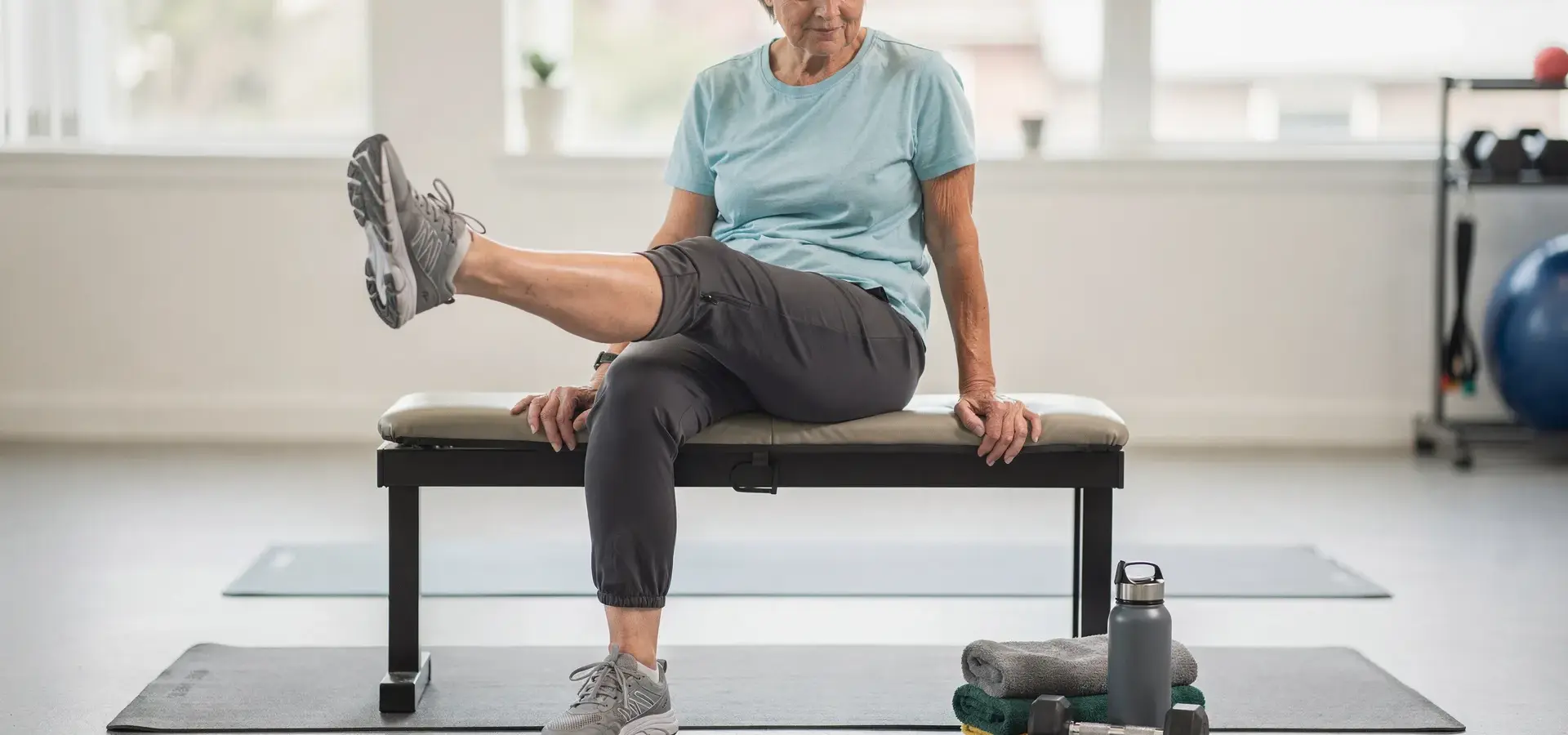
Why cautious movement is still worth trying
Knee pain in later life can make movement feel risky, especially if you worry that activity will wear down the joint, trigger more pain, or lead to a fall. Older adults with knee pain may reduce activity because they fear joint damage, pain, or falls. A cautious starting plan gives you another option: choose low-impact movement, begin with a manageable amount, and let your symptoms and control guide the next step.
Fall risk deserves attention, but fear alone does not tell you that all exercise is harmful. A long-term exercise review reports that 30% of adults over the age of 65 fall at least once a year. In the same long-term exercise review, falls were the most common moderate-severity adverse event, with 5 falls reported among the reviewed exercise studies. That makes balance, support, lighting, and a clear floor part of your exercise plan rather than afterthoughts.
Exercise can be worth trying because physical function may improve, even when the change is not dramatic for everyone. A moderate-certainty analysis found that exercise likely improved physical function by a mean 12.53 points on a 0-to-100 scale compared with no treatment, usual care, or limited education; the analysis included 54 studies and 4,352 participants. That figure describes an average across studies, not a promise about your knee. Start with a level of movement you can control, then judge whether it supports your daily function.
What exercise can and cannot do for knee pain
Exercise may improve pain and physical function, although the benefit may not produce a noticeable change in symptoms for every patient. A low-certainty analysis found that exercise may improve pain by a mean 13.14 points on a 0-to-100 scale immediately after the intervention compared with no treatment, usual care, or limited education; that analysis included 56 studies and 4,184 participants. The number describes an average treatment difference and does not predict an individual result.
A long-term review of low-impact therapeutic exercise found reassuring safety results within the limits of the included studies. Therapeutic exercise lasting 3 to 30 months was safe for most older adults with knee pain in the reviewed studies, which mainly examined selected adults doing low-impact exercise. Across 49 studies, the review found no group-level evidence that therapeutic exercise was associated with serious adverse events, increased pain, worsening function, structural osteoarthritis progression on imaging, or higher total-knee-replacement rates.
The evidence is not uniform across reviews. Low-certainty evidence from 18 studies involving 1,557 participants suggests that exercise may increase adverse events compared with no treatment, usual care, or limited education; the estimated risk ratio was 3.17, with a 95% confidence interval of 1.17 to 8.57. The long-term review mainly examined selected older adults performing low-impact therapeutic exercise, while the adverse-event estimate covered a different set of exercise studies and used a different comparison. Use the practical conclusion: start gradually, monitor your response, and change course when symptoms worsen.
The reviewed safety evidence is limited to low-impact exercise. Because the long-term studies used low-impact interventions, they do not show confidently whether higher-impact exercise such as running is safe for older adults with knee pain.

Choose movement by the result you want
Exercise choice becomes easier when you begin with the function you want to support rather than searching for one universally best movement. A network meta-analysis of 217 randomised controlled trials involving 15,684 patients found that exercise improved pain, function, gait performance, and quality of life in people with knee osteoarthritis. Different modalities were associated with improvement in at least one measured outcome. Use the comparison below to select an emphasis that fits your access, balance, symptoms, and preferred activity.
| Exercise emphasis | What it can help you practice | A lower-impact starting option |
|---|---|---|
| Aerobic | Endurance and repeated, controlled movement | Walking, swimming, or a recumbent stationary bike |
| Strengthening | Controlled force through the legs and support muscles | Body-weight work, wall squats, straight-leg raises, or calf raises |
| Flexibility | Comfortable range of motion and reduced muscle soreness | Gentle stretching after activity |
| Neuromotor or balance | Foot placement, weight shifting, and steadiness | Supported sit-to-stand, weight shifting, or heel-to-toe walking |
| Mind-body movement | A structured movement style that may support function | A gentle form that stays within your comfortable range |
Clinical guidance supports education and structured exercise for osteoarthritis, but guidance on which exercise therapy to prioritize remains ambiguous. You can combine modest amounts of more than one emphasis instead of forcing yourself into a single category.
Aerobic exercise may be the most beneficial exercise modality for improving pain, function, gait performance, and quality of life in knee osteoarthritis, but that conclusion is a cautious comparison from one network meta-analysis, not a universal prescription. In 190 trials involving 13,339 patients with knee osteoarthritis, aerobic exercise probably produced a large short-term pain reduction, with a standardized mean difference of −1.10 and a 95% confidence interval of −1.68 to −0.52. Choose walking or another aerobic option when it feels controllable; choose a different emphasis when balance, pain, access, or confidence makes that option impractical.
Strengthening can be a reasonable emphasis when your goal is controlled leg function, while aerobic movement can be a reasonable emphasis when your goal is sustained activity. At mid-term follow-up in the network meta-analysis, standardized function effects were 1.78 for aerobic exercise, 1.07 for mixed exercise, and 0.86 for strengthening exercise. These are study measures, not personal scores. Let your ability to perform a movement with steady form and tolerable symptoms determine whether you repeat it.

Build a low-impact menu of knee exercises
A basic knee exercise menu can include stretching and flexibility, strength training, and endurance conditioning, and these activities can be done without a gym membership. You do not need to perform every option in one session. Begin with one movement category that feels manageable, then add another only when the first remains comfortable and controlled.
Your starting choice can follow the task that feels most limited:
- If repeated steps are uncomfortable, try a short, easy walk or a recumbent stationary bike rather than making distance the first goal.
- If standing work feels unsteady, begin with seated or supported movements and keep a stable chair or wall within reach.
- If stiffness makes movement difficult, use several minutes of gentle range-of-motion work as a warm-up before strengthening.
- If your main goal is leg control, start with body-weight strengthening within the range and pain level you can manage.
- If steadiness is the concern, use supported weight shifting, sit-to-stand, or heel-to-toe walking instead of unsupported single-leg work.
These are starting points, not a required sequence. Choose the option that lets you control the motion, stop easily, and notice how your knee responds.
Mobility work gives you a gentle way to move the knee through a comfortable range. Use slow knee or ankle mobility repetitions without forcing the end of the movement. Walking gently activates the leg muscles without putting too much force on the knees. Swimming provides gentle resistance that may strengthen muscles and make activity less uncomfortable, while a recumbent stationary bike may be gentler on the knees because you pedal from a reclined position. Use the option that allows steady control and does not increase symptoms.
Controlled strengthening can include wall squats, half squats, straight-leg raises, calf raises, seated leg press, leg extensions or curls, and other movements listed in knee osteoarthritis rehabilitation guidance. With a wall squat, keep your back supported, use only as much knee motion as you can control, and stop before the movement becomes uncomfortable. Start strengthening with body weight, work only as much and as far as your range of motion and pain allow, and add resistance only when the exercise becomes easy.
Balance work can address a different need from strength or endurance. Balance exercises can help improve balance and help prevent falls; examples include single-leg stance, heel-to-toe walking, sit-to-stand, and weight-shifting. Perform balance work near a wall or stable chair in case you lose your balance. Gentle stretching can help restore range of motion and reduce muscle soreness. A simple walk or several minutes of gentle range-of-motion repetitions can serve as a warm-up.
Higher effort is not automatically the right starting point. Most cited exercise studies used low to moderate intensity, although one pilot study found that 16 weeks of high-intensity strength training decreased pain and improved function compared with low-intensity strength training. That pilot finding does not tell you to begin with high intensity. For a first routine, favor movements that let you stop, reduce the range, or lower the resistance without losing control.

Make the first session safer at home
A home exercise session starts with the space around you, not with the first repetition. When starting new exercises, keep a chair or wall nearby, clear rugs, cords, shoes, and other hazards, use good lighting, keep a phone or medical-alert device nearby, and begin with fewer repetitions. Perform balance exercises near a wall or stable chair in case you lose your balance. If you are exercising in a Chicago apartment, an Ohio home, or another familiar setting, choose a surface and route where you can see and reach your support.
A warm-up can consist of a simple walk or gentle range-of-motion repetitions of the targeted body area for several minutes. Warm up before strengthening, and use a cooldown rather than stopping abruptly after harder movement. Stretch after physical activity instead of stretching cold muscles. Keep each movement slow enough that you can notice a change in pain, balance, or control before adding repetitions.
One exercise guideline starts with warm-ups and cooldowns, 15 to 20 repetitions for 1 set, 2 to 3 sets when applicable, and twice-weekly sessions. The same source describes stretching held for 20 to 30 seconds, repeated 2 to 3 times twice a week after physical activity. Treat these figures as general guidance rather than a personal prescription: stop short of a movement that increases concerning symptoms, and use a smaller amount when your current tolerance is lower.
Your first session should answer a simple question: can you perform the chosen movement with steady control and symptoms that remain manageable? Start with fewer repetitions, keep your range of motion within a comfortable limit, and rest before your form deteriorates. Do not add resistance just because a listed exercise looks easy on paper. Progression belongs after you understand how your knee responds.

Start walking at a comfortable, adjustable pace
Walking gives you a simple way to practice endurance without making speed or distance the first target. If you choose walking, start with 10 to 15 minutes at a pace that feels comfortable for you and your knees, then increase the goal by a small amount every week; even 5 minutes may be effective. Keep the pace easy enough that you can remain aware of your footing, posture, and symptoms.
A walking route should match your current control rather than your long-term hopes. In Chicago or Ohio, choose an indoor or outdoor route with a surface you can manage when weather, ice, rain, or uneven ground makes footing less predictable. A comfortable walking shoe may be sufficient; a 2016 study found no difference in knee pain between specially designed pain-reducing walking shoes and regular walking shoes. Select footwear that feels comfortable and secure instead of delaying movement while searching for a special shoe.
Your walking progression should respond to your knee and your performance. Repeat the same duration when you are still learning the route or noticing symptoms, alternate walking with rest, and add only a small amount when the current level remains manageable. If walking changes your gait, increases pain, or makes you feel unsteady, shorten the route or stop and use a different low-impact option.
Use symptoms to modify or progress
Symptom-aware progression means changing one part of exercise at a time. Begin with a few minutes of activity, alternate activity with rest, and progress gradually in intensity, movement complexity, and duration. A supervised neuromuscular program progressed by adding exercises, resistance, or difficulty according to symptom response and quality of performance. Apply that principle conservatively: keep the movement familiar while you assess your response, then change duration, repetitions, resistance, or complexity rather than changing everything at once.
A short exercise log can make your next decision more concrete. After each session, record:
- The movement you chose and how long you performed it
- The number of repetitions or the resistance used
- How your knee felt before and after the session
- Whether your balance, walking pattern, or form changed
- Whether symptoms settled, stayed the same, or worsened afterward
Use the notes to repeat a manageable level, reduce the next session, or bring a clear pattern to a medical provider or physical therapist. The log is a decision aid, not a substitute for assessment.
Temporary knee pain or muscle soreness can occur when you begin an exercise program. A temporary response still deserves attention. If symptoms settle and your movement remains controlled, return to the same level rather than jumping ahead. If pain or other symptoms are worse with each session, adjust the plan and discuss it with a medical provider or physical therapist.
Pain intensity is one signal, not the only signal. In one supervised program, participants were told to reduce exercise difficulty or repetitions if pain exceeded 5 on a 0-to-10 scale; that threshold came from that specific study and is not a universal rule for every exercise or condition. Use worsening pain, reduced control, altered walking, swelling, or a feeling of instability as reasons to reduce the movement or stop it rather than pushing through.
Your response can guide the next decision:
- If symptoms stay manageable and your form remains steady, repeat the current level before progressing.
- If symptoms increase during or after exercise, reduce repetitions, shorten the range, lower resistance, or rest.
- If a flare makes ordinary movement harder, avoid adding exercise intensity and return to a comfortable level only when symptoms settle.
- If pain or function continues to worsen, pause self-directed progression and arrange qualified assessment.
Too much exercise during an arthritis flare may increase pain, inflammation, and joint damage, so a flare is a reason to reduce demand rather than prove your toughness.
A trial of 439 adults aged 60 and older found that both aerobic and resistance exercise were associated with similar significant improvements in physical-disability symptoms, physical performance, and pain. That result supports keeping both categories available, not choosing one based on a promise of a particular outcome. Use the category that you can perform consistently and adjust without losing control.
Keep higher-impact activity out of the starting plan
The long-term safety evidence concerns therapeutic exercise, not physical activity in general. The reviewed studies covered therapeutic exercise lasting up to 30 months, performed from 1 to 3 hours per week and at intensities ranging from low to vigorous; all included interventions were low impact. Those findings should not automatically be extended to household, work, travel, or sports activity, where surfaces, speed, loads, and unexpected movements can differ.
Running belongs outside a cautious starting plan unless qualified guidance gives you a reason to consider it. The review could not confidently establish that higher-impact exercise such as running is safe for older adults with knee pain. Begin with walking, swimming, recumbent cycling, controlled strengthening, or supported balance work instead. If a sport or job requires impact, turning, lifting, or repeated stairs, treat that activity as a separate question rather than assuming that a low-impact exercise study answers it.
Mild symptom changes can still occur even in low-impact exercise programs. Only a minority of participants experienced mild or temporary pain increases, ranging from 0 to 22% within individual randomized-trial exercise groups. A separate low-certainty analysis of 18 studies involving 1,557 participants suggested that exercise may increase adverse events compared with no treatment, usual care, or limited education, with a risk ratio of 3.17 and a 95% confidence interval of 1.17 to 8.57. Do not use either finding to predict your personal response; use it to justify gradual progression and clear stop rules.
Know when knee symptoms need qualified assessment
Knee symptoms after an injury need a different response from ordinary exercise soreness. Seek medical assessment after an acute injury if your knee swells, buckles, collapses, or cannot bear weight. Seek prompt qualified assessment after a fall or sports injury if symptoms worsen or movement becomes difficult, especially with severe pain, deformity, inability to bear weight, or numbness.
Persistent or worsening knee pain deserves assessment even when no single movement feels urgent. Worsening pain or other symptoms may mean that your exercise plan needs adjustment and should be discussed with a medical provider or physical therapist. Strength and range of motion vary with symptom severity and other conditions, so an exercise program should be adjusted to your abilities. Do not keep increasing repetitions or resistance while your ordinary function is declining.
Severe knee osteoarthritis calls for a lower-demand approach rather than a test of endurance. Rehabilitation guidance promotes physical activity that does not cause pain and lists mobility, half squats, wall squats, seated leg press, leg extensions or curls, straight-leg raises, calf raises, and balance exercises as possible examples. The list is a set of options, not an instruction to perform every exercise. Your clinician’s instructions, symptom severity, other conditions, goals, and progress may require changes, and a rehabilitation guideline does not replace clinical judgment.
Your first action should match the urgency:
- Use emergency care if your knee becomes unstable, you cannot bear weight, swelling develops quickly, or severe pain limits movement.
- Arrange prompt assessment after an injury when swelling, buckling, collapse, numbness, deformity, worsening symptoms, or difficult movement is present.
- Arrange a non-emergency discussion with a medical provider or physical therapist when pain persists, exercise repeatedly worsens symptoms, or your function is declining.
- Return to self-directed exercise only at a level that remains controlled and does not conflict with the guidance you receive.
These boundaries protect you from treating an injury-related problem or a changing condition as routine exercise soreness.
Choose a supported next step for your knee
Your next step is to choose one low-impact movement you can perform with support nearby, a clear space, and a pace you can control. Use symptoms and function to decide whether to repeat, reduce, pause, or seek help rather than treating a fixed routine as the goal. A qualified healthcare professional should decide whether self-directed exercise fits your medical history, balance, strength, injury status, other conditions, goals, and progress. If you cannot find a comfortable, sustainable starting point or your knee symptoms keep worsening, an evaluation can help clarify the next step.
Questions about starting exercise for knee pain in later life
Can exercise make knee arthritis worse?
Exercise may improve pain and function, but symptoms can temporarily increase when you begin. A long-term review found no group-level increase in serious adverse events or pain among selected older adults doing mainly low-impact therapeutic exercise, though a separate low-certainty analysis suggested more adverse events than usual care or no treatment. Start gradually, reduce the range, repetitions, or resistance when symptoms worsen, and pause for qualified guidance if pain or function continues to decline.
Is running safe for older adults with knee pain?
The reviewed safety studies focused on low-impact therapeutic exercise and do not establish that higher-impact activity such as running is safe for older adults with knee pain. Walking, swimming, recumbent cycling, controlled strengthening, or supported balance work may provide more cautious starting options. Treat running, sports, and other impact-heavy activities as separate decisions requiring attention to your symptoms, control, and clinical guidance.
How can I tell normal exercise soreness from a knee problem that needs care?
Mild, temporary knee pain or muscle soreness can occur when starting a routine and does not necessarily mean the condition is worsening. Stop and seek qualified assessment if symptoms repeatedly worsen, your walking or form changes, swelling develops, the knee feels unstable, or ordinary function declines. After an injury, worsening symptoms, difficult movement, severe pain, deformity, numbness, or inability to bear weight requires prompt assessment.
Should I get medical guidance before starting knee exercises?
A qualified healthcare professional should help determine whether self-directed exercise fits your medical history, balance, strength, injury status, other conditions, goals, and progress. Assessment is especially important when pain persists or worsens, symptoms follow an acute injury, or exercise feels unsafe. An exercise plan may need individual modification rather than a general routine applied unchanged.
Free consultation
Find out whether regenerative treatment is right for you.
Most consultations begin as a telehealth call with a physician specialist, so you can start without travelling to a clinic. No referral needed.