
non invasive Achilles treatments
Non-Invasive Achilles Treatments: How to Choose the Right Next Step
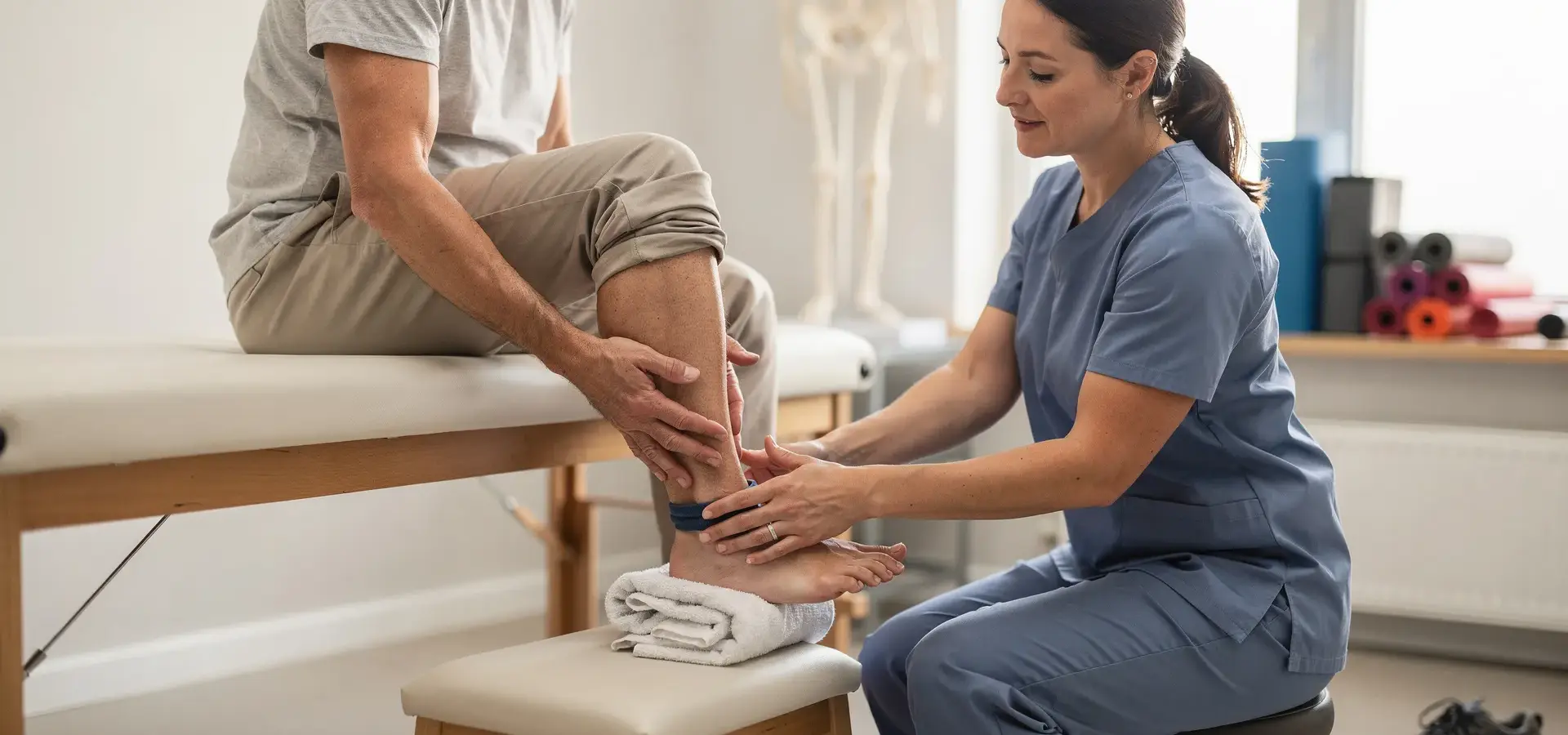
Start with the treatment decision your symptoms require
Achilles tendon problems do not all call for the same next step. The Achilles tendon links the calf muscles to the heel and helps you jump, run, and walk. Pain, stiffness, or swelling near the heel can occur with an Achilles injury, while tendinitis involves an inflamed, swollen, or irritated tendon and is often linked to repetitive stress.
A torn Achilles tendon is called a rupture. A partial tear may be managed differently from a complete rupture, so the label matters before you compare treatments. The first decision is therefore not whether you want the least invasive option. It is whether your symptoms suggest a problem that needs immediate assessment, a tendinopathy discussion, or another evaluation pathway.
Use this order when you are deciding what to do next:
- Screen for urgency. Sudden pain, a pop, marked weakness when pushing your foot down, difficulty bearing weight, or an inability to walk normally can occur with an acute rupture. Treat that pattern as a reason to seek immediate qualified medical attention.
- Separate the condition category. Ongoing pain after activity, stiffness, and localized swelling may lead to a tendinopathy-focused discussion, but symptoms alone cannot establish the diagnosis.
- Compare treatment paths only after assessment. Conservative care, minimally invasive procedures, and surgery address different clinical situations and carry different trade-offs.
- Include rehabilitation and cost in the decision. The treatment label does not describe the entire plan. Bracing, exercise, follow-up, imaging, medication, facility charges, and rehabilitation may all affect what you experience and pay.
If you are near Chicago or Ohio, the practical location does not change the first priority: sudden loss of function or suspected rupture calls for prompt qualified assessment rather than a trial of self-directed treatment.
Treat sudden weakness or a suspected rupture as urgent
A suspected acute Achilles rupture requires immediate qualified medical attention. Sudden inability to walk, acute pain while running or jumping, a popping sound, or a sensation that someone kicked the back of your ankle can occur with rupture. Weakness when pushing your foot down, difficulty bearing weight, and limping are also described findings.
Do not use a single home test to rule out a rupture. A Thompson test can occasionally be falsely negative because other foot flexors may still produce some downward movement of the foot; approximately 25% of acute ruptures were initially missed for this reason in the cited clinical review. A negative result does not outweigh sudden pain, a pop, weakness, or a major change in walking.
If the symptoms began suddenly, take these steps:
- Stop treating the problem as ordinary post-exercise soreness.
- Avoid testing the tendon with running, jumping, forceful calf raises, or repeated walking trials.
- Arrange immediate qualified medical attention, particularly if you cannot walk normally or bear weight.
- Tell the clinician exactly when the change began, what you were doing, whether you heard or felt a pop, and whether push-off strength changed.
A clinician usually evaluates a suspected acute rupture through a detailed history and physical examination. The examination is meant to distinguish rupture from other causes of pain and weakness; it is not a substitute for assessment when the warning pattern is present. Do not wait for pain to become severe before seeking help. A rupture can be overlooked when some movement remains.

Understand what non-invasive, nonsurgical, and minimally invasive mean
Non-invasive Achilles care does not involve an operation. Nonsurgical or nonoperative care is the broader treatment pathway that may include activity adjustment, medication, immobilization, bracing, protected weight bearing, physical therapy, and structured rehabilitation. A functional brace can be part of nonsurgical treatment for an Achilles rupture.
Minimally invasive surgery is still surgery. It is a surgical pathway distinct from nonoperative care, even when the access or repair technique differs from open repair. Surgical repair may use an open or percutaneous approach. Comparing a minimally invasive operation with a boot or rehabilitation program as though they were the same type of treatment can hide important differences in anesthesia, wound care, nerve risk, recovery planning, and cost.
Think of the categories this way:
| Pathway | What it means | What you need to compare |
|---|---|---|
| Non-invasive or nonsurgical | Care without an operation, which may include bracing, protected weight bearing, medication, and rehabilitation | Whether the plan fits the injury, how movement and loading will be progressed, and what monitoring is required |
| Minimally invasive surgery | An operative repair pathway that differs technically from open repair | Surgical risks, nerve or wound complications, anesthesia, follow-up, and rehabilitation |
| Open surgery | Operative repair through an open approach | The expected benefit, surgical complications, rehabilitation demands, and total cost |
The terms describe the pathway, not your diagnosis or likely outcome. A clinician must first determine whether you have tendinopathy, a partial tear, an acute rupture, or another problem. Only then can you discuss which pathway is reasonable for your findings, goals, health risks, and ability to follow rehabilitation.
Match conservative care to the type of Achilles problem
Conservative Achilles care is a group of options, not one universal protocol. Nonoperative care is often considered first-line for many Achilles problems, while surgery may be considered for some complete ruptures or for symptoms that do not respond to conservative care. The appropriate combination depends on what the examination shows.
For an acute rupture managed without surgery, conservative care may include:
- Immobilization or a functional brace
- Protected weight bearing
- Heel lifts or wedges to position the ankle during early care
- Physical therapy and structured rehabilitation
- Gradual progression of movement and loading under clinical direction
A walking boot may help limit foot movement, and crutches may reduce weight bearing. After an Achilles tendinitis diagnosis, a clinician may recommend immobilization for two or three weeks. That duration is not a general instruction for every tendon problem, and it should not be used to manage a suspected rupture without assessment.
For Achilles tendinitis, nonsurgical care may include rest or immobilization, ice, compression, elevation, pain medication, and physical therapy. These categories describe what clinicians may consider; they do not establish that every option is suitable for you.
Activity adjustment also needs a specific meaning. It may involve temporarily reducing running, jumping, hills, or another provoking load while a clinician determines how to maintain appropriate movement and begin rehabilitation. It does not automatically mean complete rest, and it does not mean you should continue through sudden weakness or a suspected rupture.
The practical boundary is simple: use conservative care as a clinician-directed pathway matched to the problem. Do not select a boot, heel lift, exercise plan, injection, or medication solely because it is described as nonsurgical.
Use loading and compression principles to understand rehabilitation
Rehabilitation for Achilles tendinopathy uses loading differently from rehabilitation after an acute rupture. For midportion Achilles tendinopathy without presumed frailty of the tendon structure, the 2024 clinical practice guideline recommends tendon-loading exercise first to improve function and decrease pain. Effective loading approaches can include eccentric, concentric, isometric, isotonic, or other progressive forms rather than one required exercise style.
The supplied 2024 guideline material gives different minimum-frequency recommendations for this population: one passage says at least 3 times a week, while another says at least twice weekly. Because those passages do not establish one universal schedule, do not turn either number into a self-prescribed program. Ask a qualified clinician to set the frequency, intensity, progression, and stopping boundaries for your findings.
The same guideline states that complete rest is not indicated for midportion tendinopathy and advises continuing activities within pain tolerance. That guidance applies to the specified tendinopathy population. It does not apply automatically to sudden weakness, a suspected rupture, or a tendon believed to have structural frailty.
Insertional Achilles tendinopathy involves a different loading concern. Rehabilitation may reduce compressive loads while maintaining enough tensile loading to strengthen and stimulate the tendon. A clinician may consider:
- Less calf stretching when stretching increases compression at the insertion
- Calf-muscle massage for stiffness
- Less ankle dorsiflexion during tendon-loading exercises
- Heel lifts as a temporary way to reduce dorsiflexion during activity
A trial of 42 sport-active people with chronic insertional Achilles tendinopathy lasting more than 3 months used a progressive 4-stage loading program that included isometric, isotonic, energy-storage and release, and sport-specific exercises. In that trial, the low-compression approach reduced tendon thickness by 0.6 mm after 24 weeks compared with baseline. That result belongs to the studied population and protocol; it is not a promise about your tendon or a reason to copy the program.
Orthoses also require restraint. Because the evidence was contradictory, the guideline made no recommendation for orthoses in midportion Achilles tendinopathy. Therapy is often described as lasting 6–12 weeks and focusing on progressive loading, mobility, and return-to-activity guidance, but your plan may differ according to the diagnosis, response, and functional demands.

Read the tendinopathy evidence without overpromising
The 2024 clinical practice guideline recommends tendon-loading exercise first for midportion Achilles tendinopathy without presumed tendon-structure frailty. Tendon-loading exercise can reduce pain and improve function; effective approaches include eccentric, heavy-load slow-speed, progressive, and isometric exercise. The 2024 clinical practice guideline reports improvement as soon as 2 weeks, with an improvement of 18 to 21 points on the VISA-A scale by 12 weeks.
The evidence mainly represents physically active people with nonacute tendinopathy and pain lasting more than 3 months. Its applicability to acute symptoms and people with low physical activity is limited. A sudden injury therefore should not be placed into a chronic tendinopathy exercise plan without assessment.
The treatment comparisons also need careful reading. A living review found substantial uncertainty across exercise, injection, and combined therapies for midportion Achilles tendinopathy. At 12 months, the review found no difference between those treatment classes. Most treatment categories in the network analysis did not differ statistically, so rankings should not be treated as a dependable league table.
That uncertainty changes how you should evaluate an option. Ask what specific problem the treatment is intended to address, what evidence applies to your symptom duration and tendon location, how progress will be measured, and what happens if the plan does not improve function. A treatment can be reasonable to discuss without being established as superior for every person.
Injections deserve the same distinction. Their role depends on the specific clinical problem and clinician assessment. Ask about the specific substance, the tendon location, the intended outcome, possible complications, the monitoring plan, and the point at which another pathway would be considered. Keep the focus on a defined clinical question rather than on the word non-invasive.
Compare rupture pathways by trade-off, not by label
Acute Achilles rupture treatment involves a trade-off rather than a universal winner. Nonoperative care may avoid surgical complications but can carry a higher rerupture risk. Surgery may lower rerupture risk but carries risks such as infection, wound problems, and nerve injury. Functional outcomes can be similar in some trials even when complication patterns differ.
These numbers should not be combined into one universal rate. Study populations, rupture characteristics, rehabilitation protocols, follow-up periods, and pooling methods differ. The consistent decision point is more useful: ask whether your priority is reducing rerupture risk, avoiding operative complications, preserving a particular activity goal, or choosing a plan you can follow reliably. Then compare those priorities with the clinician’s assessment of your rupture. For example, one randomized trial found rerupture in 6.2% of patients receiving nonoperative care and 0.6% of patients in each surgical group, while physical performance and patient-reported function were similar.
Let the clinical context determine which path is discussable
The clinical context frames the questions to bring to a qualified clinician. The preferred approach for acute rupture remains under debate, so a treatment label alone cannot settle the decision.
Ask the clinician to compare the options against these factors:
- Injury type: Is the problem tendinopathy, a partial tear, a complete rupture, or another condition? A partial tear may be managed differently from a rupture.
- Timing: When did the symptoms begin, and how soon was the problem assessed? Delayed diagnosis can change the discussion.
- Activity level: Do your daily demands involve walking, lifting, running, jumping, or sport-specific movement? Your goal matters, but it does not override the examination.
- Medical and surgical risk: Which health conditions, medicines, or prior injuries could alter the balance between an operation and nonoperative care?
- Rehabilitation demands: Can you attend follow-up, protect the tendon during the required phase, and complete the planned progression?
- Response to care: If conservative treatment is chosen, what findings or lack of progress would prompt a different discussion?
For acute rupture, rehabilitation is essential after either conservative or operative treatment, and the ability to follow the rehabilitation plan should be part of treatment selection. One meta-analysis reported 3.7% rerupture after surgery compared with 9.8% after nonsurgical treatment, but that comparison is an estimate from a particular analysis rather than a promise about your result.
Do not choose surgery solely because it sounds faster, and do not choose nonsurgical care solely because it avoids an operation. Ask what each pathway requires during the first weeks, how progress will be monitored, what complications matter most for you, and what would change the plan.
Treat rehabilitation as part of the treatment choice
Rehabilitation is part of the treatment for an acute Achilles rupture, not an optional add-on after the main decision. Rehabilitation during the first 6 months after injury is described in stages: early work emphasizes preventing rerupture, the next phase focuses on calf strength, and later work uses strengthening and proprioceptive exercises when returning toward sport.
The exact plan depends on the treatment pathway and your examination, but the decision should include practical questions about protection, weight bearing, ankle position, follow-up, and progression. A plan that looks attractive on paper may be difficult to carry out if you cannot attend visits, use the required equipment, or protect the tendon during the early phase.
A review supports accelerated functional rehabilitation over long-term casting for reducing rerupture, with functional improvement after nonoperative care comparable to operative repair. A trial of 540 people found no difference in functional outcomes at 9 months between functional bracing and plaster casting, while functional bracing was linked to earlier return to work and fewer complications. Functional bracing used a removable orthosis with heel wedges that were periodically removed as progression occurred.
The distinction is not permission to speed up your own rehabilitation. Progression must match the rupture, tendon position, strength, symptoms, and clinician-directed milestones. In the randomized trial discussed above, half of reruptures occurred within the first 10 weeks after injury, with reported cases ranging from 2 to 28 weeks. That timing makes unsupervised testing of strength or sport especially inappropriate.
Before choosing a pathway, ask for a written or clearly explained rehabilitation map:
- What protection and weight-bearing limits apply first?
- When will ankle position, walking, strength, and movement be reassessed?
- Which signs mean the load is too high or the plan needs adjustment?
- What milestone must you reach before driving, work demands, running, jumping, or sport?
- What is the plan if progress stalls or function worsens?
A decision is incomplete until you understand the rehabilitation it requires.

Put prevalence and affected groups in perspective
Achilles rupture is common enough to be examined in large U.S. health-claims data, but a rupture database figure is not the same as the prevalence of non-invasive Achilles treatments. In a Marketscan database study, 100,825 people experienced Achilles tendon rupture between 2010 and 2020, and 24.9% were managed operatively. That figure describes the study database and time period; it is not a percentage for every adult in Chicago, Ohio, or the United States.
The same study discussion reported similar functional outcomes for operative and nonoperative management, while other evidence found different rerupture and complication patterns. That is why the number of people treated without surgery should not be used as proof that nonsurgical care is appropriate for your injury.
Risk patterns also vary by activity. Recreational and amateur participants may face higher risk of tendon pathology when intense exercise is undertaken without planned training, conditioning, or preventive measures. A sudden increase in running, jumping, court sports, or field activity may be relevant history for the clinician, but it does not identify the cause by itself.
When you describe your situation, include your usual activity, any recent change in training, the exact onset, previous tendon symptoms, and the effect on walking or push-off. Those details help place a population statistic in the context of your actual assessment.
Ask for a complete cost comparison
Achilles treatment cost depends on more than the procedure name. Ask for an estimate that separates evaluation, imaging, equipment, medication, facility charges, clinician fees, therapy visits, follow-up, and insurance or self-pay responsibility.
Cost comparisons vary by treatment and setting rather than following one dependable price:
- Physical therapy is typically described as costing far less than injections or surgery, even when several visits are required.
- One cost estimate gives a typical surgery range of $10,000–$30,000 or more. Out-of-pocket responsibility depends heavily on insurance, and that source describes surgery as usually reserved for severe degeneration, partial tears that fail conservative care, or full ruptures.
- Published injection estimates vary by injection type, setting, and pricing basis. The injection type, facility, clinician, region, insurance coverage, and whether the figure is a cash price or an out-of-pocket estimate can change the result.
- Injections around the Achilles may be used cautiously because of rupture risk. Another cost estimate says some injections are not typically covered by insurance and may reduce pain temporarily without rebuilding tendon strength or load tolerance. Ask about the specific injection rather than treating all injections as one category.
A U.S. cash-price example for ruptured Achilles repair lists separate charges for evaluation, rehabilitation, imaging, equipment, anesthesia, the repair, and the surgery-center facility. The listed amounts range from $65 for crutches to $3,505 for the facility fee; the same example lists an $860 provider fee for the repair and a $320 MRI fee for an MRI of the hip, knee, or ankle joint. These are example line items, not a quote for your care.
A Marketscan study found nonoperative treatment more cost-effective in its analysis, while operative treatment was associated with higher payments and patient cost-sharing. Surgical repair may cost more partly because of greater use of clinic visits, imaging, and physical therapy sessions, and costs may differ between an ambulatory surgery center and a hospital facility. The study also associated nonoperative treatment with higher prescription costs because of longer opioid-use duration, while operative patients had shorter opioid-use duration and lower associated prescription costs.
Use these questions to make a cost estimate useful:
- What diagnosis and treatment pathway does this estimate cover?
- Does it include imaging, equipment, medication, anesthesia, facility fees, therapy, and follow-up?
- Which amounts are billed to insurance, and which could be your responsibility?
- What costs would arise if the initial plan changes or rehabilitation takes longer?
- Which services are excluded from the quoted figure?
Cost matters, but it should be compared alongside clinical fit, complications, rehabilitation, and the possibility of needing a different pathway. One useful way to compare estimates is to separate the price of an encounter from the price of a treatment episode. A therapy estimate may be quoted per visit or as a course; an injection estimate may be per injection; an operative estimate may bundle or separate surgeon, facility, anesthesia, equipment, imaging, and follow-up. The cash-price repair example shows why the label alone is insufficient: it lists separate provider, facility, imaging, equipment, and anesthesia items, while physical therapy is described across multiple visits. Ask the practice to state whether each amount is per visit, per injection, or for the planned episode of care.
Also ask what happens if the diagnosis changes after examination. A cost discussion for tendinopathy should not be treated as a quote for acute rupture care, and a nonoperative estimate should not be assumed to include every later rehabilitation visit or reassessment. The Marketscan analysis found different cost patterns for operative and nonoperative rupture care, but it was an analysis of claims and payments rather than a personal quote. Its finding that ambulatory surgery center costs were lower than hospital costs applies to operative repair in that analysis; it does not establish which setting is available or appropriate for a particular patient.
Before comparing totals, write down the clinical pathway each estimate represents: suspected condition, evaluation, imaging, intervention, rehabilitation, follow-up, and excluded services. This makes it easier to see whether a lower initial number reflects a lower total price or simply fewer listed services. Ask which services require insurance authorization, which are subject to deductibles or other cost-sharing, and which may be self-pay. These questions clarify the financial differences without treating cost as a substitute for diagnosis or treatment selection.
Bring decision-ready questions to the appointment
A qualified clinician usually assesses a suspected acute Achilles rupture through a detailed history and physical examination. Bring a concise account of what happened, how your walking changed, and what you can no longer do. Then use questions that force the treatment discussion to stay connected to the diagnosis, risks, and follow-up plan.
Questions about the diagnosis
- What findings support tendinopathy, a partial tear, a complete rupture, or another problem?
- Where is the problem located, and how does that location change the treatment discussion?
- Does the examination establish the diagnosis, or is imaging needed to answer a specific question?
- If a Thompson test is negative, what other findings are being considered?
Questions about nonsurgical care
- What would conservative care include in my situation?
- Do I need a boot, brace, heel lift, crutches, medication, or activity modification?
- What weight-bearing and movement limits apply, and when will they change?
- If exercise is appropriate, what loading level, frequency, and progression should I follow?
- What symptoms mean that I should stop an activity and contact you?
Questions about procedures or surgery
- What would a minimally invasive procedure or open repair add compared with nonoperative care for this finding?
- Which risks matter most here, including rerupture, infection, wound problems, or nerve injury?
- What evidence applies to my activity level, timing, health conditions, and goals?
- If an injection is being considered, what substance and purpose are involved, and what are the tendon-specific risks?
Questions about monitoring and escalation
- What change would show that the plan is working?
- When is the next assessment, and what will it measure?
- What would cause you to change from conservative care to a procedure or surgery?
- What should I do if pain, weakness, swelling, or walking ability worsens?
- What is the complete expected cost, including imaging, equipment, rehabilitation, facility charges, and follow-up?
Write down the answers and the next appointment or contact instruction before you leave. A clear escalation plan is more useful than a general promise to monitor symptoms.
Arrange qualified evaluation when warning signs or loss of function appear
Your next step should match the pattern in front of you. Sudden pain with a pop or kicking sensation, marked push-off weakness, difficulty bearing weight, or an inability to walk normally warrants immediate qualified medical attention. Ongoing Achilles pain without those warning signs still deserves an assessment if it limits activity, keeps returning, or does not respond to a clinician-directed plan.
Bring your symptom timeline, activity demands, treatment priorities, rehabilitation questions, and cost questions. Ask the qualified healthcare professional to explain what diagnosis is being considered, which conservative, procedural, or surgical paths fit the findings, what risks and monitoring apply, and what would change the plan. Individual suitability must be decided by a qualified professional after assessment.
Choose the next discussion based on urgency and clinical context, not on the least invasive label alone.
What should you ask before choosing a non-invasive Achilles treatment?
How common are non-invasive Achilles treatments, and who most often needs them?
A single U.S. claims study cannot show how common non-invasive treatment is among all adults or in Chicago or Ohio. One U.S. claims study recorded 100,825 Achilles ruptures from 2010 through 2020, with 24.9% managed operatively, but that figure does not represent every adult or establish prevalence in Chicago or Ohio. Recreational and amateur participants may face higher tendinopathy risk when intense activity occurs without planned training, conditioning, or preventive measures. Treatment use depends on the diagnosis, injury severity, activity demands, health risks, and clinical assessment.
What do non-invasive Achilles treatments typically cost?
Prices vary according to the diagnosis, imaging, equipment, physical therapy, medication, facility, insurance, and follow-up. Physical therapy is generally described as costing less than injections or surgery. Published injection estimates range from about $150 to $1,500 or from $500 to $2,500, reflecting different estimates and unspecified treatment details. A published surgery estimate ranges from $10,000 to $30,000 or more. These are broad examples rather than Chicago- or Ohio-specific quotes, so request an itemized estimate that includes rehabilitation and follow-up.
How long might non-invasive Achilles treatment take?
There is no single timeline for every Achilles problem. Cited therapy examples commonly describe 6–12 weeks focused on progressive loading, mobility, and return-to-activity guidance. Acute rupture rehabilitation is a longer process: the first 6 months are described as important, with early protection followed by calf strengthening and later strengthening and proprioceptive work. The applicable timeline depends on whether the problem is tendinopathy, a partial tear, or a rupture, as well as progress and the rehabilitation plan set by a qualified clinician.
Are injections appropriate for every Achilles tendon problem?
No. Whether an injection is appropriate depends on the condition and clinical assessment. Evidence for exercise, injection, and combined therapies in midportion tendinopathy remains uncertain, and injections around the Achilles may be used cautiously because of rupture risk. A qualified clinician should identify the tendon problem, explain the specific substance and intended benefit, discuss tendon-specific risks and cost, and define how progress or failure would be monitored before an injection is considered.
Free consultation
Find out whether regenerative treatment is right for you.
Most consultations begin as a telehealth call with a physician specialist, so you can start without travelling to a clinic. No referral needed.