
non surgical knee cartilage treatment
Non-Surgical Knee Cartilage Treatment: How to Choose Your Next Step

Separate the treatment question from the diagnosis question
Non-surgical knee cartilage treatment starts with two separate questions: what is causing your knee problem, and which treatment category might fit that problem? The word cartilage does not answer either question by itself. Knee symptoms can come from osteoarthritis, a focal cartilage injury, or another condition, and similar symptoms can appear across different problems.
Knee osteoarthritis may involve pain, limited movement, crepitus, swelling, inflammation, deformity, or changes in gait. A cartilage injury can also cause pain and functional limits, but the location, timing, severity, and cause may differ. Symptoms alone cannot establish which explanation applies to your knee. A clinical history, physical examination, and, when appropriate, imaging may be needed to identify the cause.
Pain that appears during stairs, exercise, squatting, or ordinary walking can tell you how the knee is behaving, but it does not identify the structure involved. The same applies to swelling, stiffness, catching, or a change in gait. Record the pattern instead of turning any single symptom into a diagnosis.
That distinction changes your next step. You may be deciding among three broad paths:
- Monitor a stable problem for a limited period while tracking symptoms and function.
- Arrange a routine clinical evaluation when pain persists, function changes, or the cause remains unclear.
A treatment name should come after the clinical question, not replace it. An injection, exercise program, medicine, regenerative approach, or surgery may be discussed for different reasons and under different conditions. None should be treated as automatically appropriate because your search includes the word cartilage.
Your immediate goal is not to select a procedure from a list. Your goal is to determine whether you need more information, what the evaluation should clarify, and which options deserve a balanced discussion before you make a decision.
Define what an evaluation must clarify
A knee evaluation should clarify the pattern of your symptoms, the findings on examination, and whether imaging or other testing can answer an unresolved question. An osteoarthritis evaluation commonly includes a clinical history, physical examination, and radiographic imaging. A cartilage-injury workup may also review when an injury or symptoms began, what you feel now, and any prior treatment or surgery.
Your history gives the clinician context that an image cannot provide by itself. Write down when the problem started, whether onset followed an injury, which movements or activities aggravate it, and how it affects walking, stairs, exercise, work, sleep, or other routine activities. Include previous knee treatment, injections, medicines, or surgery. This information can help connect the symptom pattern with the examination and available imaging.
The exact examination depends on your symptoms and the clinical question. Imaging may help identify osteoarthritis or a structural problem, but the choice of imaging should follow the history and examination rather than an assumption that every knee complaint needs the same test.
When an initial evaluation does not clarify the diagnosis, a clinician may consider advanced imaging or laboratory testing. That possibility does not mean that more testing is always needed. It means that an unresolved question should guide the next test.
Prepare for an evaluation with a short record that includes:
- The date or approximate period when symptoms began.
- Any injury, change in activity, or event that preceded the symptoms.
- The location, pattern, and severity of pain or other symptoms.
- Activities you can no longer perform or can perform only differently.
- Previous imaging, treatment, surgery, or relevant medical history.
- Questions about what the findings mean and which options depend on them.
Bring the actual reports or images you already have when they are available, along with a list of medicines and previous procedures. The purpose is not to prove that you have a cartilage injury. It is to give the clinician enough context to decide what the findings mean and whether another question remains.
A useful evaluation should leave you clearer about the suspected problem and the reason for each proposed next step. It should not require you to arrive with a diagnosis.
Start with the established non-surgical foundation
The established non-surgical foundation for knee osteoarthritis includes exercise-based care, education, and weight management when relevant to your circumstances. The OARSI panel identifies structured land-based exercise, exercise combined with dietary weight management, and mind-body exercise such as tai chi or yoga as core treatment options for knee osteoarthritis. A separate systematic review identifies exercise, weight management, and patient education as first-line options.
These recommendations apply to knee osteoarthritis. They do not establish that the same approach answers every question about a focal cartilage defect, an acute injury, or another cause of knee pain. That distinction matters because cartilage-related symptoms can have more than one source.
A foundation plan is more useful when you understand what it is intended to address. Ask whether the plan is meant to support movement, build capacity, manage symptoms, or help you judge how your knee responds over time. Ask how the plan should be adjusted if a particular activity increases symptoms. You do not need to turn a general recommendation into a rigid routine without discussing how it fits your knee and your current function.
Education belongs in this category because understanding the suspected condition affects how you interpret symptoms and weigh choices. A plan that includes activity, exercise, or weight management should be discussed in the context of your goals, limitations, and other health considerations. The point is not to assume that a single foundation option will resolve a cartilage problem. The point is to begin with categories that clinical guidance identifies for osteoarthritis while keeping the diagnosis question open.
For some people, the practical question is how to remain active without repeatedly provoking symptoms. For others, it is how to work on movement, conditioning, or weight management while a structural question is being evaluated. Those are different planning questions. Ask how the proposed foundation relates to your current function rather than assuming that more activity or less activity is always the answer.
Before moving to an injection or regenerative option, ask:
- Is osteoarthritis the working diagnosis, or is a focal cartilage injury being considered?
- What change would show that the current plan is helping or needs adjustment?
- Which activities are reasonable to continue, modify, or pause?
- What time period should you use to judge whether the plan is worth revisiting?
Those questions make the foundation a monitored part of decision-making rather than an automatic promise of improvement.
Interpret symptom-directed care through the cartilage evaluation
Symptom-directed care should be interpreted in light of what the evaluation shows about the cartilage and the rest of the knee. Knee pain symptoms alone do not establish whether the underlying problem is osteoarthritis, a focal cartilage injury, or another condition. A cartilage-injury workup may review when symptoms or an injury began, examine the knee, and document prior treatment or surgery. When an initial evaluation does not clarify the diagnosis, a clinician may consider advanced imaging or laboratory testing.
These evaluation details lead to different cartilage questions. Ask whether the findings fit a broader osteoarthritis pattern or a focal cartilage concern, what the available imaging shows about the location and severity of the finding, and how the symptoms and functional limits relate to it. Those questions do not establish that a particular treatment will work, but they keep the proposed option connected to the problem being evaluated.
For knee osteoarthritis, OARSI identifies structured land-based exercise, exercise combined with dietary weight management, and mind-body exercise as core treatment options. A systematic review also identified exercise, weight management, and patient education as first-line options. Other non-surgical approaches discussed for knee osteoarthritis include medicines, injections, radiofrequency procedures, and some regenerative approaches such as PRP or prolotherapy. These categories should not be treated as interchangeable: an option may be discussed for symptoms or function without showing that the underlying cartilage has been repaired.
The word injection describes a delivery method, not a single treatment purpose. Corticosteroid, hyaluronic acid, PRP, and prolotherapy are discussed in different contexts, so ask what the proposed option is intended to address, what limitations and risks should be considered, and what alternatives remain if it is unsuitable or does not meet its intended goal. Also ask how long the option is meant to serve its intended purpose and what would count as an adequate or inadequate response. A temporary symptom change would not establish the exact cause of a knee problem or prove structural repair.
Regenerative approaches require a separate evidence discussion. Regenerative medicine is a changing field, and some cartilage-repair approaches remain under research or clinical evaluation. A systematic review found low- to very-low-quality evidence for the effectiveness of mesenchymal stem-cell therapy in knee osteoarthritis. In the reviewed trials, follow-up mostly lasted one to two years, with one trial lasting four years; the review said long-term safety remained unknown. Because evidence for mesenchymal stem-cell therapy is limited, the review recommends caution and shared discussion of potential advantages and disadvantages.
If the evaluation identifies a cartilage problem that may be addressed surgically, surgery belongs in the discussion without determining the outcome in advance. Some cartilage-repair surgeries require lengthy recovery—up to one year in the cited source and, for some patellar procedures, up to 18 months. Ask how the suspected finding, its location and severity, your symptoms, and your activity goals affect the comparison between monitoring, symptom-directed care, regenerative approaches, and any procedure under consideration.
A cartilage-focused evaluation can therefore stay specific: clarify whether the concern is osteoarthritis, a focal cartilage injury, or another condition; identify what the examination and imaging establish; then compare each option’s purpose, evidence, limitations, risks, and alternatives. A non-surgical label alone does not show that an option fits the finding or that cartilage has been repaired.
Compare injections by purpose, not by the word “injection”
Knee injections are not one treatment category with one expected role. Non-surgical osteoarthritis literature discusses intra-articular corticosteroid and hyaluronic acid injections among symptom-management approaches, while it discusses PRP and prolotherapy among regenerative approaches. The shared delivery method does not make these options interchangeable.
The name of an injection also does not answer whether it fits your knee. A meaningful comparison should connect the proposed option to the suspected diagnosis, the intended goal, the available evidence, and your alternatives. You should be able to ask:
- What finding or symptom is this option intended to address?
- What potential benefit should we discuss without assuming that it will occur?
- What limitations or uncertainties apply to this option for my suspected condition?
- What risks, precautions, or reasons not to use it should be considered in my situation?
- What other non-surgical categories could be considered instead?
- What would be the next step if the option is not suitable or does not meet its intended goal?
These questions are especially important when the same word, such as injection, makes different approaches sound similar. A corticosteroid injection, a hyaluronic acid injection, and a regenerative approach may be discussed for different clinical reasons. The evidence for one should not be transferred to another merely because all are delivered into or around the knee.
Your discussion should also distinguish a proposed treatment from a demonstrated outcome. A recommendation to consider an option does not guarantee pain relief, cartilage repair, restored function, or avoidance of surgery. The appropriate conclusion may be that more information is needed before choosing among injections, exercise-based care, other procedures, or surgery.
Ask whether the injection is directed into the joint or around a particular structure, and ask what diagnosis supports that choice. The location and purpose matter because a procedure aimed at symptoms is not automatically a treatment for cartilage itself. Keep the exact name, intended target, and stated goal together in your notes.
If you are comparing injections, write down the exact product or approach, the intended purpose, the evidence being used, and the alternatives discussed. Specific wording makes the conversation easier to evaluate later.
Treat regenerative approaches as an uncertainty question
Regenerative approaches require an evidence-and-suitability discussion rather than an assumption that the treatment will rebuild knee cartilage. A registered clinical trial describes an investigational procedure using a patient’s own cartilage and platelet concentrate; a trial listing is not proof that the procedure is established or effective.
A systematic review of mesenchymal stem-cell therapy for knee osteoarthritis found low- to very-low-quality evidence for effectiveness. The review said that follow-up in the included trials mostly lasted one to two years, with one trial lasting four years, and that long-term safety remained unknown. Because the evidence was limited, the review recommended caution and shared discussion of potential advantages and disadvantages.
Reviews of stem-cell cartilage therapies also identify unresolved challenges involving cell engraftment, immunogenicity, and potential tumorigenicity. Those are subjects for a clinical discussion, not reasons to assume that every stem-cell-based approach has the same profile. The findings relate to particular therapies, study designs, and people studied, so you should ask how the evidence applies to the option being proposed for your knee.
At REGEN Orthopedic Medicine, we offer options that include stem cell therapy, exosome therapy, peptide therapy, and combination protocols. We offer non-surgical regenerative options for the knee, hip, and shoulder. Those business facts describe available services; they do not establish that a particular option is suitable for your diagnosis or that a specific result will occur.
If you are considering regenerative care, ask for a clear explanation of:
- The suspected knee problem the approach is intended to address.
- The treatment category and the biological or clinical rationale being used.
- The quality, population, and timeframe of the evidence cited.
- What remains uncertain, including relevant safety questions.
- The alternatives, including continued non-surgical care or surgery when applicable.
- What findings would make the approach unsuitable for you.
Also ask whether the proposed treatment is being offered as established care, as an option supported by limited clinical evidence, or in connection with clinical evaluation. That distinction changes how you should interpret the expected benefit, the uncertainty, and the alternatives.
The word regenerative can describe a broad group of approaches. Your decision should rest on the specific option, the specific clinical question, and the limits of the evidence.
Use the evidence limits to set realistic expectations
Evidence limits should shape the expectations you bring to a knee treatment discussion. A treatment can be available without being appropriate for every diagnosis, and a promising research direction can remain uncertain for routine clinical decisions. Availability, biological theory, and proof of effectiveness are different questions.
The mesenchymal stem-cell review is a useful example of why those questions must remain separate. The review found low- to very-low-quality evidence for effectiveness in knee osteoarthritis, reported mostly one- to two-year follow-up, and stated that long-term safety remained unknown. The review therefore advised caution and shared discussion of potential advantages and disadvantages.
A broader review of cartilage-repair modalities describes unresolved challenges for stem-cell-based therapies, including cell engraftment, immunogenicity, and potential tumorigenicity. These terms refer to scientific and safety questions that should be explained in plain language during a consultation. You can ask which concern is relevant to the proposed option and how it affects the decision.
Set expectations by asking for measurable, decision-relevant information rather than a broad outcome statement. Questions can include:
- What change is the treatment intended to produce?
- How would that change be assessed?
- What evidence supports that expectation for a condition like mine?
- How long were people followed in the evidence being cited?
- What important uncertainty remains?
- What would we consider if the expected change does not occur?
A careful answer may include uncertainty. That is useful information because it tells you whether the decision is based on established guidance, limited clinical evidence, an investigational approach, or a combination of these. It also gives you a basis for comparing the option with exercise-based care, symptom-directed treatment, other procedures, monitoring, or surgery.
Ask what would change the plan if the proposed response does not occur. A clear fallback keeps the decision from becoming dependent on a single hoped-for result and helps you compare the time, effort, and uncertainty attached to each option.
No category should be selected solely because it sounds advanced, natural, or restorative. Match the claim to the evidence and the evidence to your own clinical question.
Keep surgery in the comparison without making it the automatic endpoint
Arthroscopic procedures can sometimes repair articular cartilage, while more severe defects may require a larger repair procedure. Some cartilage-repair procedures involve recovery of up to one year, and some patellar procedures may involve recovery of up to 18 months.
Those recovery periods apply to the procedures described in the cited clinical information, not to every knee operation. Ask which procedure is being discussed, what it is intended to address, and what recovery would mean for your work, activity, mobility, and support needs. A surgical option should be compared with realistic alternatives rather than with an undefined promise that a non-surgical treatment will repair the same problem.
Research status also matters. One ClinicalTrials.gov entry describes an investigational procedure involving arthroscopic debridement, a patient’s own cartilage, platelet concentrate, and application to a cartilage defect. The entry describes the study procedure; it does not establish that the procedure is routine, effective, or appropriate for you.
You do not have to make a treatment decision immediately. You can discuss potential benefits, harms, and alternatives with a healthcare professional before deciding. That gives you time to ask whether the proposed plan is intended to manage symptoms, repair a focal defect, delay another option, or address a different clinical goal.
Keep these questions in the comparison:
- What is the suspected problem and how certain is that assessment?
- What does each option aim to change?
- What recovery, restrictions, or follow-up would each option involve?
- What evidence and uncertainty apply to the non-surgical and surgical paths?
- What happens if you monitor the problem or continue conservative care?
Including surgery in the discussion does not make it the automatic endpoint. It prevents you from comparing an identified procedure with an undefined alternative.
Turn the consultation into a structured comparison
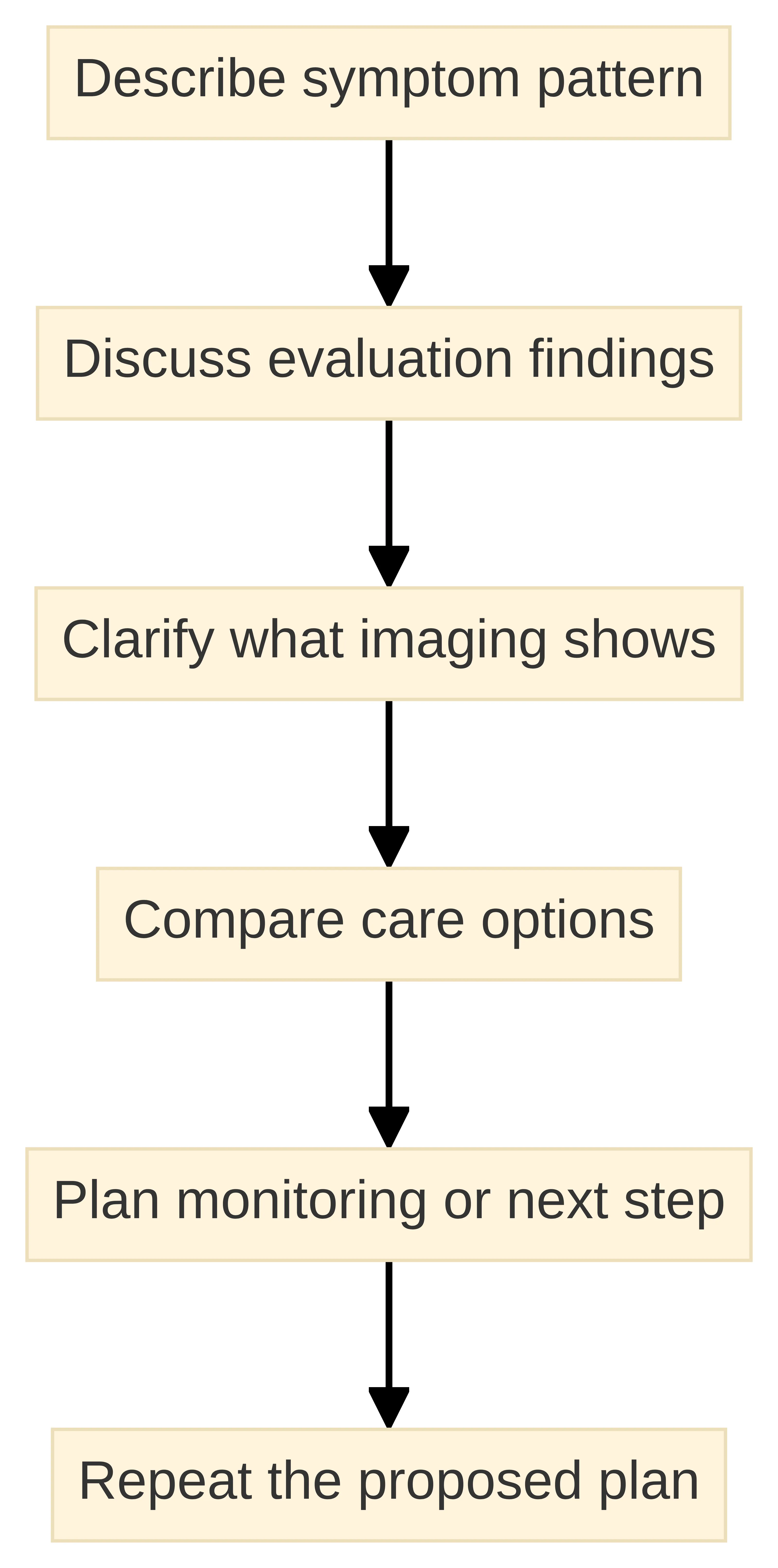
A consultation becomes more useful when you bring a clear symptom history and leave with a clear comparison. Clinical evaluation commonly draws on history, examination, and imaging, while shared decision-making includes discussion of potential benefits, harms, alternatives, and the time you may need before choosing.
Bring the information that helps connect your experience with the clinical question:
- When the symptoms began and whether an injury preceded them.
- Which movements, activities, or positions change the symptoms.
- How the knee affects walking, stairs, exercise, work, sleep, or other priorities.
- What you have already tried and what happened afterward.
- Prior imaging, procedures, surgery, or relevant medical history.
- Your main goal for the next phase of care.
Then organize the discussion around the decision rather than around a treatment name. You can ask:
- What conditions could explain this pattern, and which one is being considered first?
- What did the examination show?
- What does existing imaging clarify, and what question would additional imaging answer?
- Which options address symptoms, and which options are being considered for a structural finding?
- What potential benefits, limitations, risks, and uncertainties apply to each option?
- What alternatives remain if I do not choose this option now?
- What would monitoring involve, and what change would prompt a new discussion?
- If surgery is relevant, what procedure and recovery should I compare with the non-surgical choices?
Write down the answers in separate columns or sections for diagnosis, purpose, evidence, limitations, recovery, and next step. The format is less important than keeping unlike claims apart. For example, evidence that an option may manage symptoms should not be recorded as proof that it repairs cartilage.
A decision guide from the NHS also notes that you do not have to decide immediately and can use a discussion with healthcare professionals to consider potential benefits and harms. Use that time to identify what matters most to you, including function, recovery, uncertainty, cost, and willingness to consider surgery when those topics apply. A structured comparison can show that monitoring is reasonable for now, that a routine evaluation is needed, or that prompt care should take priority.
Before leaving, repeat the proposed next step in your own words and ask what would cause the plan to change. That creates a practical boundary for monitoring or follow-up without turning the consultation into a commitment to one treatment.
Know when monitoring is no longer the useful default
Monitoring can be a temporary choice when your symptoms are stable, the situation is not concerning, and you have a clear reason to reassess. Monitoring is not a diagnosis, and temporary symptom change does not prove that the underlying knee problem has resolved.
Persistent symptoms, worsening symptoms, or meaningful limits on movement and daily function are reasons to replace indefinite self-management with a clinical discussion. Cartilage-injury literature emphasizes thorough evaluation and early detection, noting that some lesions may go unrecognized for months or years and that delayed diagnosis can be associated with worsening symptoms and potential further damage. That does not determine what is happening in your knee, but it does support taking an ongoing or unclear problem seriously.
Use a simple boundary for your next step:
- Choose monitoring only when you can describe what you are watching and when you will reassess it.
- Choose a routine evaluation when symptoms persist, the cause is unclear, or function is changing.
A monitoring plan should record the symptom pattern, the activities affected, and the change that would end the monitoring period. Do not use temporary relief as proof that no evaluation is needed. Do not use persistent pain as proof that a particular injection or regenerative approach is the answer.
You also do not need to wait until you have selected a treatment. An evaluation can be the next step when the main problem is uncertainty about the diagnosis or the available categories. If your symptoms are becoming harder to manage or are interfering with ordinary activities, use that change in function as a reason to revisit the plan rather than extending monitoring indefinitely.
The decision is not whether you can name your cartilage problem from symptoms alone. The decision is whether you have enough information to monitor responsibly or whether the pattern now warrants professional assessment.
What a REGEN Orthopedic Medicine evaluation can and cannot establish
At REGEN Orthopedic Medicine, we offer non-surgical regenerative options for the knee, hip, and shoulder. We tailor each treatment option to your specific needs.
A REGEN Orthopedic Medicine evaluation can give you a setting to discuss your symptoms, the suspected problem, and whether a non-surgical option belongs in the comparison. It cannot guarantee cartilage repair, pain relief, restored function, or avoidance of surgery. It also cannot make an option appropriate without considering your clinical history, examination findings, imaging when appropriate, goals, and alternatives.
The useful outcome of the discussion may be a treatment conversation, a recommendation to gather more information, continued conservative care, or a different direction. If regenerative treatment is unlikely to help your joint, we will guide you toward what may help. If surgery is deemed necessary, we will inform you. A qualified professional must decide individual suitability after considering your circumstances.
Before you choose a path, keep the central distinction in view: the right next step depends on the problem being evaluated, the purpose of the proposed option, and the strength and limits of the evidence.
Questions to ask before requesting an evaluation
What are the main non-surgical treatment categories for knee cartilage problems?
The primary non-surgical treatment categories for knee cartilage issues include conservative care, injections, and regenerative approaches. Each category addresses different aspects of knee pain and functionality.
How can I prepare for a clinical evaluation of my knee symptoms?
To prepare for a clinical evaluation, document the onset of symptoms, any injuries, activities that aggravate the pain, previous treatments, and any relevant medical history. This information will help the clinician understand your condition better.
What should I expect during a knee evaluation?
A knee evaluation typically includes a clinical history, physical examination, and possibly imaging studies to clarify the diagnosis and determine the best treatment options.
What factors influence the decision to pursue non-surgical treatment for knee pain?
Factors influencing the decision to pursue non-surgical treatment include the severity of symptoms, functional limitations, previous treatments, and the specific diagnosis determined during evaluation.
How does REGEN Orthopedic Medicine approach treatment for knee pain?
REGEN Orthopedic Medicine provides physician-led, non-surgical regenerative treatments tailored to each patient’s specific needs, focusing on relieving pain and restoring function without invasive procedures.
Are consultations at REGEN Orthopedic Medicine free?
Yes, REGEN Orthopedic Medicine offers free consultations for individuals experiencing knee, hip, or shoulder pain.
Free consultation
Find out whether regenerative treatment is right for you.
Most consultations begin as a telehealth call with a physician specialist, so you can start without travelling to a clinic. No referral needed.